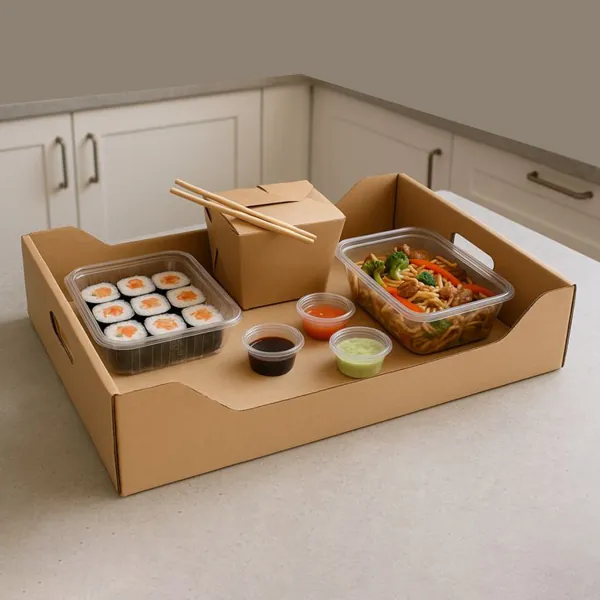
Corrugated Food Tray
Corrugated trays exist for one reason: a loaded tray that has to be picked up from the middle without folding in half.
View tray & get pricing →Custom food packaging · US · UK · Canada · Australia
Food tray category — 7 trays
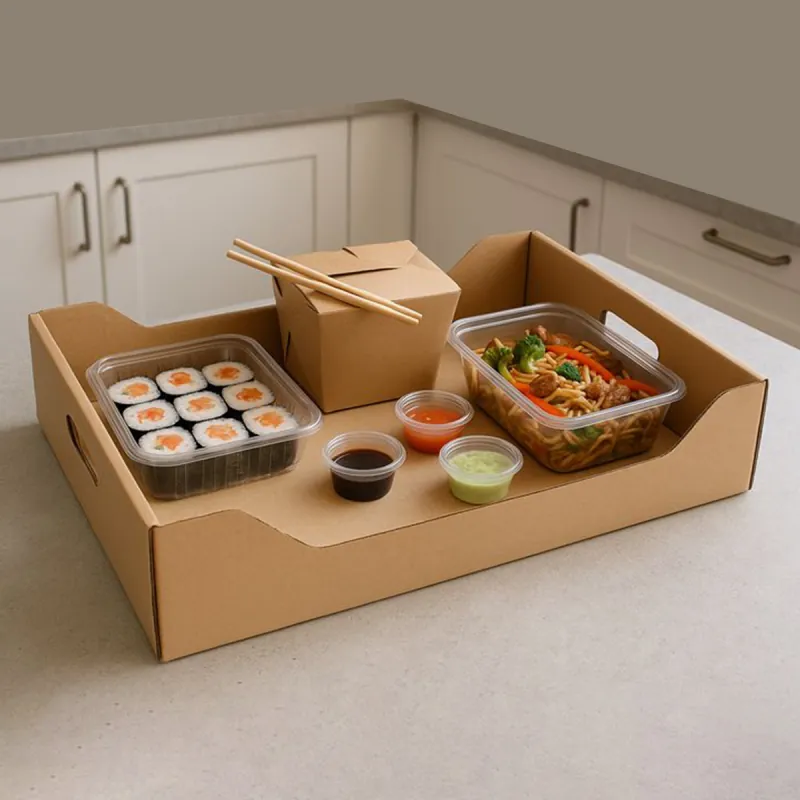
Corrugated board earns its place when a tray has to carry real weight without flexing. The fluted middle layer acts as a set of tiny arches between two liners, which is why a corrugated tray a fraction of a millimetre thicker than folding carton holds several kilos of loaded deli food and still lifts cleanly from the middle.
This section covers the trays we build in fluted board: open service trays, appetiser trays, bread trays, pan liners, deli trays and drink carriers. Most are specified in E-flute for a smooth print surface, or B-flute where load matters more than the finish.
Tell us which of the corrugated food trays you need, the size and roughly how many. We reply with a full quote, usually within one working day.
01 — The range
Fluted board trays that carry weight — for deli counters, bakery racks, bulk service and transport. Every one is made to order, so treat the descriptions as starting points rather than fixed specifications.
Corrugated trays exist for one reason: a loaded tray that has to be picked up from the middle without folding in half.
View tray & get pricing →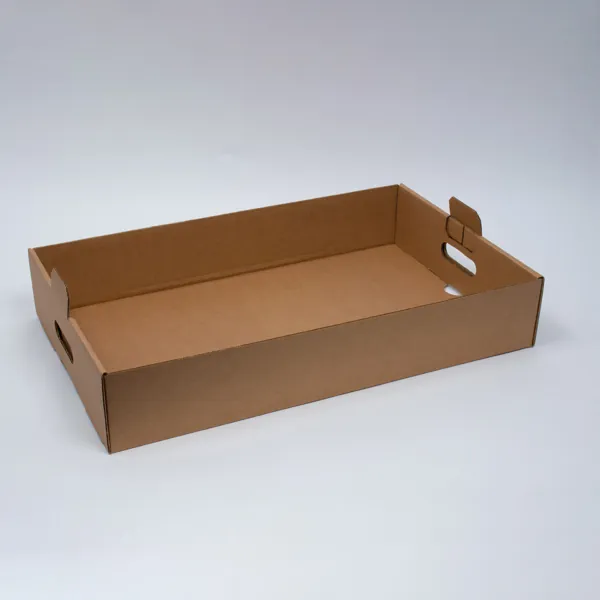
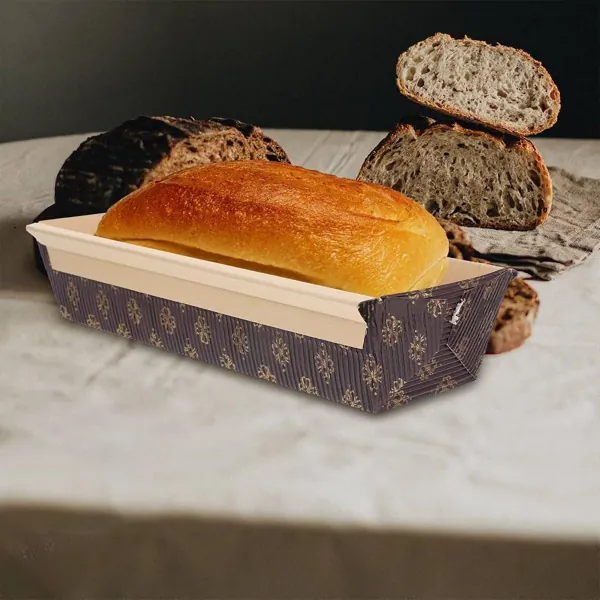
Bread packaging splits into two quite different jobs, and buying the wrong one is a common and expensive mistake.
View tray & get pricing →
A deli tray takes more punishment than most food packaging.
View tray & get pricing →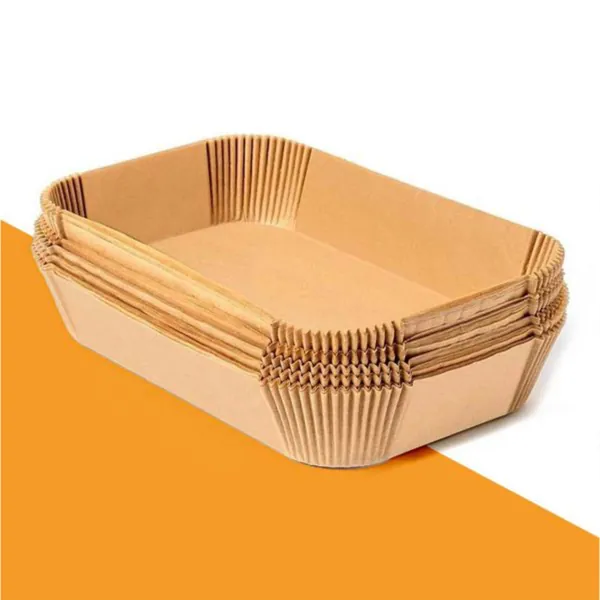
A pan liner is the least glamorous item on this site and one of the most immediately useful.
View tray & get pricing →
A drink carrier is a mechanical problem before it is a packaging one.
View tray & get pricing →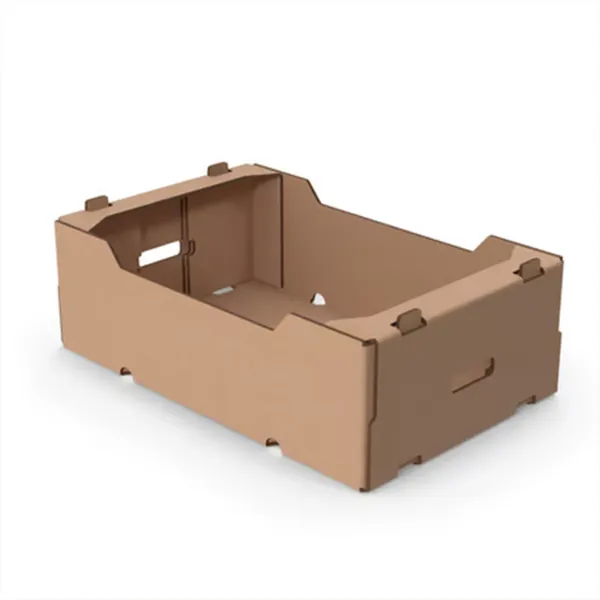
Vegetables need two things from a tray that most food packaging does not have to provide: airflow and stack strength.
View tray & get pricing →02 — In detail
Flute grade is the single most useful thing to get right on a corrugated tray. It sets stiffness, print quality and how much space the finished trays take in your stockroom.
| Flute | Approximate wall | Best for | Print surface |
|---|---|---|---|
| E-flute | About 1.5 mm | Retail-facing trays, printed appetiser and deli trays, anything on display | Very good — close to folding carton |
| B-flute | About 3 mm | Loaded catering trays, bread trays, transport trays | Good, with slight fluting visible in large solids |
| F-flute | About 0.8 mm | Small food trays where a crisp fold and fine print matter | Excellent |
| BC double wall | About 6 mm | Heavy bulk trays and shipper-style bases | Functional rather than decorative |
If you are choosing between fluted and solid board, the comparison in kraft vs corrugated food trays lays out the cost and performance difference on a like-for-like footprint.
These four decisions change how a corrugated tray behaves far more than the artwork does.
A shallow 25 mm wall suits flat-laid sandwiches and pastries. A 75 mm wall holds loose portions such as wings or fries without them spilling over the edge in transit.
Glued corners give a smooth interior and a stronger tray. Locking tabs let the tray ship flat and be made up on site. Which one is right depends on whether you have staff time at the counter.
Die-cut hand holes turn a tray into something one person can carry across a car park. They need to sit in the reinforced part of the wall, which affects where your print can go.
If loaded trays are stacked on a rack, the wall needs enough compression strength to carry the tray above. Tell us the stack height and we will pick the board rather than guessing.
Corrugated takes ink well, but it is not folding carton. On E-flute you can run four-colour process and get a result that reads cleanly at arm's length. On B-flute, large flat areas of solid colour can show a faint washboard pattern where the ink sits over the flutes — usually invisible in service, occasionally noticeable in a product photograph.
The practical answer is to design with the substrate rather than against it: line art, bold type, spot colours and generous white space all look sharper on corrugated than a full-bleed photograph does. Our printing guide covers the ink systems and the artwork setup we need from you.
All of these are fluted rather than folded, so the question is what the tray has to carry and how it is handled.
03 — Questions
For its weight, yes. The fluted middle layer resists bending far better than a solid sheet of the same thickness, so a corrugated tray carries a heavier load without sagging in the middle when lifted. That is why deli, catering and bread trays are almost always fluted.
E-flute for anything a customer sees, B-flute for anything heavy, F-flute for small trays where print detail matters. If you are not sure, tell us the heaviest thing the tray will hold and whether it is stacked, and we will specify it for you.
Not on their own for long. Fluted board wicks moisture along the flutes. For wet food we either specify a grease and moisture resistant liner on the food-contact face, or recommend an insert. A pan liner is often the simpler answer when the tray itself is not the food-contact surface.
Flat, in the majority of cases. Corrugated is bulky once erected, so shipping flat keeps freight sensible and lets you store several thousand trays in the space a few hundred assembled ones would take. Glued styles arrive pre-formed on one axis and are opened by hand.
Yes, and windows are common on bakery and deli trays. A window cut removes structural material, so we compensate with board grade or a wider frame around the aperture. Send the artwork and we will show you where the window can safely sit.
Corrugated tooling is inexpensive relative to rigid or moulded formats, so first runs can be modest. The practical floor is driven by the cutting die and the press setup rather than the board itself. Ask for pricing at two or three quantities and you will see exactly where the unit cost breaks.
Kraft liner is a natural material and its shade drifts slightly between mill batches. Printed areas hold consistent because they are matched to your approved proof; the exposed brown board can vary a shade between production runs. If exact background colour matters, specify a printed flood or a white liner.
Uncoated corrugated is one of the most widely recycled packaging materials, provided it is not saturated with food or grease. Where we add a moisture barrier, that can change what your local facility accepts. We state the exact construction in writing so you can check it against the rules where the tray is used.
For several styles, yes — a corrugated party tray with lid is the clearest example. Lids can be a fitted corrugated cap, a clear dome or a film. Tell us whether the tray is displayed, transported or stacked and we will suggest which of the three suits.
Describe the food, the portion and the setting. We will tell you which tray in this range fits, and say so plainly if the answer is a format from somewhere else on the site.