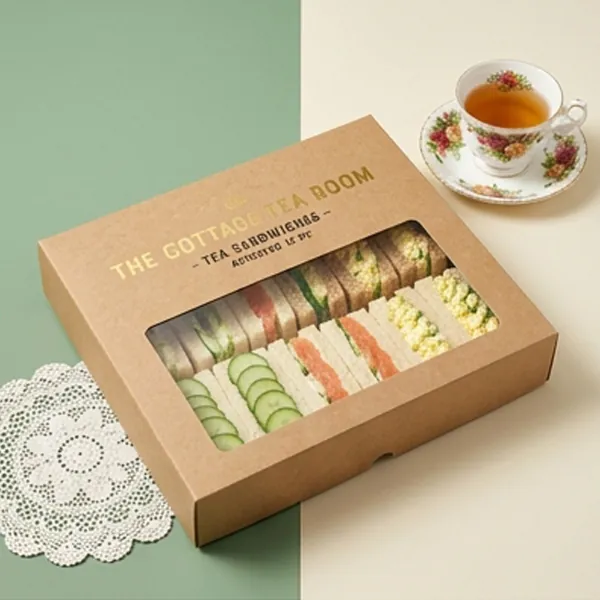
Tea Sandwich Tray
Finger sandwiches are packed in rows, standing on their cut edge, and the whole point is that a customer can see the row through a window before they buy.
View tray & get pricing →Custom food packaging · US · UK · Canada · Australia
Serving Trays & Platters
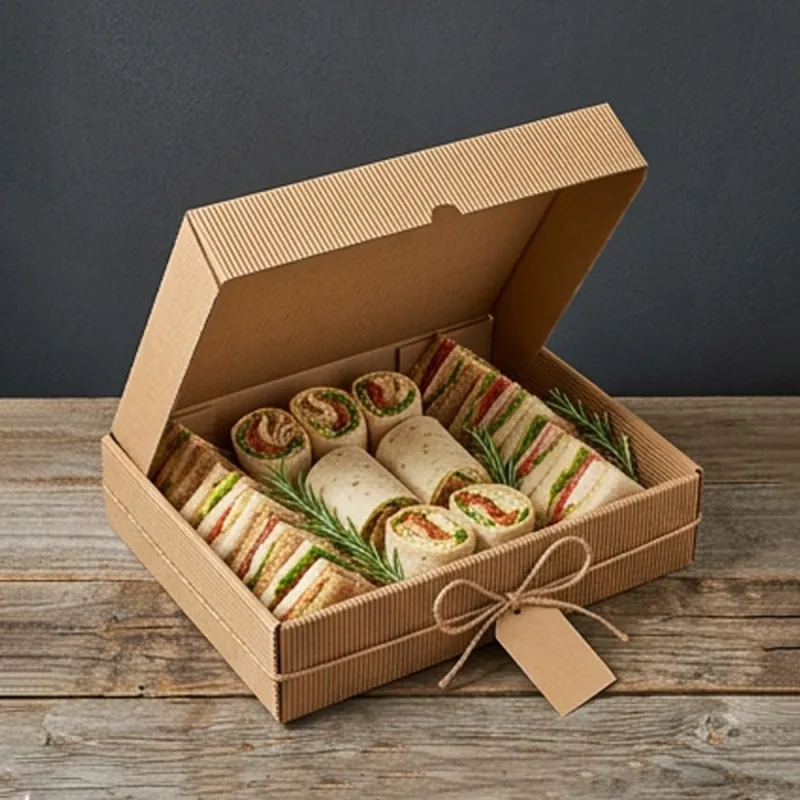
The corporate sandwich platter is one of the highest-volume formats in catering, and the specification is almost entirely determined by how you cut your sandwiches. Triangles laid overlapping need a different footprint from rectangles stood upright, which needs a different one again from wraps laid diagonally.
Start there and the rest of the tray follows. Start from a stock size and you will spend months arranging food to fit a box instead of the other way round.
Pricing starts from $0.30 per tray
The unit price depends on the size, board, printing, finishing, quantity and delivery country, so every quote is worked out for your specification rather than taken from a list.
Send the size and the run length. We reply with pricing, material options and a production date — usually within one working day.
01 — Specification
Every element below is set when we quote. Nothing here is a fixed catalogue entry — if a line does not match what you need, say so and we will change it.
02 — Build the spec
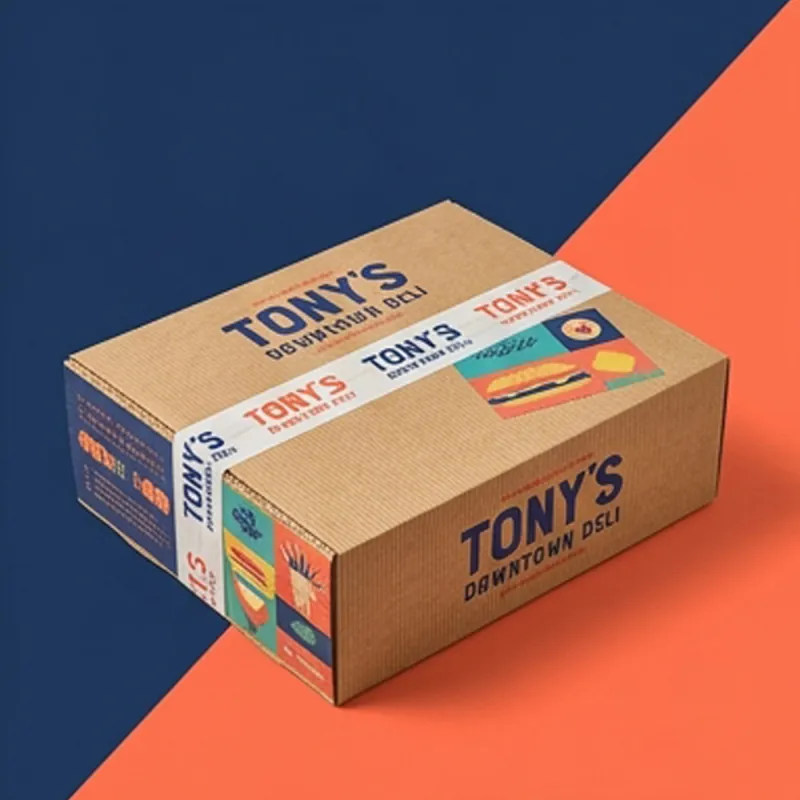
The same five questions we would ask on a phone call, with the corrugated sandwich platter already selected. You get a properly detailed brief at the end, which is what makes a first quote accurate rather than approximate.
Prefer the full builder with a live sketch? Open the tray designer.
03 — In detail
A round of sandwiches cut into triangles and laid overlapping occupies roughly a third less area than the same round cut into rectangles and stood upright. Wraps cut on the diagonal and stood on their cut face need real depth. Cocktail-cut fingers need a shallow tray but a lot of length.
Before you ask for a quote, lay out one platter’s worth of your actual sandwiches on a table in the arrangement your kitchen uses, and measure the rectangle it takes up. Add about an inch on each dimension and that is your internal footprint. It takes five minutes and it is more reliable than any sizing chart.
Sanity-check figures only — measure your own layout before ordering.
| Cut style | Layout | Depth needed |
|---|---|---|
| Triangles, overlapping rows | Densest layout, looks generous | Shallow — about 40–50 mm |
| Rectangles, stood upright | Shows the filling edge, easy to lift | Deeper — about 70–80 mm |
| Wraps, diagonal cut, standing | Tallest of the common layouts | About 80–90 mm |
| Cocktail fingers, flat rows | Long and shallow | About 35–40 mm |
| Mixed selection | Design for the tallest item | Take the deepest of the above |
The standard. Stacks in a van, protects the arrangement, and the lid is your main print surface. Best where trays are opened by your own staff or the client.
A box with an integrated handle across the top, so one person can carry two. Popular for corporate delivery where the driver walks from the van to a reception desk.
Cheapest and best-looking on a table, but it does not stack and offers no protection in transit. Suitable when the platter is assembled on site.
Lets the client see the selection before opening. Worth it for buffet-style delivery and for anything sold from a chiller.
04 — Nearby
Chosen because operators who buy the corrugated sandwich platter usually need one of these in the same order, not because they happen to sit in the same category.
Finger sandwiches are packed in rows, standing on their cut edge, and the whole point is that a customer can see the row through a window before they buy.
View tray & get pricing →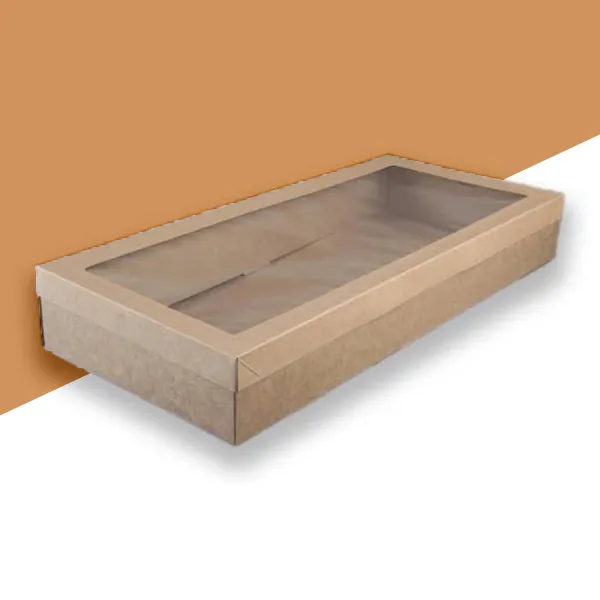
The lidded catering tray is the format that most drop-off caterers standardise on, because it is the only one that solves the whole journey.
View tray & get pricing →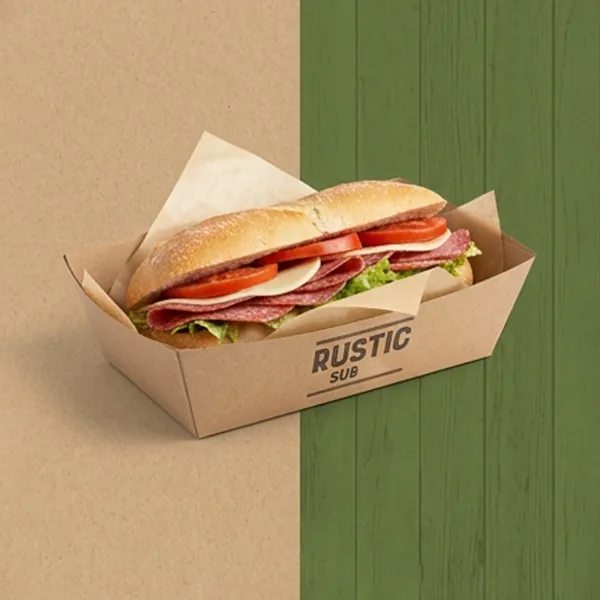
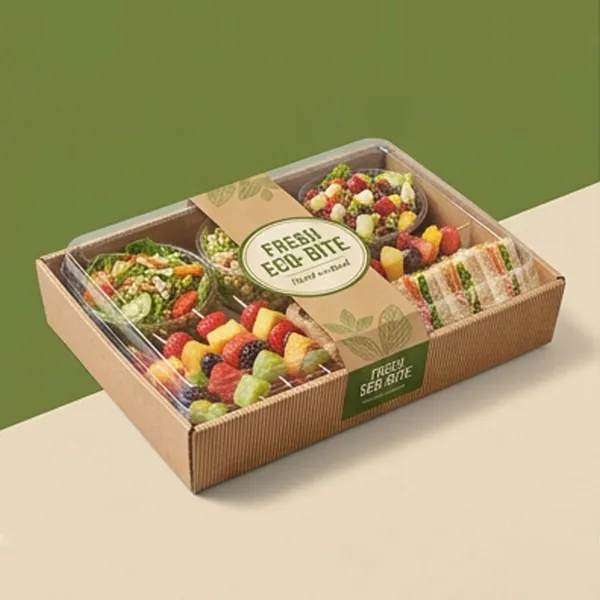
A party tray is a divided platter under a clear lid.
View tray & get pricing →05 — Questions
Lay one platter’s worth of your own sandwiches out in your usual arrangement, measure the rectangle, and add about an inch each way. That is more reliable than any chart, because cut style changes the area needed by a third or more.
Shallow — around 40 to 50 mm — for overlapping triangles. Deeper, around 70 to 90 mm, if sandwiches or wraps stand upright. Design for the tallest item in a mixed selection rather than the average.
Untreated board will show a translucent mark under a buttered or dressed sandwich within a couple of hours. A grease-resistant food-contact face prevents it and costs very little. For corporate work where presentation matters, treat it as standard.
Lidded ones do, if specified for it. Open platters do not. Tell us the stack height and loaded weight and we will build the corners to carry it without pressing on the food below.
If your driver walks any distance from the van, yes — it turns two trips into one. It changes the box construction, so decide before tooling rather than adding it later.
Yes. It helps wherever the client sees the platter before it is opened, and it is close to essential for anything sold from a retail chiller. It adds a film component and some cost.
It depends on your cut and your bread. Rather than guessing, tell us how many covers you want to serve per platter and lay out an example — we will size to that and tell you if the footprint is getting impractical.
Yes, and the inside of the lid is the best place for it. The outside sells your brand across a meeting room; the inside is read by people who are already choosing what to eat.
Yes, along with the US and Australia. Sandwich conventions differ by market — UK rounds and cuts are not the same as US ones — so we work from your actual product rather than assuming a regional standard.
Send the dimensions, the quantity and the country you want it delivered to. We come back with a full quote — material, print, finishing, freight and a production date.