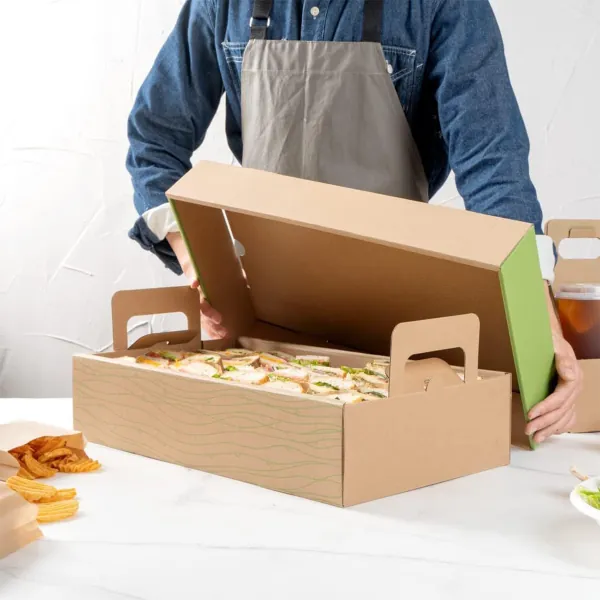
Corrugated Catering Tray
This is the working catering tray: fluted, deep, strong enough to hold several full foil pans, and usually built with a raised header board that turns t…
View tray & get pricing →Custom food packaging · US · UK · Canada · Australia
Catering Trays
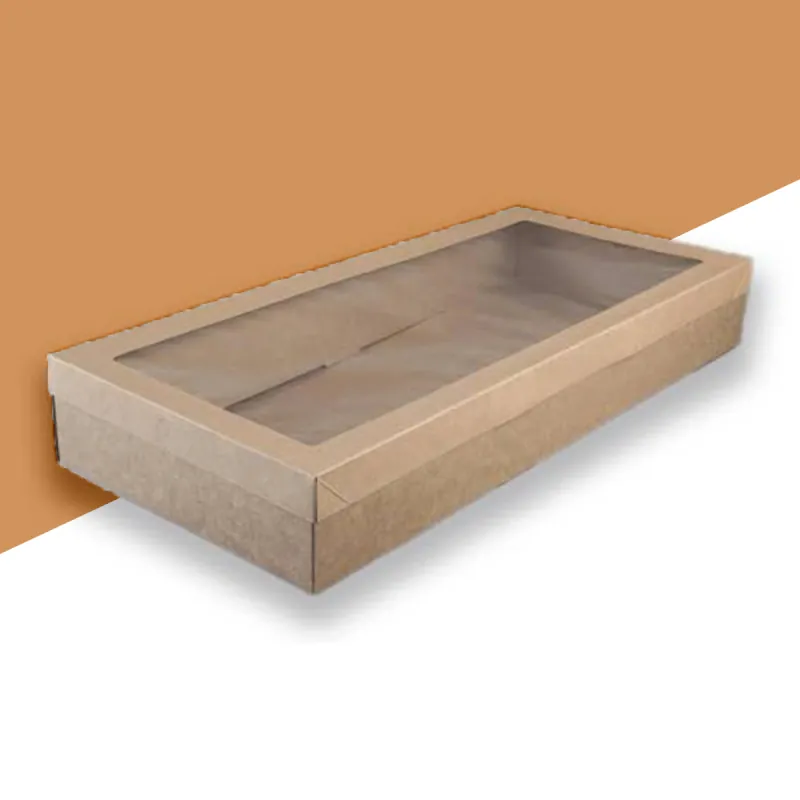
The lidded catering tray is the format that most drop-off caterers standardise on, because it is the only one that solves the whole journey. Food is loaded in a kitchen, the lid goes on, the tray is stacked in a van, driven, carried up a stairwell and opened in front of a paying client. Everything about the specification has to survive that sequence.
The two things people most often get wrong are lid overlap and board grade. A lid with insufficient overlap pops off over a speed bump; a base specified for cost rather than load flexes and lets the arrangement slide.
Pricing starts from $0.30 per tray
The unit price depends on the size, board, printing, finishing, quantity and delivery country, so every quote is worked out for your specification rather than taken from a list.
Send the size and the run length. We reply with pricing, material options and a production date — usually within one working day.
01 — Specification
Every element below is set when we quote. Nothing here is a fixed catalogue entry — if a line does not match what you need, say so and we will change it.
02 — Build the spec
The same five questions we would ask on a phone call, with the catering tray with lid already selected. You get a properly detailed brief at the end, which is what makes a first quote accurate rather than approximate.
Prefer the full builder with a live sketch? Open the tray designer.
03 — In detail
How far the lid comes down the side of the base. Too little and it lifts under vibration; too much and it is hard to get off in front of a client. There is a right answer and it depends on the depth of the tray.
A loaded catering tray is heavier than people estimate. If the base flexes when lifted from the middle, the arrangement slides and the presentation is ruined before the lid comes off.
Measure your tallest garnish, not the average height of the food. A lid resting on a filled roll flattens the thing you spent the morning building.
Glued corners are stronger and give a smooth interior. Tab-locked corners let the tray ship flat. Which is right depends on whether you have staff time to assemble.
| Where the tray is opened | Best lid | Reason |
|---|---|---|
| Boardroom, opened by your staff | Plain fitted board lid | Cheapest, strongest, stacks best; the reveal is done by a person |
| Buffet table, self-service | Window lid or clear dome | The food sells itself before anyone lifts a lid |
| Retail chiller | Film seal | Meets the display and shelf-life expectations of a retail cabinet |
| Left with a client for later | Fitted lid with a printed panel | The lid becomes a reheating and storage instruction sheet |
A caterer with six trays for one delivery will stack them. That means the bottom tray carries the weight of five loaded trays above it, and that load goes through the corners rather than the base. A tray that is perfectly adequate on a table can collapse in a van.
The fix is not exotic — corner posts and the right flute. What matters is telling us the stack height and the loaded weight up front. If you tell us "catering tray, about 18 by 12", we will design for a table. If you tell us "six high in a van, about four kilos each", we will design for the van.
Hot food warning: board catering trays are designed for ambient and chilled service. Hot food generates steam inside a closed lid, which softens the board and drips onto the presentation. If you transport hot service, say so — we will either specify a moisture-resistant construction with venting or tell you honestly that a different format is the right answer.
04 — Nearby
Chosen because operators who buy the catering tray with lid usually need one of these in the same order, not because they happen to sit in the same category.
This is the working catering tray: fluted, deep, strong enough to hold several full foil pans, and usually built with a raised header board that turns t…
View tray & get pricing →
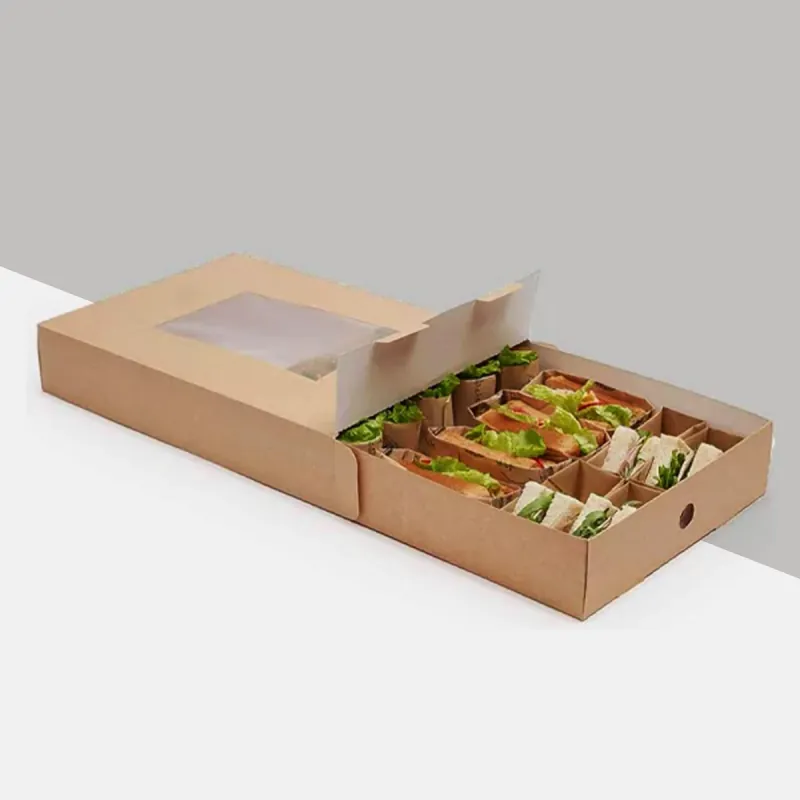
A party tray is a divided platter under a clear lid.
View tray & get pricing →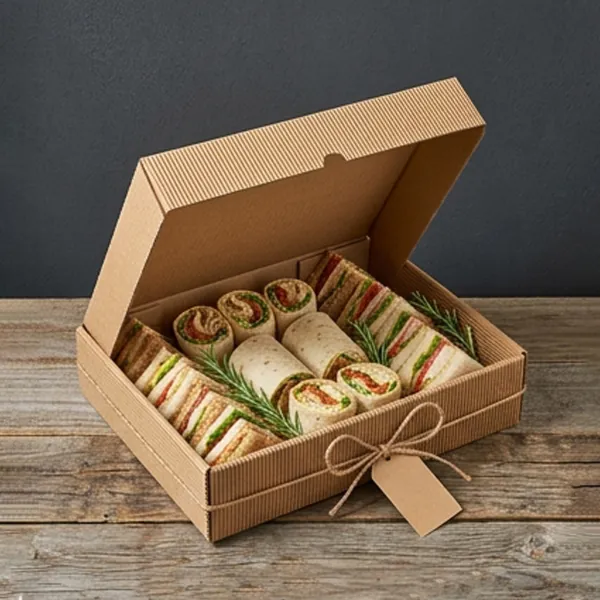
The corporate sandwich platter is one of the highest-volume formats in catering, and the specification is almost entirely determined by how you cut your…
View tray & get pricing →
Catering is the one part of food service where packaging routinely converts new business.
View tray & get pricing →05 — Questions
There is no universal answer, because it depends entirely on portion size. Tell us the covers you want per tray and the food, and we will suggest a footprint. A tray around 18 by 12 inches commonly presents buffet food for eight to twelve, but that is a starting point rather than a rule.
With the right overlap and board grade, yes. Lids that pop off almost always come from insufficient overlap for the tray depth, or a base that flexes and changes shape under load. If you have had this problem before, send the tray you use now and we will tell you which of the two caused it.
Yes, if the tray is specified for it. Stack strength comes from the corner posts. Tell us how many trays go on top of each other and roughly what each weighs, and we will build in margin rather than working to a theoretical limit.
A window is worth it wherever the client sees the tray before it is opened — buffet lines, retail chillers, drop-off catering left on a table. It is unnecessary where your own staff open every tray, and it costs more and adds a film component.
Tallest item plus at least a centimetre of clearance. Measure your tallest garnish rather than a typical item. If your menu varies, measure the worst case and design for it — a slightly deep tray looks generous, a shallow one crushes the food.
Yes, they are separate components with separate tooling. Most caterers put branding on the lid and practical information — allergens, reheating, storage — on the base or the inside of the lid.
On anything above a small tray, yes. They turn a two-handed carry into a one-handed one, which matters when a driver has a second tray and a door to open. They do take space out of your print area, so decide before artwork.
Usually flat, because an assembled lidded tray is mostly air and would multiply freight cost. Glued styles arrive formed on one axis. Tell us how much assembly time your kitchen has and we will recommend accordingly.
Yes. Send one — base and lid — and we will match the footprint, depth and overlap so your existing racks, van shelving and portioning all stay unchanged.
Yes, and to Canada and the US. Lidded trays are bulky even flat-packed, so freight is a meaningful part of the landed cost on long-haul routes. We quote it explicitly rather than burying it in a per-unit figure.
Send the dimensions, the quantity and the country you want it delivered to. We come back with a full quote — material, print, finishing, freight and a production date.