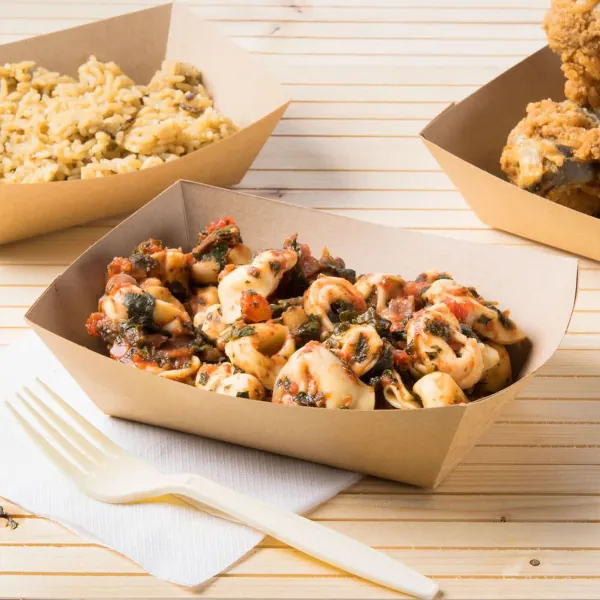
Kraft Paper Food Tray
The kraft paper food tray is the one shape that every counter ends up buying.
View tray & get pricing →Custom food packaging · US · UK · Canada · Australia
Industry guide
A food truck buys packaging under a constraint nothing else in food service has: storage. Every carton of trays takes space that could hold product, and there is no stockroom to fall back on. That single fact drives most of what a truck should specify.
The second constraint is pace. Trading is intensely peaked — an hour of nothing followed by forty covers in twenty minutes — so anything that adds a second per order costs real money in the rush.
Describe the operation and roughly how many trays you get through. We come back with the formats that fit, with pricing — usually within one working day.
In roughly this order, which is different from a bricks-and-mortar operation.
The most useful thing a truck can do is find a single tray size that works for four or five menu items rather than stocking a different container for each. A 2lb open tray will hold loaded fries, a taco portion, a wings serving and a rice bowl perfectly acceptably.
That does two things. It halves your storage requirement, and it puts all your volume behind one printed line, which brings the unit cost down to a point where printing is trivially affordable. A truck running one printed tray across most of the menu usually pays less per unit than one running five plain stock sizes.
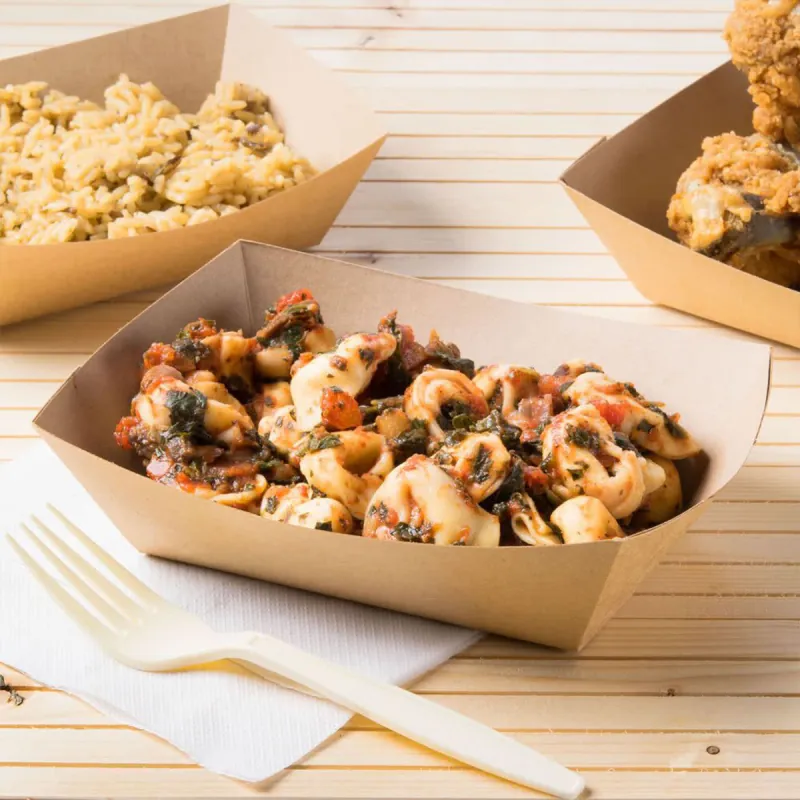
The workhorse. Loaded fries, tacos, wings, rice bowls, mixed portions. See the kraft paper food tray.
For fries and fried sides. Fills in one movement from the basket and gives a tall branding panel. See the fry scoop.
For burgers and anything with height that must not be compressed. Slower to fill, but necessary for a stacked build.
Tacos, chip and dip, anything where the sauce must stay off the main item.
A rough sense of why flat-packing matters. Figures are illustrative rather than product-specific.
| Format | Relative storage volume | Assembly time |
|---|---|---|
| Flat-packed tray | Lowest | A second or two per unit |
| Flat-packed clamshell | Low | Two to three seconds per unit |
| Nesting pre-formed cup | Moderate | None |
| Pre-glued formed tray | Highest | None |
The right trade-off depends on whether your binding constraint is the cupboard or the queue. Most trucks find it is the cupboard.
Picked for the specific demands described above rather than as a general list.
The kraft paper food tray is the one shape that every counter ends up buying.
View tray & get pricing →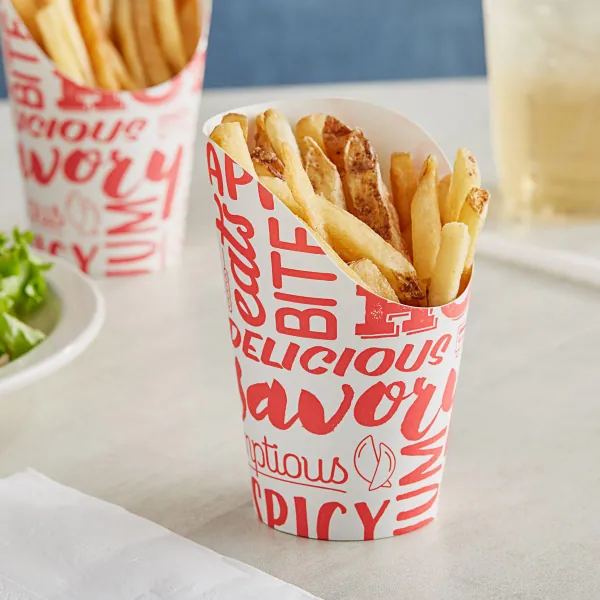
The fry scoop exists because of a specific piece of ergonomics: a member of staff should be able to fill it from a fryer basket with one hand, in one mo…
View tray & get pricing →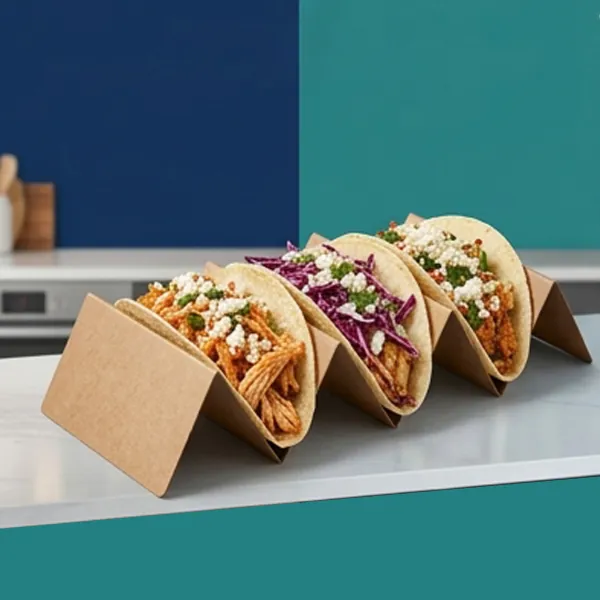
A taco holder does one thing: it stops tacos falling over.
View tray & get pricing →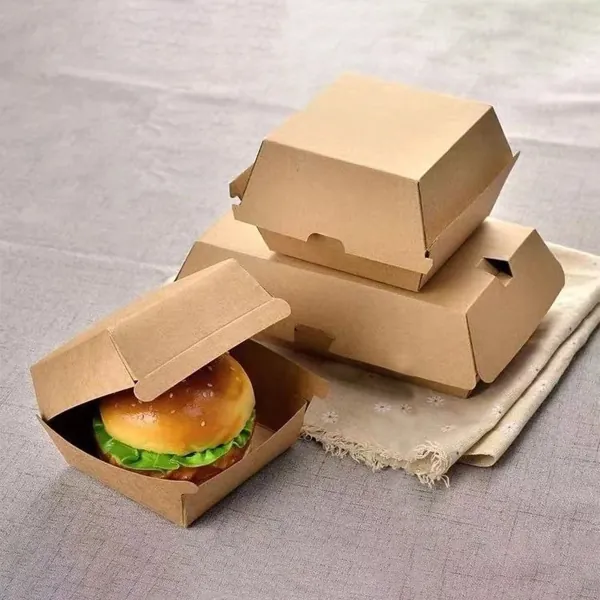
A burger clamshell is a hinged box that closes around a burger, and its whole purpose is to stop the build collapsing between the pass and the customer.
View tray & get pricing →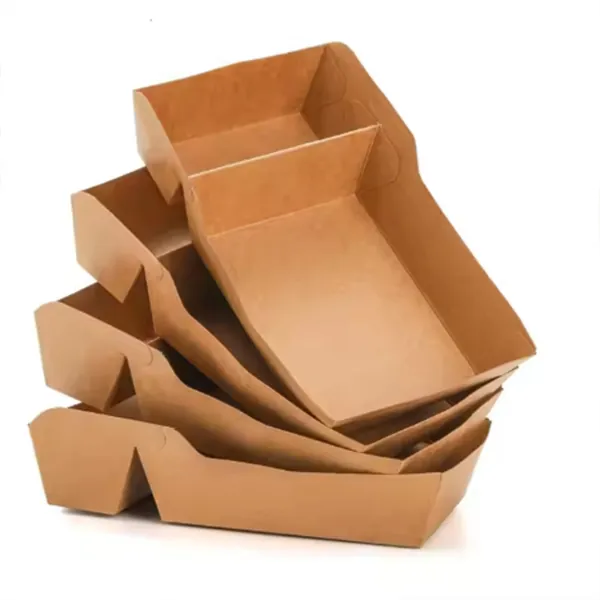
The chip and dip tray is the simplest divided format there is: a main bay and one or two smaller wells.
View tray & get pricing →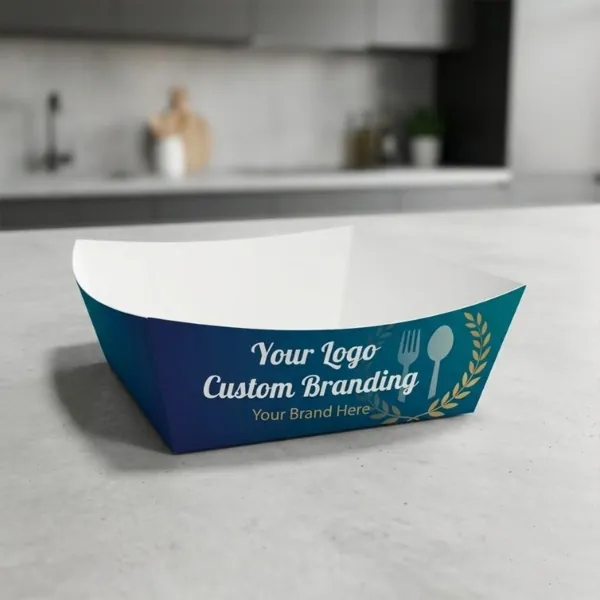
This is the general-purpose printed tray: any of our shapes, in your board, carrying your artwork.
View tray & get pricing →Flat-packed trays, without qualification. An assembled tray is mostly air. If your storage is the binding constraint — and for most trucks it is — flat-packing everything and batch-assembling during quiet periods is the right answer.
For most street food menus, yes. A single open tray size handles loaded fries, tacos, wings and rice bowls perfectly well. It halves your storage and puts all your volume behind one printed line, which makes printing much cheaper per unit.
Often, because the volume concentrates on one or two formats. A truck running one printed tray across most of the menu frequently pays less per unit than one running several plain stock sizes bought in small quantities.
A second or two each once practised. The efficient pattern is to batch-assemble a stack during a quiet period rather than folding at the window during a rush.
Truck menus are disproportionately fried, so yes for most operations. Untreated board darkens within minutes under fried food and the customer sees it immediately.
Bold and readable at a distance. Trucks are seen across a market or a festival field, not in the hand. One or two colours on kraft, set large, does more than a detailed design nobody can read from the queue.
As much as fits, and reorder on a fixed cycle rather than when you run low. The failure mode for a truck is running out mid-event, which is far more expensive than holding a little extra.
Yes, and for a truck we would encourage it. Test a format for a few trading days before committing to volume — storage constraints mean a wrong decision is more painful for a truck than for a fixed site.
Send the food, the volumes and the country you take delivery in. We reply with formats, material options and a full quote including freight.