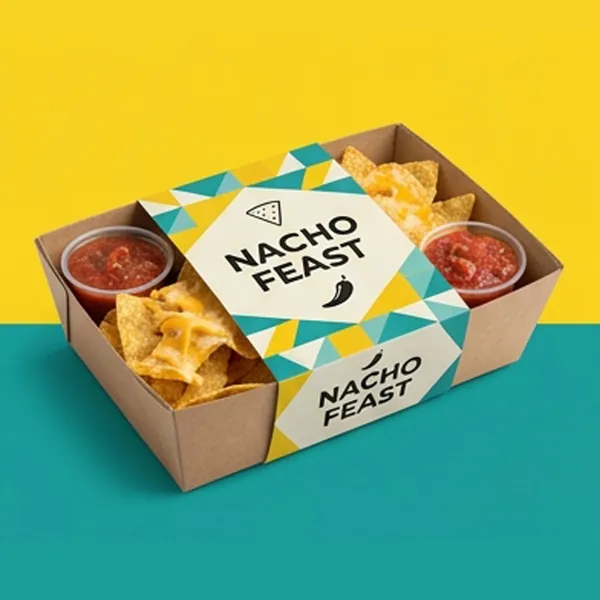
Serving Trays & Platters
Chip and Dip Trays
- Two or three sections
- Wells cut to your pots
- Grease-resistant
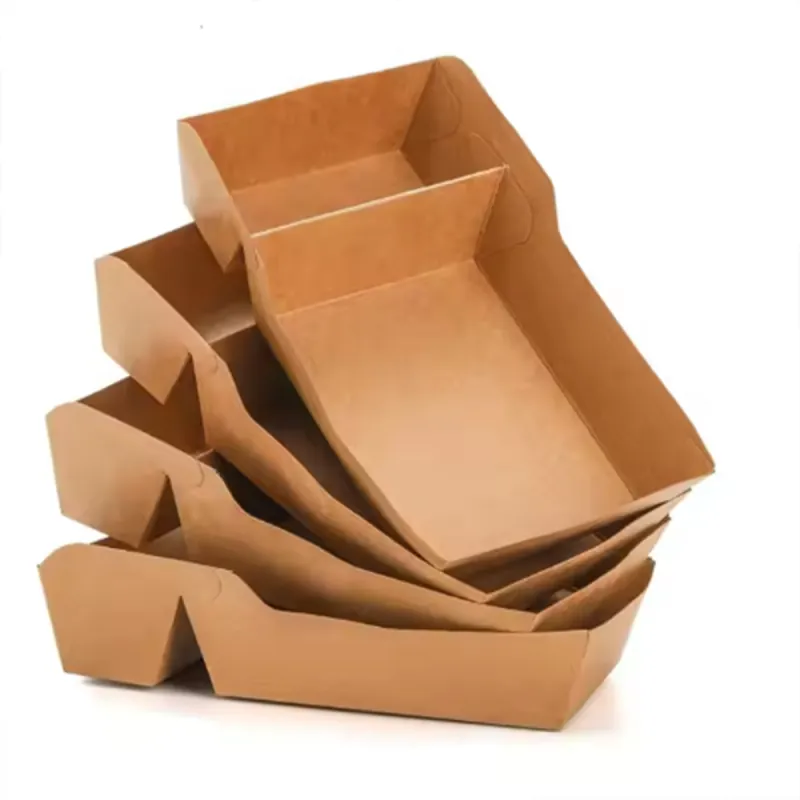
The chip and dip tray is the simplest divided format there is: a main bay and one or two smaller wells. It appears everywhere — fried chicken with two sauces, chips with guacamole, tempura with soy, chicken tenders with ranch — because the pattern of "main item plus sauce" is close to universal in fast food.
- Wells sized to your dip pots, or open for direct filling
- Main bay proportioned so the portion still looks generous
- Grease-resistant face for fried food and warm sauces
- Compact enough to hold in one hand
Pricing starts from $0.30 per tray
The unit price depends on the size, board, printing, finishing, quantity and delivery country, so every quote is worked out for your specification rather than taken from a list.
Get pricing for chip and dip trays
Send the size and the run length. We reply with pricing, material options and a production date — usually within one working day.
01 — Specification
Specification at a glance
Every element below is set when we quote. Nothing here is a fixed catalogue entry — if a line does not match what you need, say so and we will change it.
- Layout
- One main bay plus one or two dip wells
- Well sizing
- To your pot, or open for direct filling
- Board
- Kraft or white; grease-resistant face recommended
- Depth
- Main bay typically 45–60 mm
- 1–4 colours across the front and side walls
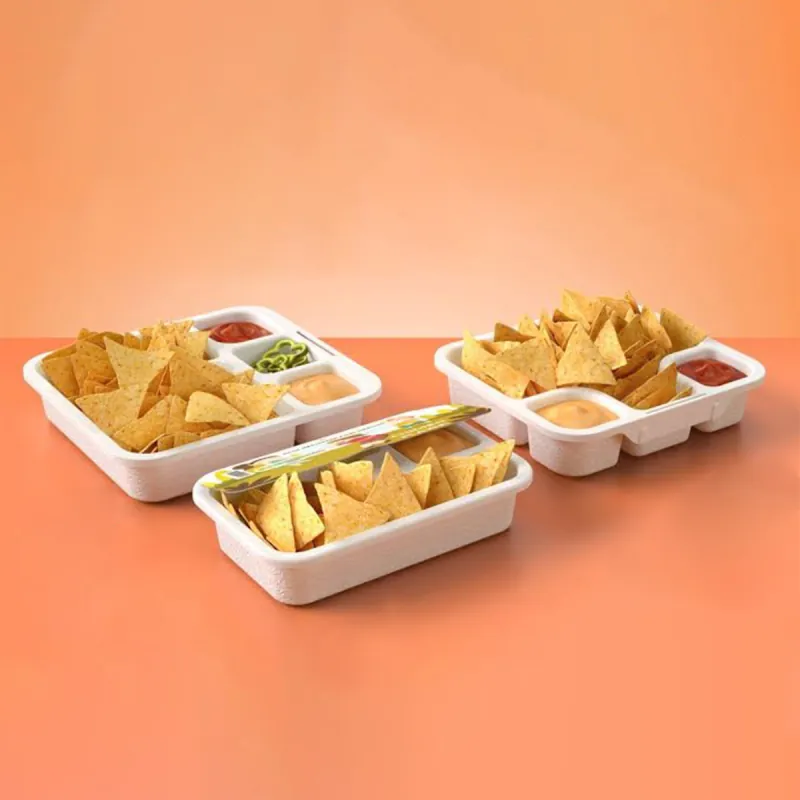
02 — Build the spec
Design this tray in five steps
The same five questions we would ask on a phone call, with the chip and dip tray already selected. You get a properly detailed brief at the end, which is what makes a first quote accurate rather than approximate.
Prefer the full builder with a live sketch? Open the tray designer.
03 — In detail
The proportion problem
The single design decision that matters on this tray is how much of the footprint the dip wells take. Give them too much and the main portion looks mean, which customers notice immediately and read as poor value. Give them too little and the sauce overflows when the tray is tilted.
As a working rule, the dip wells together should occupy under a quarter of the tray area. If your sauce portions genuinely need more than that, the honest answer is a bigger tray rather than a smaller food bay — customers judge the food volume, not the total.
Common configurations
| Layout | Typical menu | Note |
|---|---|---|
| One well, corner | Chips with a single sauce | Simplest and cheapest; well sits out of the way |
| Two wells, side by side | Tenders with two sauces | The most-ordered configuration |
| One well, centre | Crudités or chips around a central dip | Presentation-led; suits sharing |
| Two wells plus a divider | Mixed fried platter with a slaw side | Three-part layout for a fuller meal |
Things to specify
- Well depth — deep enough that sauce does not slop over the divider when the tray tilts.
- Divider height — taller than the sauce surface, not level with the main bay.
- Whether wells hold pots or are filled directly, which changes the treatment needed.
- Grease resistance, which is effectively mandatory for a fried menu.
- Whether the tray is carried one-handed, which caps the practical footprint.
04 — Nearby
Trays that work alongside this one
Chosen because operators who buy the chip and dip tray usually need one of these in the same order, not because they happen to sit in the same category.
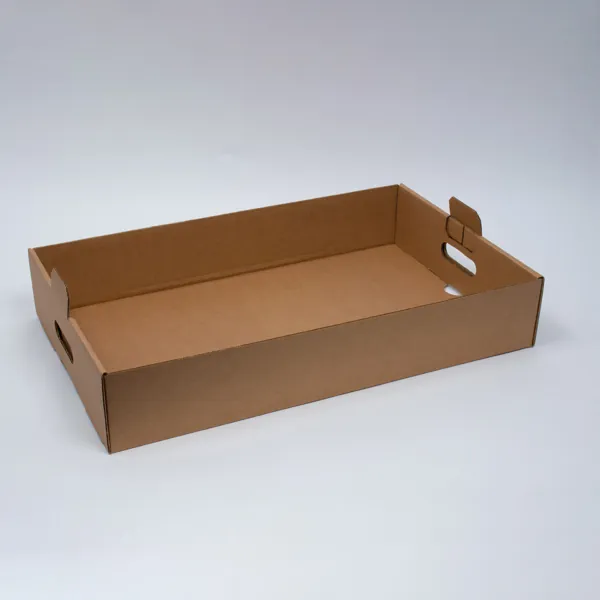
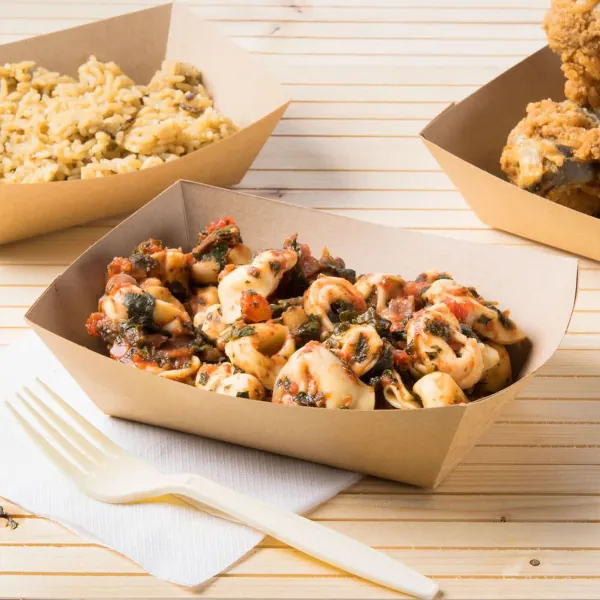
Kraft Paper Food Tray
The kraft paper food tray is the one shape that every counter ends up buying.
View tray & get pricing →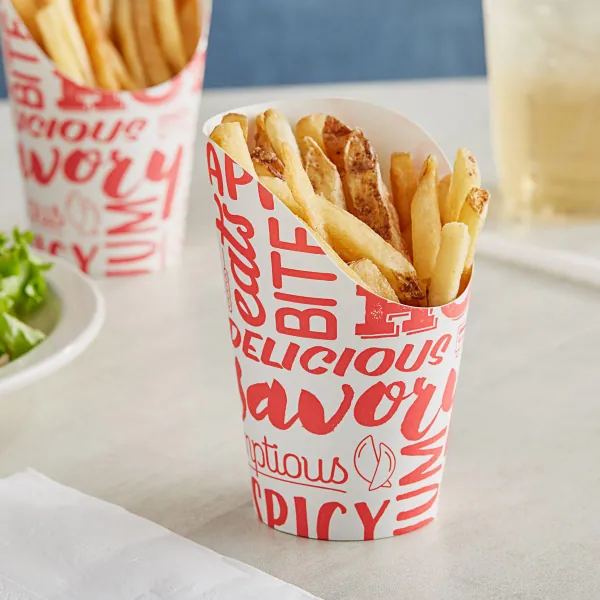
French Fry Scoop
The fry scoop exists because of a specific piece of ergonomics: a member of staff should be able to fill it from a fryer basket with one hand, in one mo…
View tray & get pricing →05 — Questions
Chip and Dip Tray questions
How big should the dip wells be?
Together, under about a quarter of the tray area. Beyond that the main portion starts to look small, and customers judge value on the food rather than the total footprint. If your sauce portions need more space, go up a tray size rather than shrinking the food bay.
Can the wells hold standard dip pots?
Yes, if we cut them to your pots. Send one — we size the well to the rim and base diameters so the pot sits firmly rather than rattling or needing to be forced in.
Will warm sauce soak through the board?
Untreated board under warm sauce will darken and eventually soften. A grease-resistant face handles a normal service period. Tell us if sauces are served warm, as it changes the specification.
Can I have three wells?
Yes, though at that point the main bay gets small on a compact tray. Three wells generally means going up a size. It is worth deciding by loading a physical sample rather than on paper.
Is this tray suitable for delivery?
With a lid, and with sauce in sealed pots rather than open wells. An open dip well will spill in a delivery bag on the first corner, however carefully it is packed.
How do I keep chips crisp?
Keep the tray open, or vent the lid. Steam is what softens fried food, and a sealed tray traps it. This is why chips have always been served in open formats.
What print area do I get?
The front and side walls. On a compact tray that is a modest strip, but it faces the customer while they eat, which makes it a better position than it looks. Keep the design bold rather than detailed.
Can you match a tray I already use?
Yes. Send it to us, and include the dip pots you use with it. Matching both means your portioning and your pot stock stay unchanged.
Before you order, read
- Choosing Trays for Hot and Greasy Foods — Grease, steam and heat — and the three fixes that handle them.
- Food Tray Size Guide — What tray sizes mean, and how to pick one from your own portions.
Who buys this tray
Ready to price the chip and dip tray?
Send the dimensions, the quantity and the country you want it delivered to. We come back with a full quote — material, print, finishing, freight and a production date.