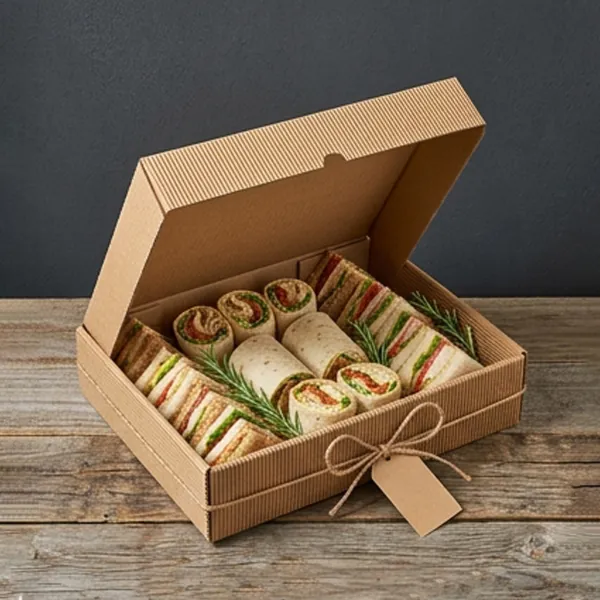
Corrugated Sandwich Platter
The corporate sandwich platter is one of the highest-volume formats in catering, and the specification is almost entirely determined by how you cut your…
View tray & get pricing →Custom food packaging · US · UK · Canada · Australia
Food tray category — 6 trays
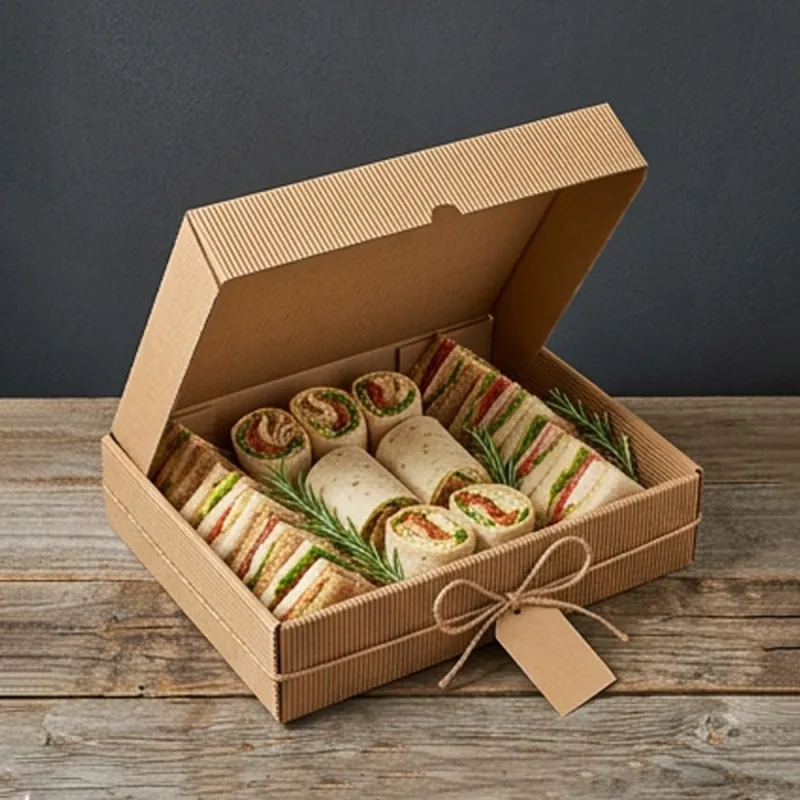
A serving platter is a display surface first and a container second. It is usually shallow, usually wider than it is deep, and its whole job is to make food look arranged rather than piled. That changes what matters in the specification: flatness, edge finish and surface appearance count for more than wall strength.
This range covers sandwich platters, vegetable and crudité trays, dessert platters, tea sandwich trays and the small dip-and-chip formats that sit alongside them on a buffet.
Tell us which of the serving trays & platters you need, the size and roughly how many. We reply with a full quote, usually within one working day.
01 — The range
Flat presentation platters for buffets, retail chillers and front-of-house display. Every one is made to order, so treat the descriptions as starting points rather than fixed specifications.
The corporate sandwich platter is one of the highest-volume formats in catering, and the specification is almost entirely determined by how you cut your…
View tray & get pricing →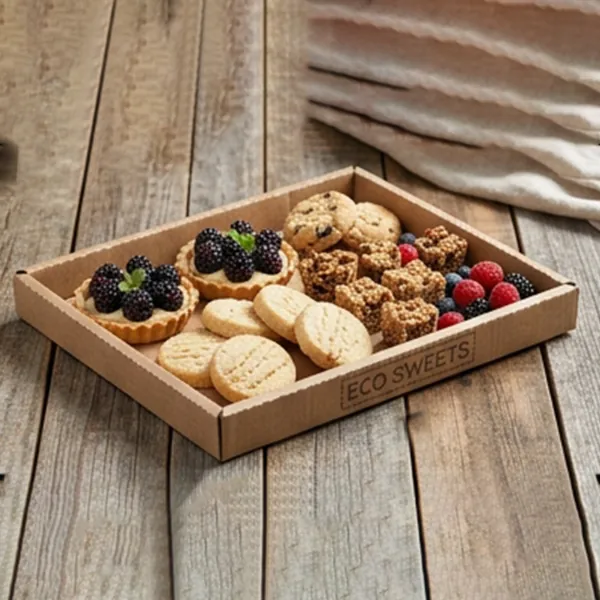
Dessert is the one course where the packaging is photographed.
View tray & get pricing →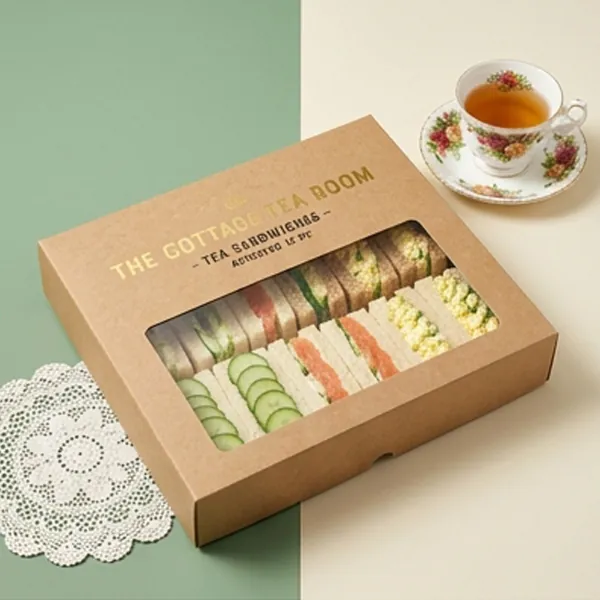
Finger sandwiches are packed in rows, standing on their cut edge, and the whole point is that a customer can see the row through a window before they buy.
View tray & get pricing →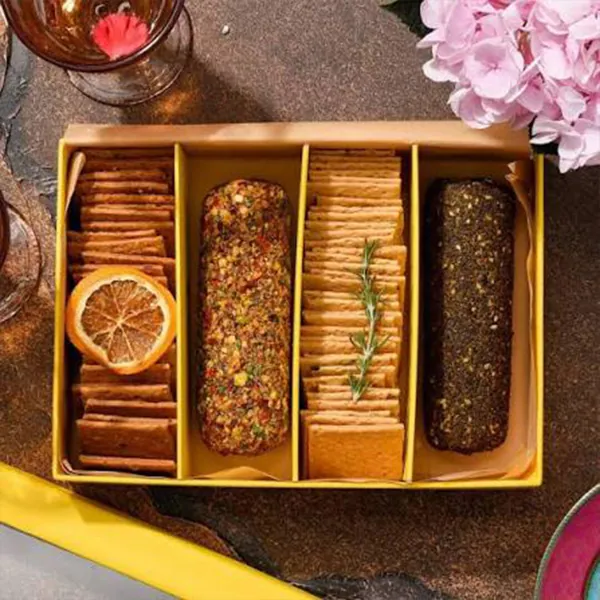
The cheese and cracker tray has one specific enemy: moisture.
View tray & get pricing →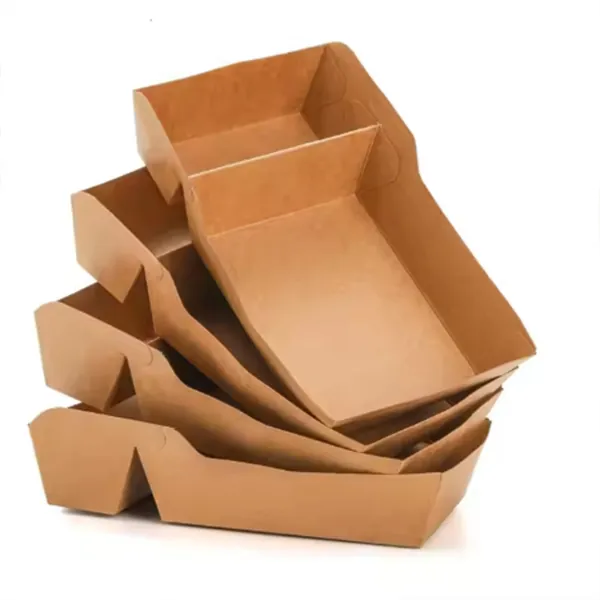
The chip and dip tray is the simplest divided format there is: a main bay and one or two smaller wells.
View tray & get pricing →
02 — In detail
Nothing undermines a buffet faster than a platter with a bow in it. Flatness comes from board grade and from how the platter is stored before use. We specify the caliper against the loaded weight, and we will tell you if the footprint you want needs a heavier board to stay flat.
The cut edge of a board platter is the detail people notice at close range. A rolled or folded edge reads as finished; a raw die-cut edge reads as disposable. Which you want depends on the setting — a corporate boardroom and a stadium concourse have different thresholds.
Dark boards make pale food look flat; glossy white can bounce light into a photograph. Matt white and matt black are the two most reliable backgrounds for food, which is why so many retail platters use them. A dessert platter almost always benefits from a matt finish.
Platter sizing is driven by how the food is laid out, not by a nominal serving count. Some practical starting points:
Buying for a chiller? A platter destined for a retail chilled cabinet has to work with your film sealing or lidding equipment. Send us the sealing machine and rim profile you use, and we will build the platter to match rather than making you adapt to ours.
Platters are display surfaces first, so the decisions are about flatness, finish and how the food is laid out.
03 — Questions
A platter is shallow and made to be looked at; a catering tray is deeper and made to be transported closed. If your food goes straight onto a buffet table, a platter is the right format. If it travels in a van first, look at the catering tray range instead.
Several styles take a clear dome or a film seal. Domes suit self-service display where customers need to see the food. Film suits retail chillers where the platter is scanned and carried home. Tell us the setting and we will match the closure to it.
A correctly specified platter is, up to a point. Beyond roughly 18 inches on the long side, a loaded platter needs two hands or a rigid base regardless of board grade. If single-handed carrying matters, tell us the maximum loaded weight and we will build to it.
Yes. Black is achieved either with a black-lined board or with a printed flood. A flood-printed black on white board gives a more even, deeper result but adds ink cost; a black liner is cheaper at volume. Both are matt-finished by preference because gloss black shows every fingerprint.
Flat, banded and boxed, with enough units per carton that the stack keeps itself flat. Once they arrive, store them flat and away from radiators and direct sun. Board takes on moisture from the air, and a platter stored on its edge in a damp store room will curl.
We can print full bleed, and on a display platter it is usually worth it — a printed border frames the food. The one caution is that heavy ink coverage on a thin board can encourage curl, so we may recommend a slightly heavier caliper for a full-bleed design.
Round, oval, square and rectangular are all achievable — it is a question of cutting die, not machinery. Round platters waste more board per sheet, so they carry a small cost premium over a rectangle of the same area.
Board platters are intended for ambient and chilled service. Hot, steaming food will soften an untreated board within minutes. If you need to present hot food, ask about moisture-resistant constructions or a rigid format when you request your quote.
Describe the food, the portion and the setting. We will tell you which tray in this range fits, and say so plainly if the answer is a format from somewhere else on the site.