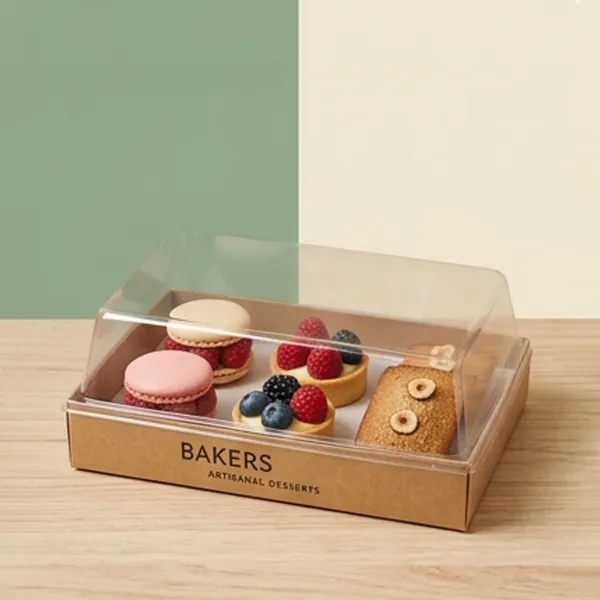
Kraft Dessert Tray with Dome
A dome over a kraft tray is the standard presentation for a mixed patisserie selection sold from a counter.
View tray & get pricing →Custom food packaging · US · UK · Canada · Australia
Serving Trays & Platters
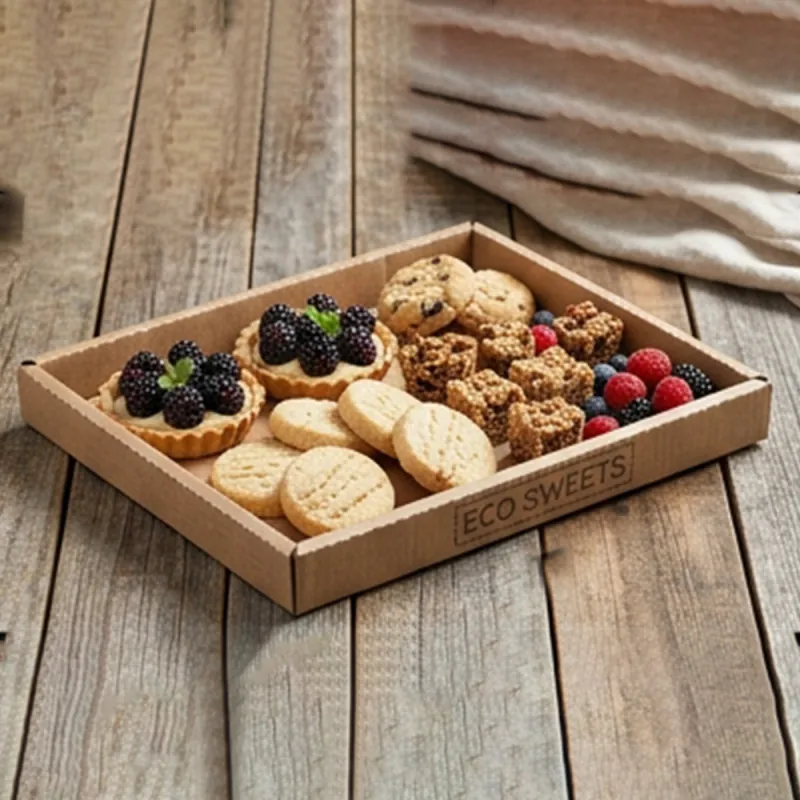
Dessert is the one course where the packaging is photographed. A tray of patisserie is arranged deliberately, it sits under lights, and somebody will take a picture of it before anybody eats. That makes surface finish and colour choice matter more here than on any other tray in the range.
These are shallow, flat platters designed to be looked down on. The structural requirements are modest; the presentation requirements are not.
Pricing starts from $0.30 per tray
The unit price depends on the size, board, printing, finishing, quantity and delivery country, so every quote is worked out for your specification rather than taken from a list.
Send the size and the run length. We reply with pricing, material options and a production date — usually within one working day.
01 — Specification
Every element below is set when we quote. Nothing here is a fixed catalogue entry — if a line does not match what you need, say so and we will change it.
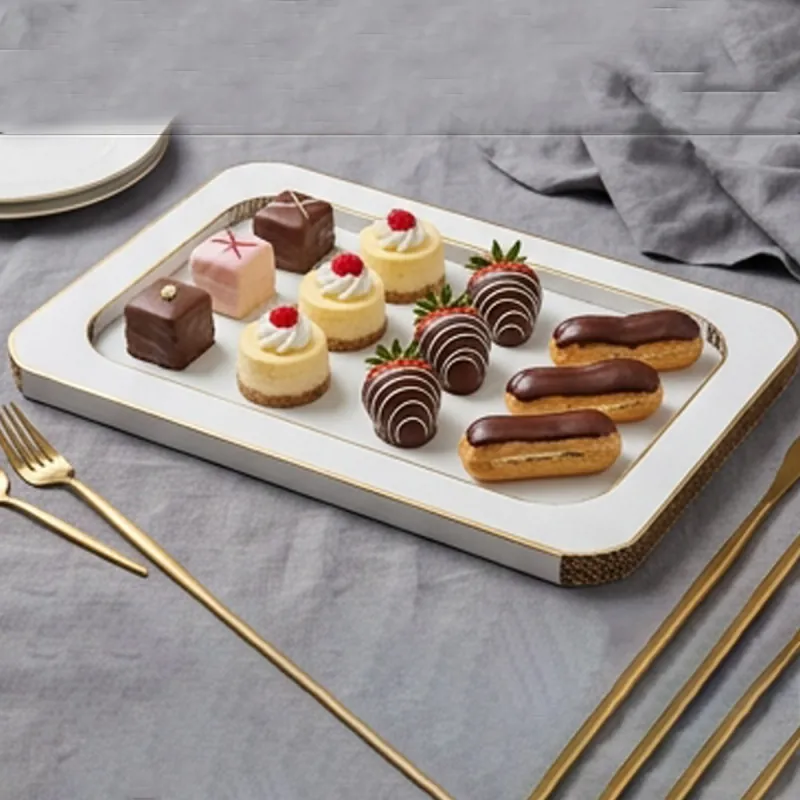
02 — Build the spec
The same five questions we would ask on a phone call, with the corrugated dessert platter already selected. You get a properly detailed brief at the end, which is what makes a first quote accurate rather than approximate.
Prefer the full builder with a live sketch? Open the tray designer.
03 — In detail
Gloss surfaces reflect whatever light is above them, which in a professional photograph means a bright white streak across the tray and, in a phone photo at an event, a smeared highlight and every fingerprint. Matt kills both.
Dark backgrounds flatter dessert for the same reason gallery walls are neutral: the food is usually pale, sweet-coloured and highly detailed, and it needs contrast rather than competition. Matt black is the default for patisserie for exactly this reason. Kraft works where the range is rustic — biscuits, tray bakes, tarts — and white works where the desserts are richly coloured.
A platter that is too thin for its span will bow visibly under a full load. On a dessert platter, where the arrangement is precise, a bowed base ruins the geometry. Specify caliper against the loaded weight and the span.
Shortbread, pastry and chocolate all migrate fat into board. Within a few hours you get a translucent halo around each item. A grease-resistant surface prevents it entirely.
Smooth, glazed items slide on a smooth board when the tray is carried. A slightly textured surface or a paper doily insert solves it without changing the tray.
A raw cut edge on a black platter shows a brown or grey core, which is visible at close range on a table. A wrapped or folded edge, or a flood-printed edge, avoids it.
Dessert platters are usually sized by the count of a single item type rather than by covers, because a patisserie selection is priced per piece.
| Items per platter | Typical arrangement | Rough footprint |
|---|---|---|
| 9–12 petits fours | Three by three or three by four grid | Small square platter |
| 16–24 macarons | Rows with clearance between each | Medium rectangle |
| 12–15 mixed patisserie | Grouped by type with gaps | Large rectangle |
| 20–30 biscuits or cookies | Overlapping rows | Medium to large rectangle |
| 6–8 individual desserts | Widely spaced, needs depth for height | Medium platter with extra depth |
04 — Nearby
Chosen because operators who buy the corrugated dessert platter usually need one of these in the same order, not because they happen to sit in the same category.
A dome over a kraft tray is the standard presentation for a mixed patisserie selection sold from a counter.
View tray & get pricing →
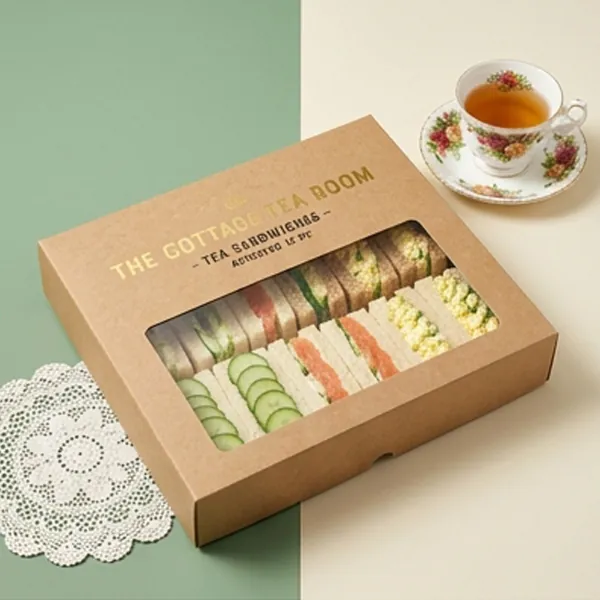
Finger sandwiches are packed in rows, standing on their cut edge, and the whole point is that a customer can see the row through a window before they buy.
View tray & get pricing →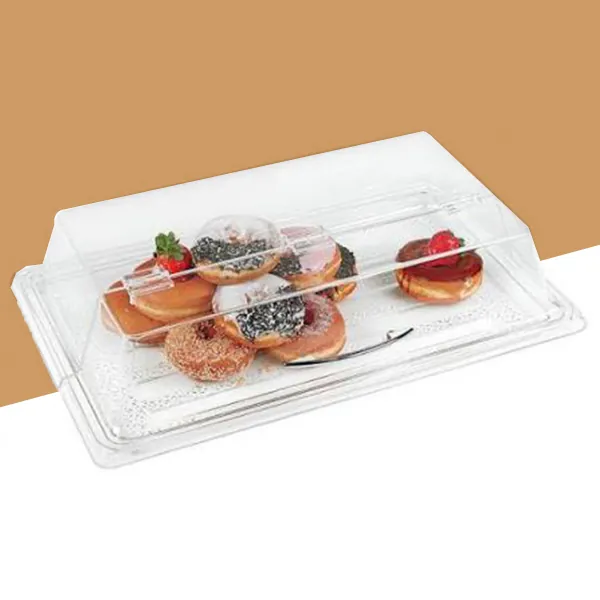
A bakery display tray has to do two jobs that pull in opposite directions.
View tray & get pricing →05 — Questions
Black for classic patisserie and pale desserts, because contrast makes them read. White where the desserts themselves are richly coloured. Kraft for rustic ranges — biscuits, tarts, tray bakes. Look at your own product photography and pick the background that already appears behind your best-selling items.
Because dessert is the course people photograph. The tray is in the frame every time, so surface finish, colour and flatness are doing commercial work rather than just holding food.
On an untreated surface, yes — you get a translucent halo around each item within a few hours. A grease-resistant food-contact face prevents it and costs very little relative to the value of the product sitting on it.
Yes. A dome protects a delicate arrangement and lets it be displayed without being touched. It costs more, takes storage space and does not stack well, so it is worth it for display and retail rather than for transport.
A slightly textured surface, a paper doily insert, or a shallow die-cut position for each item. For high-value patisserie, a fitted insert is worth the cost — it is the difference between a platter arriving as packed and arriving rearranged.
Not loaded, without a lid or a dome — the tray above sits on the arrangement. If you need to stack for delivery, use a lidded format and tell us the stack height.
A raw cut edge shows the board core, which reads as cheap at close range. A wrapped edge, a folded edge or an edge-to-edge flood print all solve it. It is a small detail that people genuinely notice on a dessert table.
Yes — round, oval, square and rectangular are all a matter of the cutting die. Round wastes more board per sheet, so it carries a small cost premium over a rectangle of the same area.
Send the dimensions, the quantity and the country you want it delivered to. We come back with a full quote — material, print, finishing, freight and a production date.