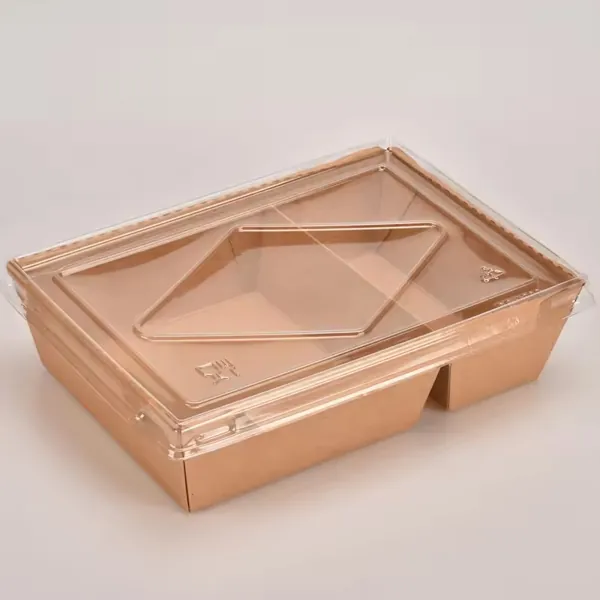
Compartment Tray with Lid
The lidded compartment tray is the format that meal-prep businesses, bento services and premium takeaway have converged on.
View tray & get pricing →Custom food packaging · US · UK · Canada · Australia
Food tray category — 4 trays
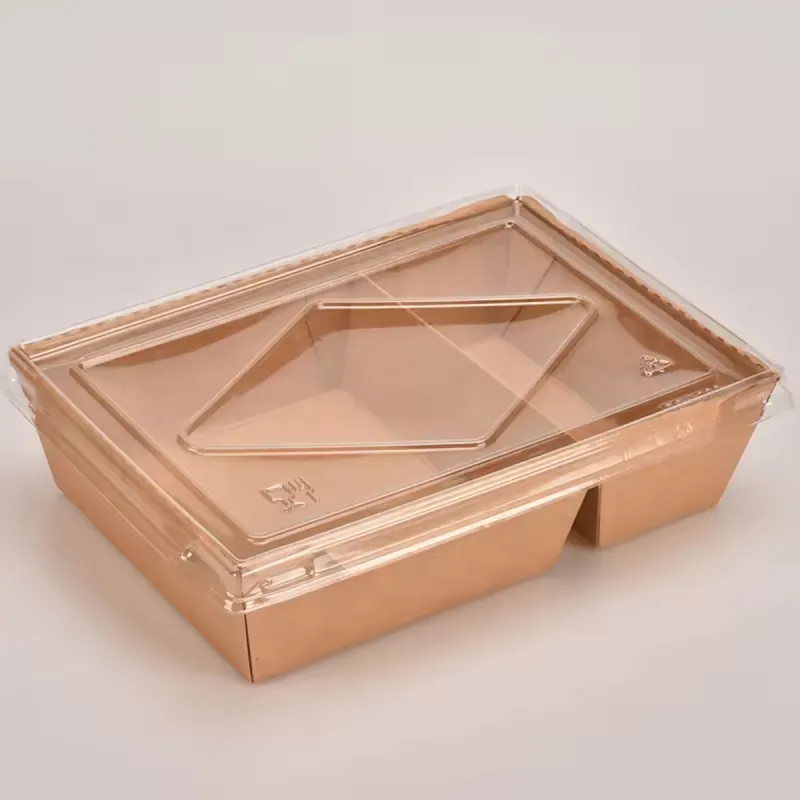
A compartment tray solves an operational problem rather than a presentation one: keeping a wet element away from a dry one so neither ruins the other between the servery and the person eating. Get the well sizes right and a compartment tray replaces three separate containers.
The trays here range from a four-well school meal tray in moulded fibre through to lidded compartment trays for meal prep and rigid cafeteria trays that hold a full plate of service.
Tell us which of the compartment & meal trays you need, the size and roughly how many. We reply with a full quote, usually within one working day.
01 — The range
Divided trays that keep a full meal separated from kitchen to table. Every one is made to order, so treat the descriptions as starting points rather than fixed specifications.
The lidded compartment tray is the format that meal-prep businesses, bento services and premium takeaway have converged on.
View tray & get pricing →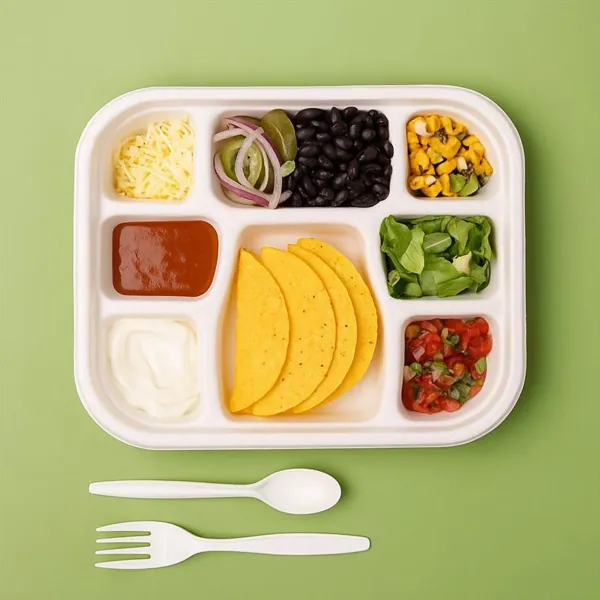
School meal trays have a specification nobody else has to meet.
View tray & get pricing →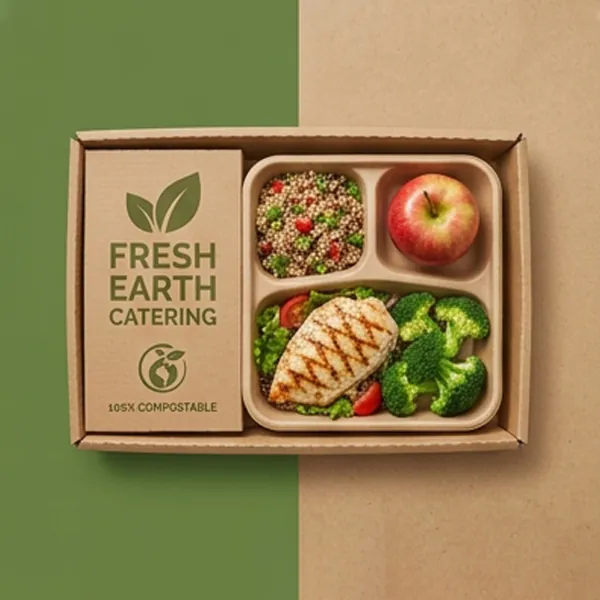
A cafeteria tray carries an entire meal — main, sides, dessert, cutlery, sometimes a drink — from a servery to a table, held by one person who is also c…
View tray & get pricing →
The lunch tray sits between a takeaway container and a proper meal tray.
View tray & get pricing →02 — In detail
Not a generic meal — the specific dishes. A tray designed for pasta and salad is a different shape from one designed for curry, rice and a poppadom.
A well that is wide enough but too shallow overflows. Portion volume in millilitres is the number that matters, and most kitchens can weigh a portion and convert.
Sauce and dressing need a well with a properly formed radius and, usually, a lid that seals against it. Dry sides do not.
It has to fit your servery, your trolley shelf and your delivery bag. Give us those three dimensions and we work backwards to the wells.
A flat lid stacks. A domed lid clears a tall item. A film seal is the only one that genuinely stops leakage in transit.
These are the layouts we are asked for most often. Any of them can be resized.
If none of those match your service, send a sketch. Custom well layouts are a tooling question, not an impossibility.
Folded board compartment trays are the cheapest and lightest, and work well for ambient and lightly sauced food. They are formed from a single blank, so the wells are shallower and the corners are folded rather than moulded.
Moulded fibre gives deep, properly radiused wells and handles hot and wet food far better, which is why the bagasse school meal tray is moulded rather than folded. It is heavier and the tooling is more involved.
Rigid trays sit at the top of the range — thicker, flatter and reusable within a service. A rigid cafeteria tray is the right answer where trays are collected and washed rather than discarded.
The material matters more here than in most ranges, because hot and wet food behaves very differently against folded board and moulded fibre.
03 — Questions
Four is the most common because it covers a main, two sides and a dessert or sauce. The right answer depends on your menu cycle rather than convention — if your standard service is a main plus one side, a three-well tray is cheaper and quicker to fill.
Not if the dividing walls are the correct height for the portion volume and the tray is carried flat. Leakage almost always means either an overfilled well or a wall that was specified too low. Tell us the portion volumes and we will size the walls with headroom.
Moulded fibre trays generally tolerate microwave reheating; coated board varies by coating; anything with a metallic ink does not. We will confirm the exact construction of what you order so you can test it in your own equipment before telling customers it is microwave safe.
We supply fitted lids and can specify trays with a rim profile compatible with film sealing equipment. A fitted board lid contains and protects but does not seal against liquid. If you are transporting sauce, film is the reliable option.
In moulded fibre, yes — that is one of the format’s real advantages. A deep well for a stew alongside shallow wells for dry sides is entirely achievable. In folded board the depths are constrained by the single blank.
It depends on your trolley. Measure the usable shelf width and depth and tell us how many trays you need per shelf. We will size the tray so you get a whole number across the shelf rather than a wasted strip.
With a lid, generally yes. Without one, the wells nest into each other and food is crushed. If trays are stacked in a hot cupboard or a delivery bag, plan on lids from the start.
On folded board, freely. On moulded fibre, printing is more limited — the surface is textured and absorbent, so a printed band or label is usually a better result than full coverage. We will show you what is realistic on the material you choose.
Describe the food, the portion and the setting. We will tell you which tray in this range fits, and say so plainly if the answer is a format from somewhere else on the site.