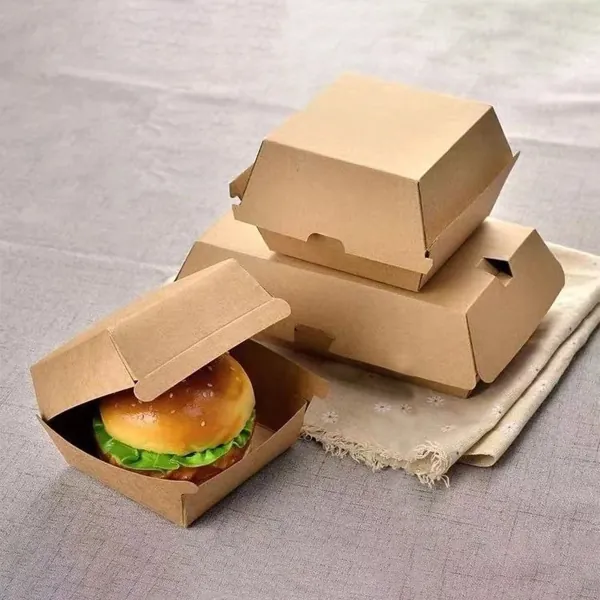
Burger Clamshell Tray
A burger clamshell is a hinged box that closes around a burger, and its whole purpose is to stop the build collapsing between the pass and the customer.
View tray & get pricing →Custom food packaging · US · UK · Canada · Australia
Food tray category — 6 trays
Fast food packaging has about four seconds to work. It is filled at speed, handed over, carried in one hand, and eaten somewhere that is not a table. Everything about the format follows from that: a shape you can fill without looking, a wall you can grip without squeezing the food, and a board that does not go translucent while the customer is still holding it.
This section covers the open trays, scoops and clamshells that do that job — hot dog trays, fry scoops, corn dog trays, burger clamshells, fish and chip trays and popcorn scoops.
Tell us which of the fast food & concession trays you need, the size and roughly how many. We reply with a full quote, usually within one working day.
01 — The range
Grease-resistant trays, scoops and clamshells for high-volume counter service. Every one is made to order, so treat the descriptions as starting points rather than fixed specifications.
A burger clamshell is a hinged box that closes around a burger, and its whole purpose is to stop the build collapsing between the pass and the customer.
View tray & get pricing →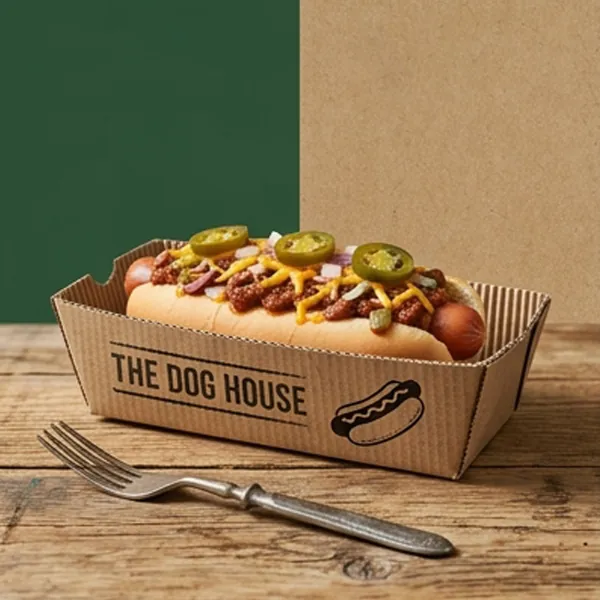
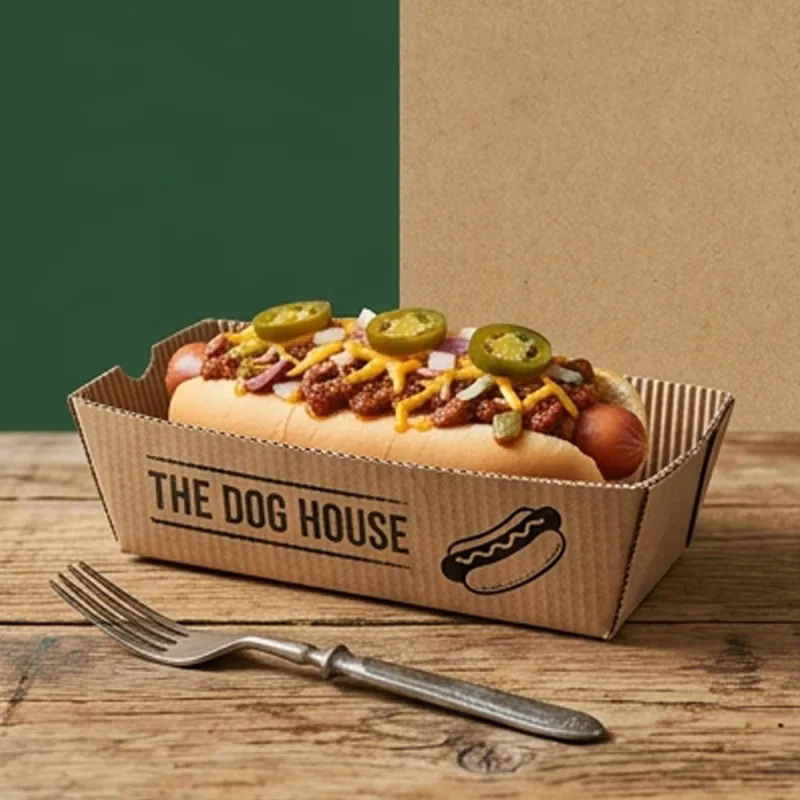
The hot dog tray is one of the oldest shapes in food packaging and it has barely changed, because it does not need to.
View tray & get pricing →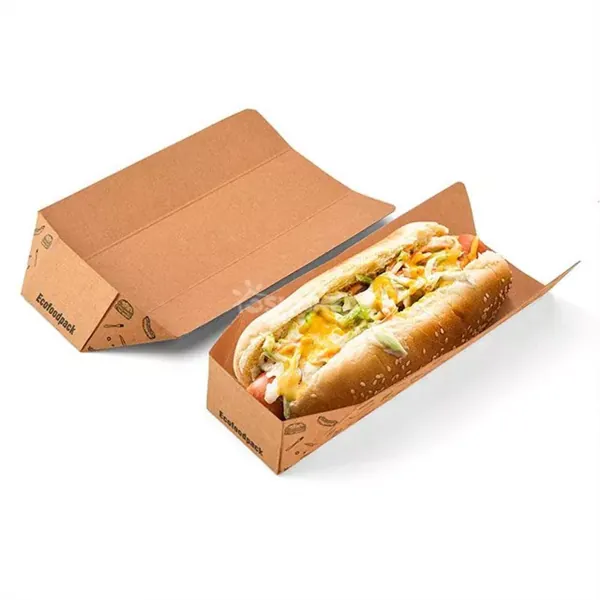
Corn dogs are eaten from a stick, which sounds like it removes the need for packaging entirely.
View tray & get pricing →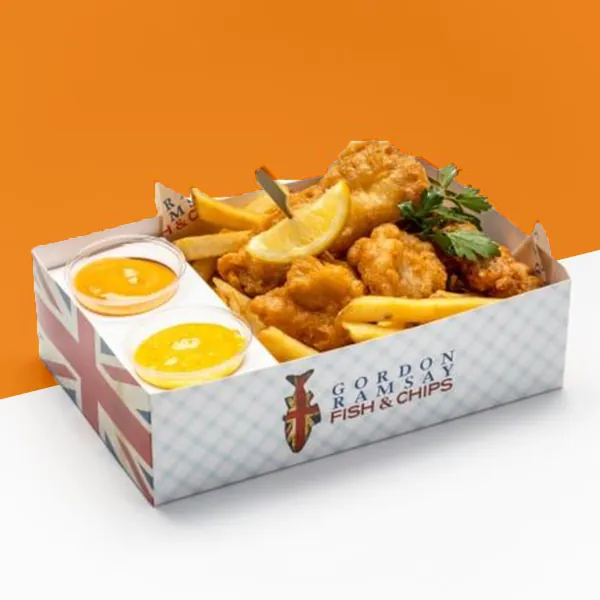
Fish and chips is the hardest test a board tray faces.
View tray & get pricing →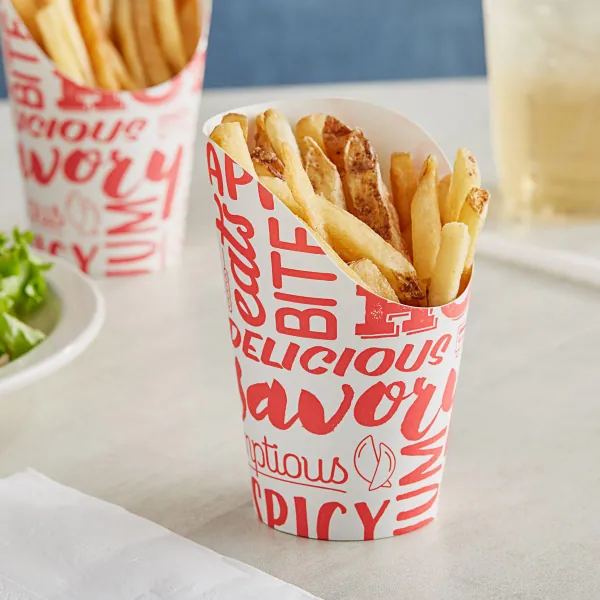
The fry scoop exists because of a specific piece of ergonomics: a member of staff should be able to fill it from a fryer basket with one hand, in one mo…
View tray & get pricing →
Popcorn is sold by volume and eaten by the handful, which makes the pack unusually important: the customer’s sense of value comes almost entirely…
View tray & get pricing →02 — In detail
A tray that takes an extra second to open costs a busy stand real money over a shift. Pre-glued and self-erecting formats cost slightly more per unit and pay for themselves in labour at volume. Flat-packed styles are cheaper and make sense where staff assemble during quiet periods.
Shape matters too. An open scoop can be filled with one hand from a fryer basket. A clamshell needs two hands but protects a burger from collapsing. If you are choosing between the two, watch your own service line for ten minutes and count the hands involved.
| Menu item | Format that usually works | Why |
|---|---|---|
| Hot dogs and brats | Open hot dog tray | Long, narrow, shallow — supports the bun without hiding the toppings |
| Fries and loaded fries | Fry scoop | Angled front lets staff fill straight from the basket and the customer reach in |
| Burgers | Clamshell | Closes around the burger so it does not compress or slide |
| Corn dogs | Corn dog tray | Holds the stick clear of the food surface |
| Fish and chips | Deep open tray | Depth for a mixed portion, wide enough to eat from directly |
| Popcorn and snacks | Scoop | Tall back panel gives a big, cheap branding surface |
These five details let us quote accurately without a round of questions:
Speed of service and grease resistance decide most of this range. Watch your own counter for ten minutes and the answer usually becomes obvious.
03 — Questions
Print sits on the outer face and is not in contact with the food, so it is not the weak point — the board is. What ruins the look of a fast food tray is grease coming through from the inside, which is why we specify a grease-resistant food-contact surface on almost everything in this range.
Steam is the enemy, not the board. Open formats such as scoops let steam escape, which is exactly why fries are traditionally served in them rather than in closed boxes. If you must close the pack for delivery, ask about vented constructions.
Yes. Send the carrier or the cup holder dimensions and we will build the tray footprint to drop into it. This is a common request from drive-through and stadium operators who do not want to change their carriers.
For anything taller than about two inches or anything with a sauce, yes — the clamshell holds the build together. For a thin, flat item a tray is faster to fill and cheaper. If half your menu is each, it is often worth running both rather than compromising on one.
More than most operators use. The tall back panel of a scoop is the single best branding surface in fast food packaging because it faces the customer while they eat. A one-colour logo across that panel is inexpensive and highly visible.
Yes — see the stadium carrier tray for multi-item service, and food trays for stadium concessions for how the whole range fits a concourse operation.
Plain uncoated board with no metallic ink is generally microwave tolerant for short reheats, but performance depends on the coating and the food. We will tell you the exact construction so you can test it in your own operation before you make any claim to customers.
Lower than you would expect for one-colour work on a small format. The setup cost is fixed, so the question is simply how quickly you use the stock. A single busy stand often gets through enough in a quarter to justify a printed run.
Yes. Plain natural kraft or white board trays are available across most of this range, and many operators start there while artwork is being developed, then move to print on the second order.
Describe the food, the portion and the setting. We will tell you which tray in this range fits, and say so plainly if the answer is a format from somewhere else on the site.