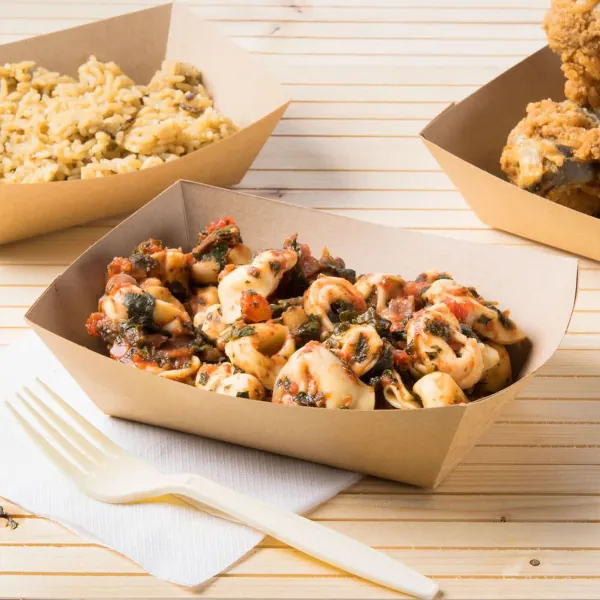
Kraft Paper Food Tray
The kraft paper food tray is the one shape that every counter ends up buying.
View tray & get pricing →Custom food packaging · US · UK · Canada · Australia
Fast Food & Concession Trays
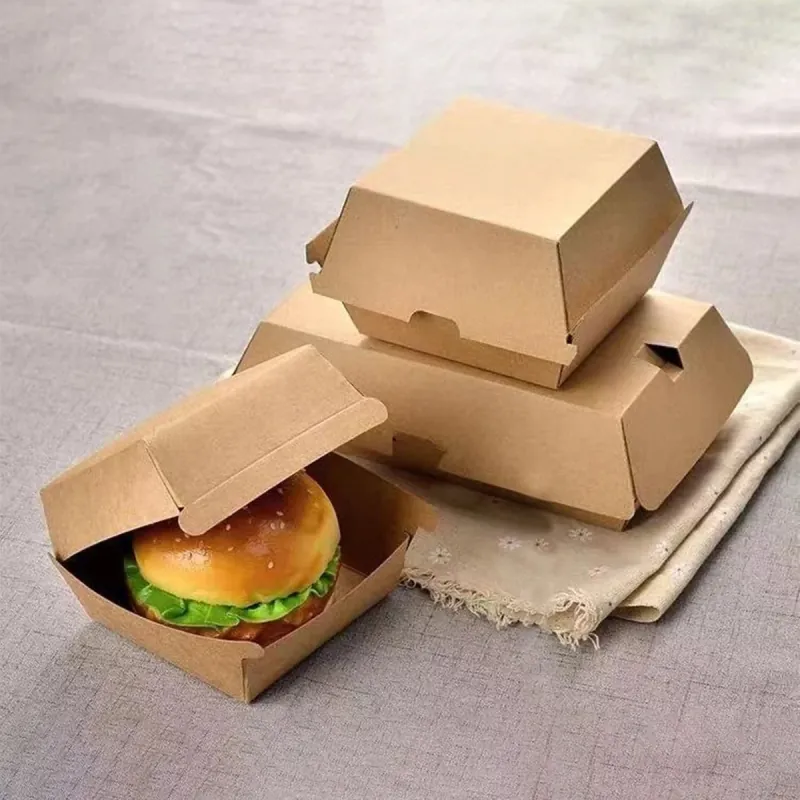
A burger clamshell is a hinged box that closes around a burger, and its whole purpose is to stop the build collapsing between the pass and the customer. That makes internal height the critical dimension — a box that is a centimetre too short compresses the burger, which is the fastest way to make a good product look mediocre.
The other thing it does, quietly, is hold heat and moisture, which is a benefit for a burger and a problem for the fries next to it. Both are solvable with the right specification.
Pricing starts from $0.30 per tray
The unit price depends on the size, board, printing, finishing, quantity and delivery country, so every quote is worked out for your specification rather than taken from a list.
Send the size and the run length. We reply with pricing, material options and a production date — usually within one working day.
01 — Specification
Every element below is set when we quote. Nothing here is a fixed catalogue entry — if a line does not match what you need, say so and we will change it.
02 — Build the spec
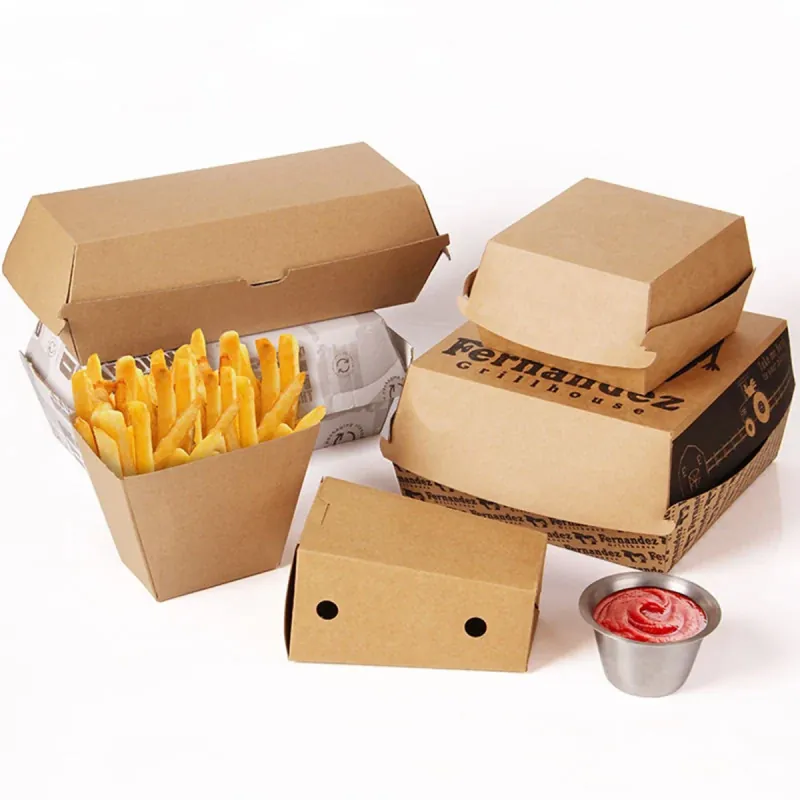
The same five questions we would ask on a phone call, with the burger clamshell tray already selected. You get a properly detailed brief at the end, which is what makes a first quote accurate rather than approximate.
Prefer the full builder with a live sketch? Open the tray designer.
03 — In detail
Measure your tallest burger — the double with a fried egg and onion rings, not the single — from the base of the bun to the top of the crown, and add clearance. That number is the internal height, and getting it wrong is unrecoverable: a box too short compresses the build every single time it is used.
The second measurement is the diameter of your bun, and again, take the largest. Buns vary by batch, and a clamshell that only just closes on a good day will not close at all on a day when the bakery has proved the dough a little longer.
Internal height sized against an average burger rather than the tallest one on the menu. The most common problem and the least fixable after tooling.
No grease-resistant face. A burger with cheese and sauce marks plain board within minutes, and it is visible when the customer picks the box up.
A sealed clamshell traps steam, which softens the bun. For delivery, vents are the answer; for immediate handover, it is usually fine.
An under-specified tuck that opens in a delivery bag. Ask for a positive lock if boxes are stacked or bagged.
Both formats appear on the same menus, and the choice is worth making deliberately.
04 — Nearby
Chosen because operators who buy the burger clamshell tray usually need one of these in the same order, not because they happen to sit in the same category.
The kraft paper food tray is the one shape that every counter ends up buying.
View tray & get pricing →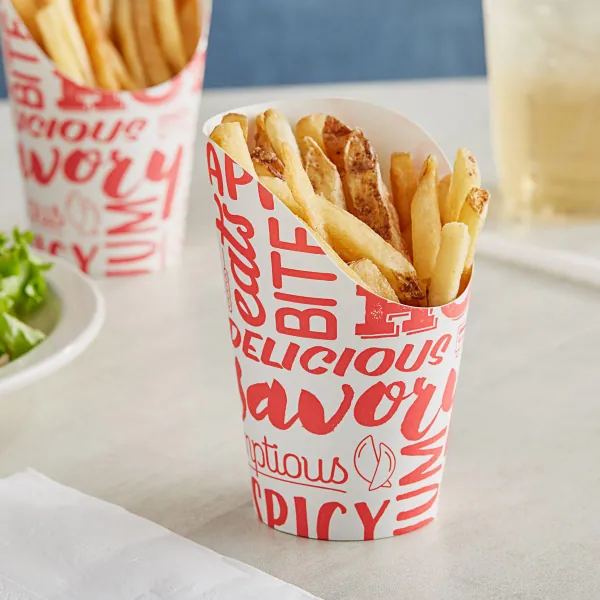
The fry scoop exists because of a specific piece of ergonomics: a member of staff should be able to fill it from a fryer basket with one hand, in one mo…
View tray & get pricing →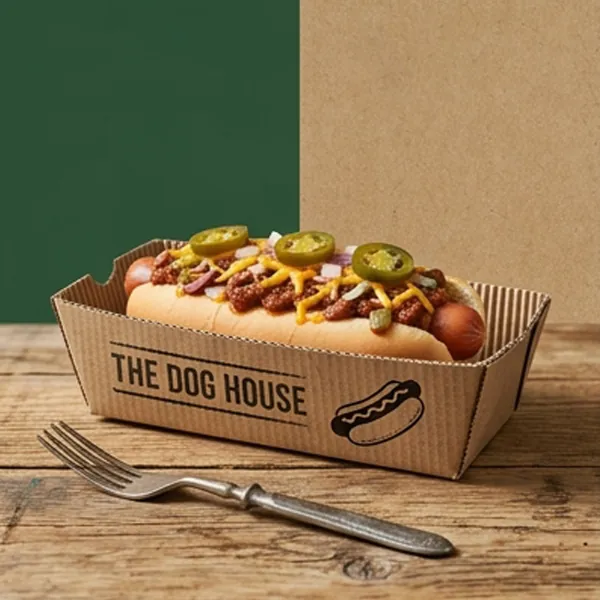
The hot dog tray is one of the oldest shapes in food packaging and it has barely changed, because it does not need to.
View tray & get pricing →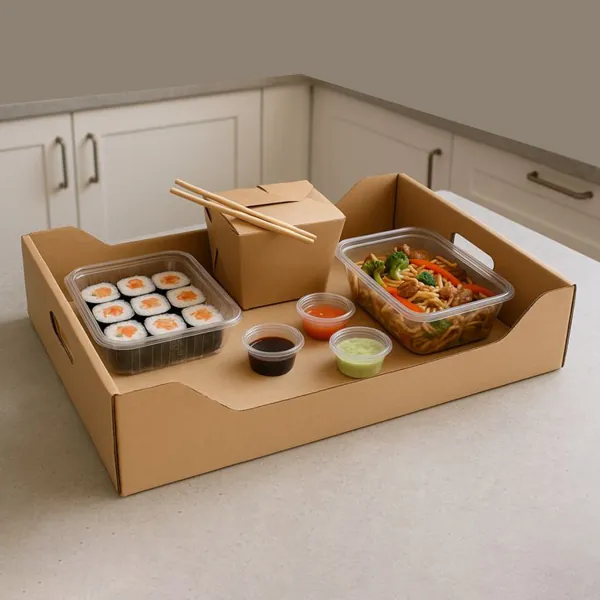
Corrugated trays exist for one reason: a loaded tray that has to be picked up from the middle without folding in half.
View tray & get pricing →05 — Questions
Measure your tallest build — the fully loaded double, not the standard single — from the base of the bun to the top of the crown, and add clearance. Sizing to an average burger means compressing your best-selling premium item every time.
A sealed clamshell traps steam, which softens a bun over about ten minutes. For immediate handover that is not usually a problem. For delivery, ask for die-cut vents — they let steam escape without letting heat out too quickly.
For a burger with cheese and sauce, yes. Plain board marks within minutes and the customer sees it as soon as they pick the box up. It costs very little and it is the single most visible packaging failure in burger service.
It can, but it should not. Fries in a closed box steam and soften. If you want a combined container, use a divided open tray or a clamshell with a separate vented fry compartment, and expect a compromise either way.
Yes as standard, and they fold up in a couple of seconds. Pre-glued versions are available where service pace makes assembly time expensive, at a higher unit cost and much higher freight.
With a positive front lock, yes. A simple tuck can work loose when boxes are stacked and jostled. If most of your volume goes out through delivery platforms, specify the lock.
The lid is a large, flat, unobstructed panel and it is what the customer sees before opening. It is one of the better print surfaces in fast food packaging. The sides work well for a repeated wordmark.
Yes. Send one, ideally with a burger in it if you can manage the logistics, or with a photograph of a loaded box beside a ruler. Matching means your bags, racks and heated cabinets stay unchanged.
Kraft for craft and smash-burger positioning, white where the design needs colour accuracy or photography. Kraft hides grease marks better, which matters if you are not specifying a treated board.
Send the dimensions, the quantity and the country you want it delivered to. We come back with a full quote — material, print, finishing, freight and a production date.