Resource guide
Food Tray Printing Guide
How printing on food trays works: spot colours versus process, what each colour count costs, how substrates change colour, and what a proof does and does not tell you.
Updated August 28, 2026 · About 10 minutes to read
Printing a food tray is not complicated, but it has a sequence, a small number of genuine constraints, and a few places where a decision made casually costs money later. This guide covers the commercial side — colours, costs, expectations. The technical file requirements are in the artwork guide.
Spot colours and process colour
Spot colours
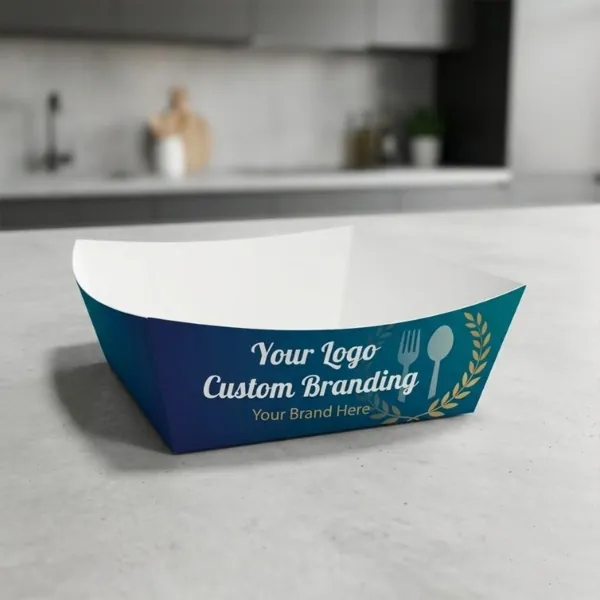
Each colour is a specific ink, mixed to your reference, printed from its own plate. One, two, three or four spot colours are common. Because the ink is mixed rather than built from four process inks, a brand colour lands accurately and solid areas print evenly.
Spot printing is the right choice for logos, line art, type-led designs and anything where a specific colour matters. It is also cheaper at low colour counts, because you are paying for fewer plates.
Four-colour process
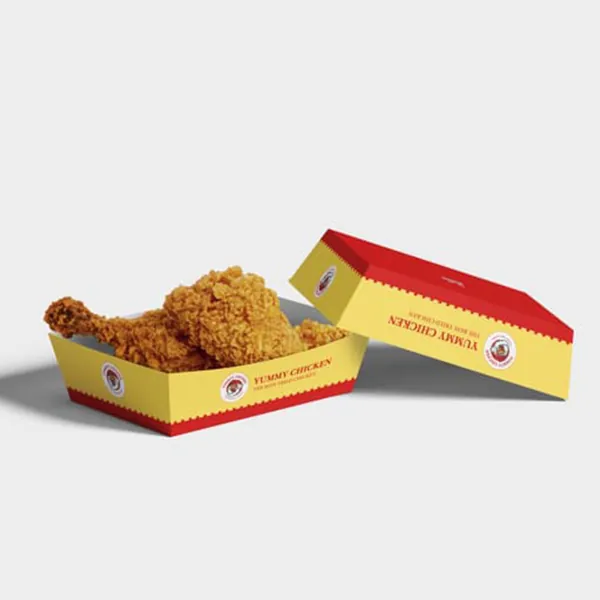
Cyan, magenta, yellow and black, overlaid to produce a full range. Necessary for photography, gradients and designs with many colours. It requires a light substrate — on natural kraft the brown shifts everything warm and flattens the contrast.
It is the most expensive setup and the one most likely to produce a result that differs from what you saw on screen, which is why a physical proof matters more here than anywhere else.
Colour count and what it gets you
| Colours | Suits | Relative setup cost | Substrate |
|---|---|---|---|
| 1 spot | Logo, line art, stamp-style marks, type | Lowest | Any, including natural kraft |
| 2 spot | Logo plus a brand colour or highlight | Low | Any |
| 3 spot | A palette with a background flood | Moderate | Better on lighter board |
| 4 spot | Complex brand systems needing exact colours | Higher | Lighter board strongly preferred |
| CMYK process | Photography, gradients, illustration | Highest | Bleached white board or white liner |
Why one colour on kraft is not a compromise
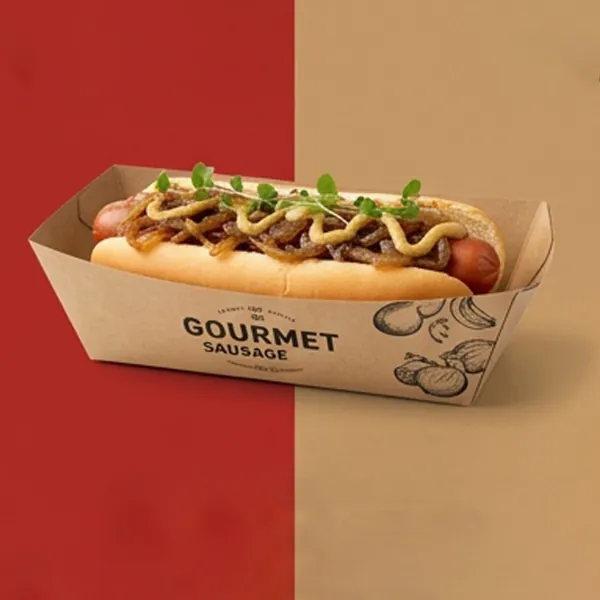
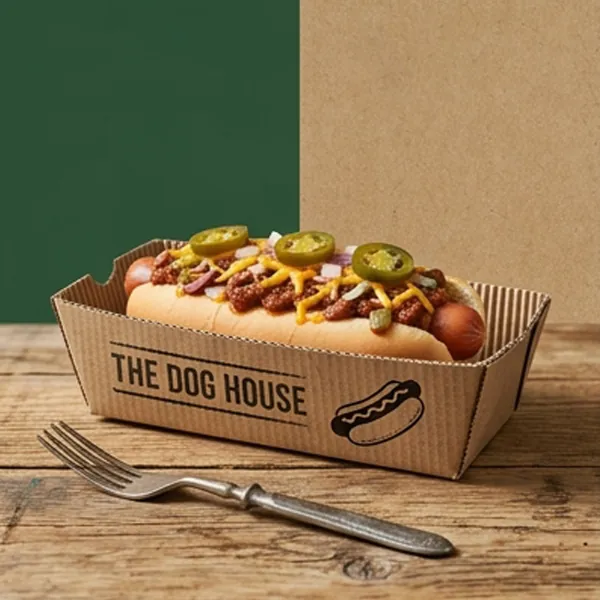
Operators often assume more colours reads as more professional. In food packaging the opposite is frequently true. A single well-drawn ink on natural kraft is the look most craft, artisan and heritage food brands deliberately commission, and it is what a large proportion of the best-looking food packaging in the world actually is.
It is also, conveniently, the cheapest to set up, which makes short runs viable and lets you print every tray you use rather than only your flagship item. Printing everything at one colour beats printing one thing at four.
How the substrate changes your colour
Natural kraft
Every ink shifts warm and darkens because the brown board shows through. Pale colours and pastels largely disappear. Blacks, deep colours and white ink all work well.
Bleached white board
The most accurate substrate. Spot colours land close to their reference and process work has its full range. This is what to specify if colour accuracy is part of your brand.
Corrugated E and F flute
Close to folding board for print quality. Very large solid areas can show a faint flute pattern; line art and type do not.
Moulded fibre
Textured and absorbent. Fine detail does not hold. Use a printed band, sleeve or applied label instead — this is not a limitation to work around, it is what the material is.
The proofing sequence
-
Dieline first
We supply a flat template with cut lines, creases, glue areas and the safe zone marked. Design on this, not on a rectangle.
-
Digital proof
Confirms layout, content and the colour breakdown. This is where you catch typos, wrong phone numbers and elements sitting across a fold.
-
Physical proof, where colour matters
Printed on the actual board. This is the only reliable indication of how colour will really look. Worth the extra days for a first branded run.
-
Approval
The point of no return. After approval, changes mean new plates. Have a second person read the proof; the person who wrote the copy is the worst proofreader of it.
Setup cost is fixed; ink cost is small. That means the per-unit cost of printing falls sharply with quantity. The useful question is not "can we afford to print" but "how quickly do we use trays" — ask for pricing at your realistic quarterly and annual usage and the decision usually makes itself.
Taking a design to production
If print is the reason for the order rather than an addition to it, start in the custom printed food tray range.
Printed packaging pays back fastest where it moves through a crowd rather than sitting on a table, which is the argument set out in the stadium concession guide.
Questions this guide gets asked
How many colours should I use?
Fewer than you think. One well-drawn colour on kraft looks better than a mediocre four-colour design and costs far less to set up, which makes shorter runs viable. Move up only where the design genuinely fails without it.
Can you match my Pantone reference exactly?
Very closely on bleached board with a spot ink. On natural kraft, the brown substrate shifts every colour and an exact match is not physically possible. We will show you what your specific colour does on that board.
Do I need a physical proof?
For a first branded run, yes. A digital proof catches content and layout errors; only a physical proof on the actual board shows how the colour and the surface will really look under real lighting.
Why is my design more expensive on kraft than white?
It usually is not — kraft board is cheaper. What costs more is trying to make a design intended for white board work on brown, which often means adding a white flood underneath, and that is an extra ink pass.
Can I print on the inside of a tray?
Yes, priced as a second side. It is seen at the end of the meal, which makes it a good place for a reorder prompt or a social handle rather than the primary logo.
Do you keep my cutting die for repeat orders?
Yes, the die stays on file. Repeat orders with new artwork carry plate cost only, which is why seasonal and event-specific designs are far cheaper than most buyers expect.
Can you print certification or recycling symbols?
Only where the material you have ordered genuinely holds that certification in the market you sell in. Those marks have specific legal meanings that differ by country, and printing one you are not entitled to creates a regulatory problem.