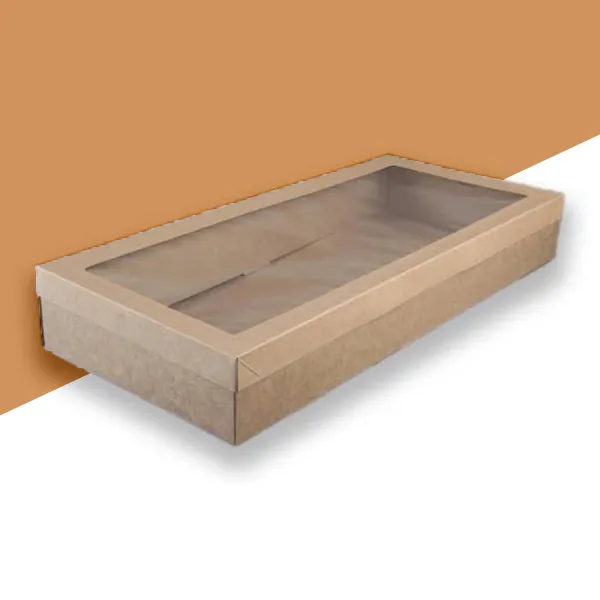
Catering Tray with Lid
The lidded catering tray is the format that most drop-off caterers standardise on, because it is the only one that solves the whole journey.
View tray & get pricing →Custom food packaging · US · UK · Canada · Australia
Custom Printed Food Trays
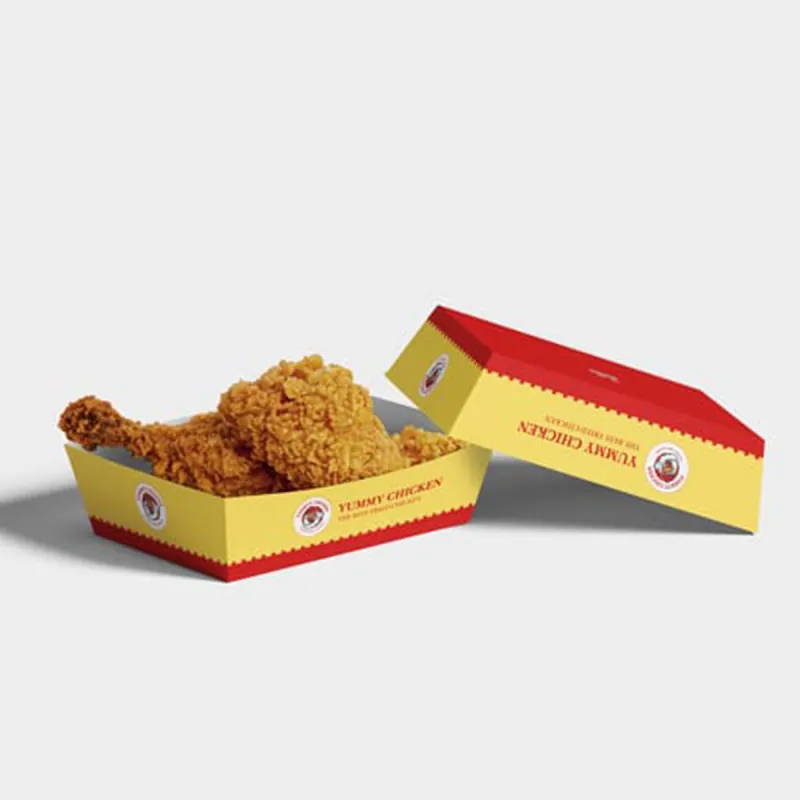
Catering is the one part of food service where packaging routinely converts new business. A tray arrives at an office, gets opened in front of a dozen people, and half of them are potential customers who will ask who catered it. If your name is not on the tray, they ask the person who ordered — and often do not get an answer.
This page is about doing that properly: what to print, where, and how much it actually costs.
Pricing starts from $0.30 per tray
The unit price depends on the size, board, printing, finishing, quantity and delivery country, so every quote is worked out for your specification rather than taken from a list.
Send the size and the run length. We reply with pricing, material options and a production date — usually within one working day.
01 — Specification
Every element below is set when we quote. Nothing here is a fixed catalogue entry — if a line does not match what you need, say so and we will change it.
02 — Build the spec
The same five questions we would ask on a phone call, with the custom printed catering tray already selected. You get a properly detailed brief at the end, which is what makes a first quote accurate rather than approximate.
Prefer the full builder with a live sketch? Open the tray designer.
03 — In detail
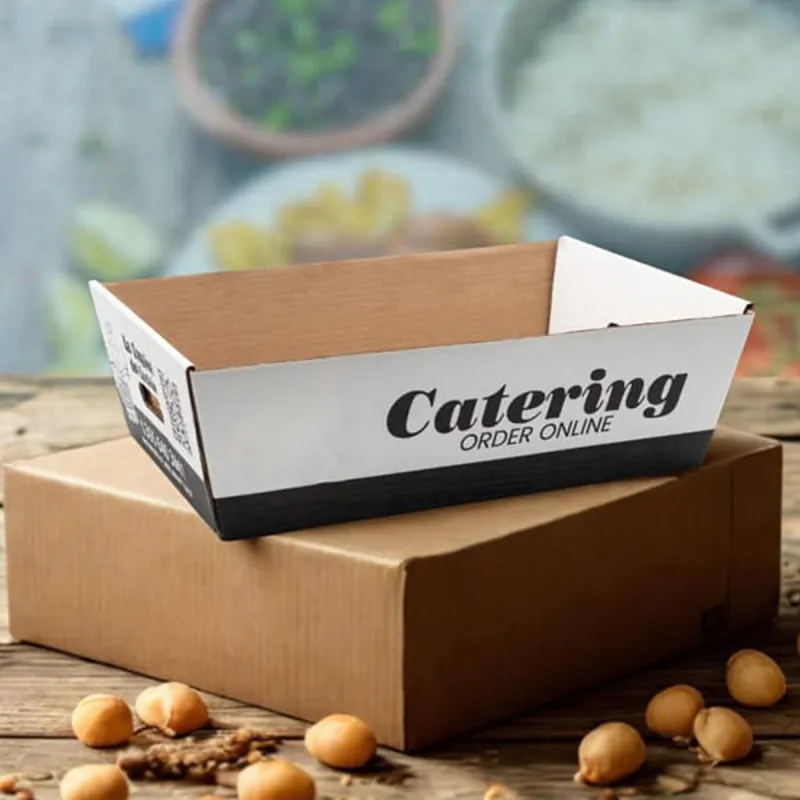
A catering tray gives you four or five distinct surfaces, and they get seen at different moments. Use them for different things.
Seen while the tray is still closed, from across a room. Name, mark, one line of positioning. Set it large; this is a room-reading surface, not a hand-reading one.
Seen only after opening, by the people about to eat. Menu, allergen note, reheating guidance, a QR code to reorder. Nobody minds detail here because they are already engaged.
Still visible once the lid is off and the tray is on the table for an hour. Website, ordering line, social handle.
If your trays go onto a buffet, this stands above the food at eye level. It is the single most visible panel on the whole product.
When trays are stacked in a van or on a counter, the edge is all anybody sees. A repeated wordmark along it is cheap and surprisingly effective.
One colour on kraft, on the lid and one side wall. It is inexpensive enough that you can print every tray you use, which matters more than the finish quality — a plain tray at every delivery loses more business than a slightly less refined printed one.
Two or three spot colours, or full colour on a white lid. The audience is judging you on presentation and the order values justify the cost. This is where a physical proof is worth the extra few days.
Full colour, with a legal panel, barcode and product photography. Effectively a retail pack, and it needs to be designed as one rather than as a catering tray with extra ink.
Design on the dieline, not on a rectangle. Catering trays have lid overlaps, fold lines, hand holes and sometimes a header fold. Every one of those is somewhere a logo can end up creased or cut in half. We supply the dieline free before artwork starts — use it.
Print cost on a catering tray divides into setup and running. Setup is fixed — plates and make-ready — and is paid once per design per surface. Running cost is the ink, and it is small. That means the unit cost of printing falls sharply with quantity, and the practical question is not "can I afford to print" but "how quickly do I use trays".
A caterer doing twenty drop-offs a week will get through enough trays in a quarter to make one-colour printing cost a few cents per tray. Ask us for pricing at your realistic quarterly and annual usage and the decision usually makes itself.
04 — Nearby
Chosen because operators who buy the custom printed catering tray usually need one of these in the same order, not because they happen to sit in the same category.
The lidded catering tray is the format that most drop-off caterers standardise on, because it is the only one that solves the whole journey.
View tray & get pricing →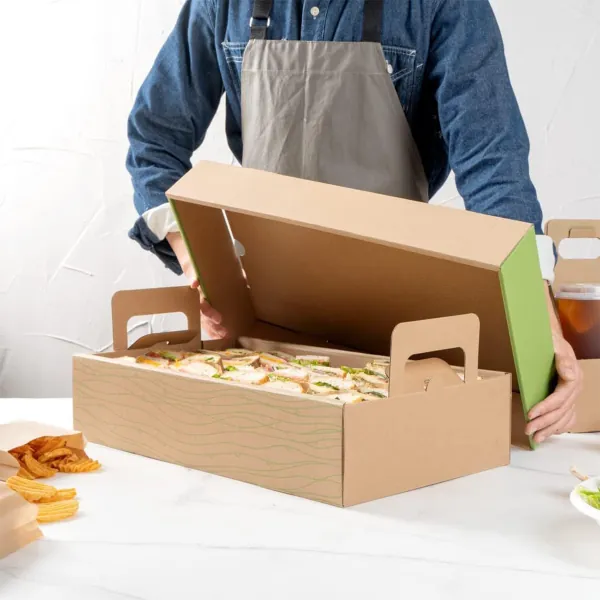
This is the working catering tray: fluted, deep, strong enough to hold several full foil pans, and usually built with a raised header board that turns t…
View tray & get pricing →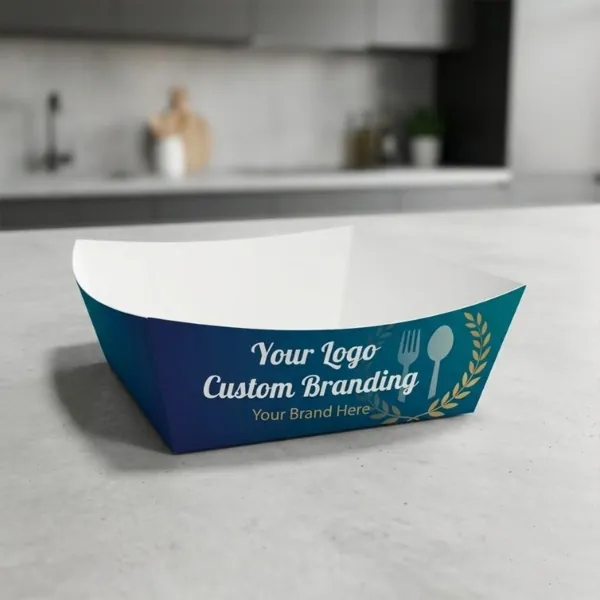
This is the general-purpose printed tray: any of our shapes, in your board, carrying your artwork.
View tray & get pricing →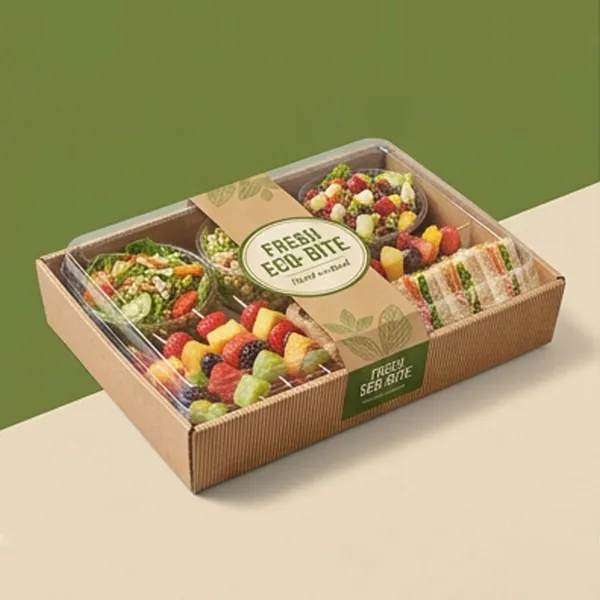
A party tray is a divided platter under a clear lid.
View tray & get pricing →05 — Questions
One colour on natural kraft, on the lid face. It is the lowest setup cost, it looks deliberately plain rather than cheap, and at catering volumes it works out to a very small amount per tray. Most operators should start there.
Yes. They are separate components with separate tooling and separate plates. The most common pattern is branding on the lid and practical information — menu, allergens, reheating — on the base or inside the lid.
Always, and free. Designing a catering tray without one is the single most common cause of a reprint, because lids have overlaps and bases have folds that are not obvious from a photograph.
Spot colours on natural kraft shift warm because the brown substrate shows through every ink. We will show you what your specific colour actually does on that board. If exact colour matters, a white lid on a kraft base is a common and effective compromise.
For a first branded catering run, yes. A digital proof catches typos and layout errors; only a physical proof on the actual board tells you how the colour and the surface will really look under an office fluorescent light.
Yes. The cutting die is shared, so additional designs carry plate cost only. Caterers with a few large contract clients often run a house design plus one or two client-specific versions.
Longer than production, in our experience — it is usually the client side that stretches a timeline, not the press. Start the design conversation early and build in time for a second set of eyes on the proof.
We will print whatever you supply, on a clearly defined panel we mark on the dieline. What the panel must say is a legal question that differs between the US, UK, Canada and Australia, and that content has to come from you.
Not on a standard tray — print is applied to the outer face. Where interior print is requested we specify inks appropriate for that application and note it on your specification.
Yes, and inside the lid is the best place for one, because the customer is already looking at the food when they see it. Test the code at final print size before approval — codes that scan on screen sometimes fail at small sizes on textured board.
Send the dimensions, the quantity and the country you want it delivered to. We come back with a full quote — material, print, finishing, freight and a production date.