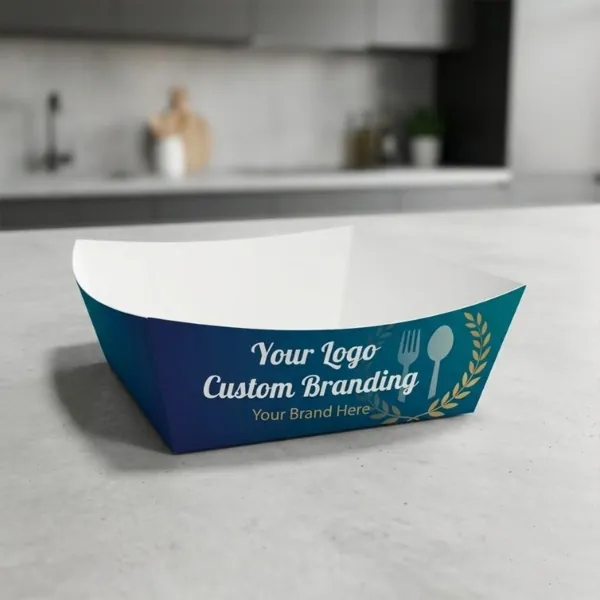
Custom Printed Food Tray
This is the general-purpose printed tray: any of our shapes, in your board, carrying your artwork.
View tray & get pricing →Custom food packaging · US · UK · Canada · Australia
Food tray category — 3 trays
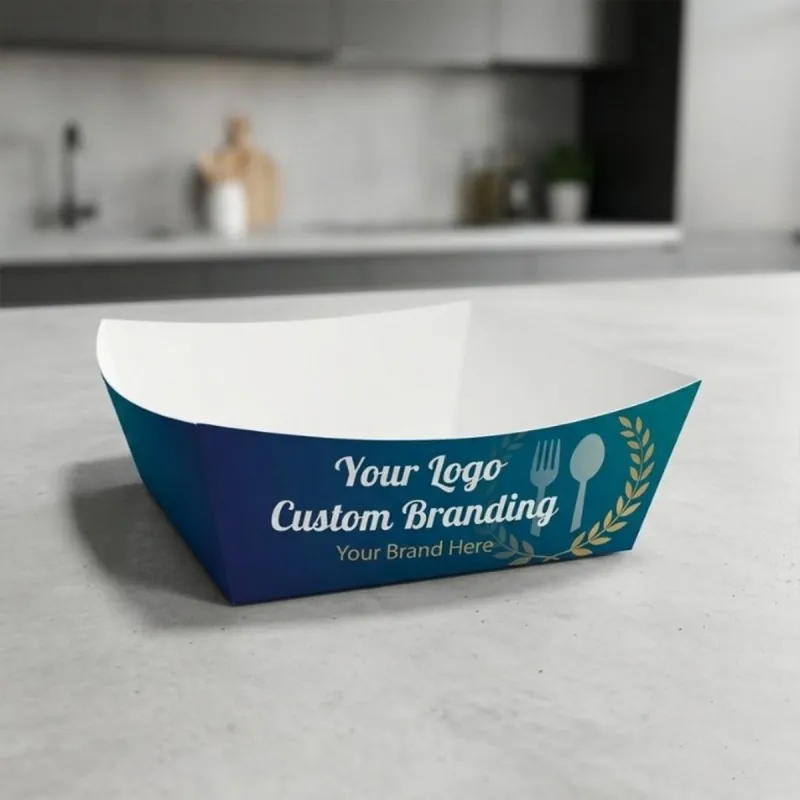
Almost every tray on this site can be printed. This section exists for the cases where printing is the whole point of the order: a branded tray that goes out in front of thousands of customers, where the print quality and the colour accuracy matter as much as the structure.
It also covers the practical side of getting there — what file we need, how many colours you should use, what a proof does and does not tell you, and where a printed tray earns its cost back.
Tell us which of the custom printed food trays you need, the size and roughly how many. We reply with a full quote, usually within one working day.
01 — The range
Any tray in the range, printed with your artwork — plus the three formats built specifically for branding. Every one is made to order, so treat the descriptions as starting points rather than fixed specifications.
This is the general-purpose printed tray: any of our shapes, in your board, carrying your artwork.
View tray & get pricing →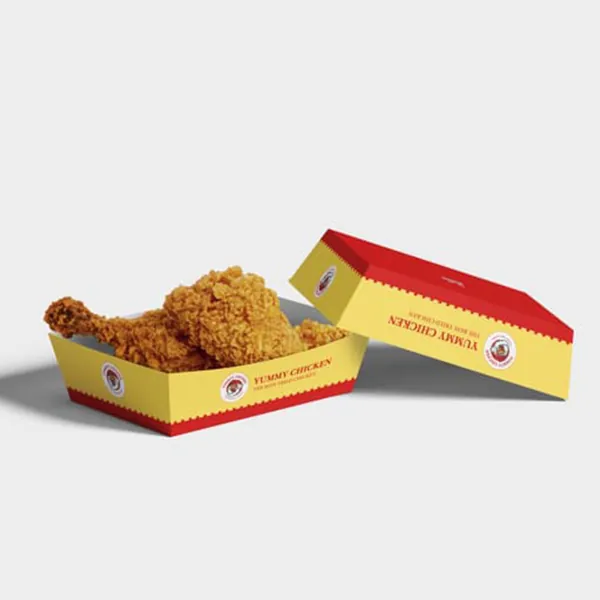
Catering is the one part of food service where packaging routinely converts new business.
View tray & get pricing →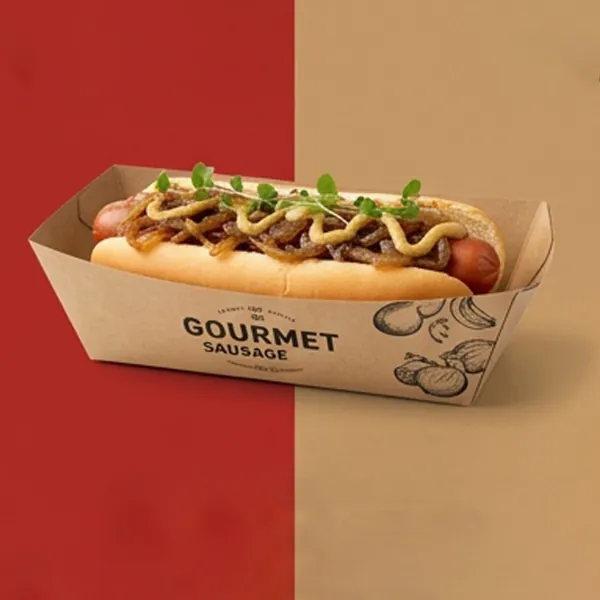
A hot dog tray is a small piece of packaging with an unusually large branding opportunity.
View tray & get pricing →02 — In detail
Colour count is the biggest single lever on the price of a printed tray, and most brands over-specify it.
A single ink on natural kraft or white board. This is where the majority of food-service branding sits, and it is not a compromise — a well-drawn one-colour mark on brown board looks more considered than a mediocre four-colour job. It is also the cheapest to set up, which makes short runs viable.
Enough for a logo plus a brand colour plus a highlight. Spot inks are mixed to your specified reference, so a brand colour lands accurately rather than being approximated from process inks. This is usually the sweet spot for a brand with a distinct palette.
Necessary when you have photography, gradients or a design with many colours. It needs a white or light board to sit on. Expect a warm shift and reduced contrast if you insist on running process on natural kraft.
A flat template showing the cut, the folds and the safe area for your chosen tray. Your designer works on top of it.
Vector where possible, fonts outlined, images at full size and adequate resolution, colours specified. The artwork guide covers the detail.
A digital proof confirms position, spelling and colour breakdown. Where colour accuracy is critical, ask for a physical proof on the actual board.
Approval is the point of no return — after it, changes mean new plates. Read the proof properly, and have someone else read it too.
Trays are die-cut, folded or glued as specified, packed flat and dispatched to your delivery country.
A note on colour expectations: board is not paper and it is not a screen. The same ink prints differently on bleached board, natural kraft and moulded fibre. If a specific brand colour is non-negotiable, tell us at quote stage — sometimes the honest answer is to change the board rather than chase the colour.
Any tray on the site can be printed. These three exist because printing is the whole point of the order rather than an addition to it.
03 — Questions
Vector artwork as a print-ready PDF, AI or EPS with fonts outlined is ideal. If you only have a raster file, we need it at final size and high resolution — an image pulled from a website will not print acceptably at tray scale. Send what you have and we will tell you honestly whether it will hold up.
On a coated white board we can get very close with a spot ink. On natural kraft, the brown substrate shifts every ink and an exact match is not physically possible — we will show you what the colour actually does on that board so you can decide. On moulded fibre, expect a looser match again.
Yes, for every custom tray, before artwork starts. The dieline shows the cut line, fold lines, glue areas and the safe zone. Designing without one is the most common cause of a logo landing across a crease.
A digital proof confirms layout, content and colour breakdown — it catches typos and misplaced elements. A physical proof, printed on the actual board, is the only reliable check of how the colour will really look. For a first branded run, a physical proof is worth the extra few days.
Yes, and it is under-used. Interior print is seen at the moment the food is finished, which is a good moment for a reorder prompt, a social handle or a short thank-you. It does add an ink pass, so it is priced as a second side.
Print is applied to the outer face of a food tray as standard, so it is not in contact with the food. Where interior print is requested, it is specified with food-contact-appropriate inks and we confirm that specification in writing.
Setup cost is fixed, so the answer is a function of how fast you use stock rather than a magic number. Ask for pricing at three quantities — say a small trial, a quarter of usage and a year of usage — and the unit cost curve will make the decision obvious.
Yes. The cutting die is reusable and stays with your account; only the plates change. That means a repeat order with new artwork costs less than the original, and seasonal designs are entirely practical.
We supply customers in the United States, United Kingdom, Canada and Australia and route production and freight to suit the destination. Tell us the delivery country at quote stage so the pricing reflects the real landed cost rather than a factory-gate figure.
Describe the food, the portion and the setting. We will tell you which tray in this range fits, and say so plainly if the answer is a format from somewhere else on the site.