Resource guide
Catering Tray Buying Guide
How to specify catering trays that survive the van and look right on the table: footprint families, lid overlap, stack strength, hand holes and where to put branding.
Updated August 28, 2026 · About 10 minutes to read
Catering packaging is judged at one moment — when the lid comes off in front of a client — but it has to survive five stages to get there: loading, stacking, driving, carrying and setting down. Most catering packaging complaints are really failures at one of those five, and almost all of them are specification problems rather than manufacturing ones.
The specification sequence
-
Start from covers per tray
How many people does one tray serve, and what food? That sets the internal footprint before anything else. Lay out an actual tray’s worth and measure it.
-
Take the depth from your tallest garnish
Not the average item. A lid resting on a filled roll flattens the presentation you built, on every tray, every time.
-
Choose a footprint family
Two or three sizes that stack together beat six that do not. This single decision saves more van space and loading time than anything else on this list.
-
Specify the lid for the journey
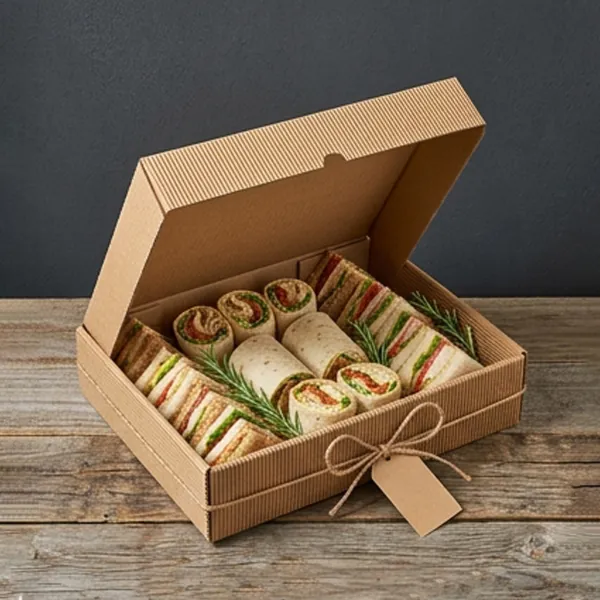
Overlap sized to the tray depth. A lid that is fine on a table can lift over a speed bump.
-
Then the stack
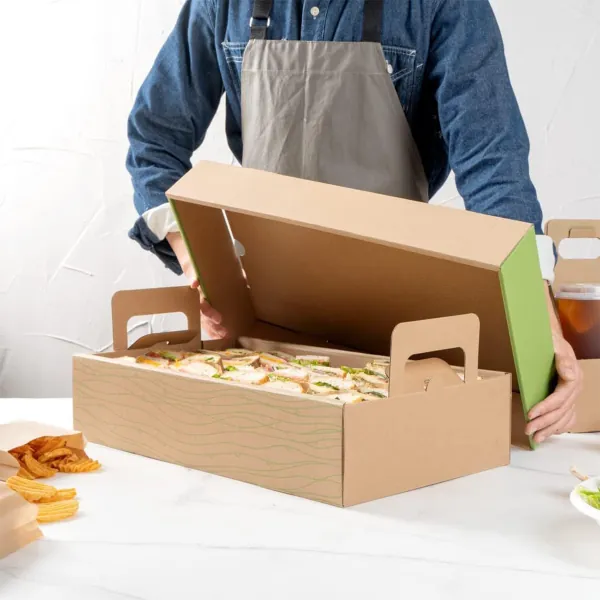
Tell your supplier how many loaded trays go on top of each other, and roughly what each weighs. Stack strength comes from corner posts, not the base.
-
Print last, on the dieline
Once the structure is fixed, you know where the folds and hand holes fall and the design can work around them.
Lid types compared
| Lid | Protects | Displays | Stacks | Contains liquid |
|---|---|---|---|---|
| Fitted board lid | Yes | No | Best | No |
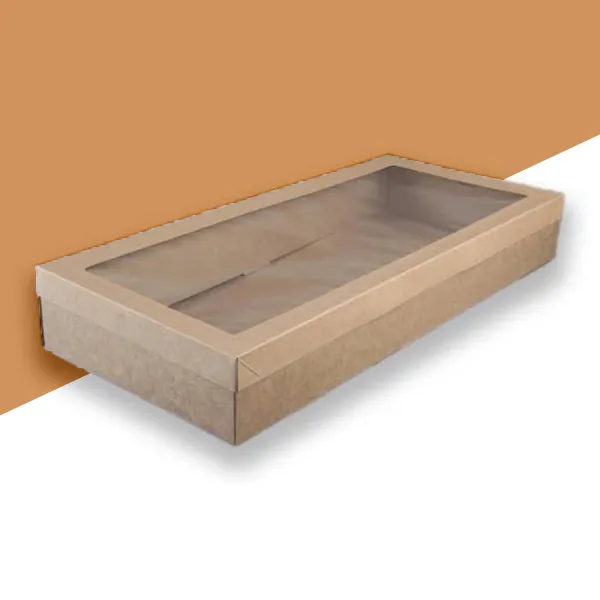
| Board lid with window | Yes | Partly | Good | No |
| Clear dome | Yes | Yes | Poorly | No |
| Film seal | Yes | Yes | Good | Yes |
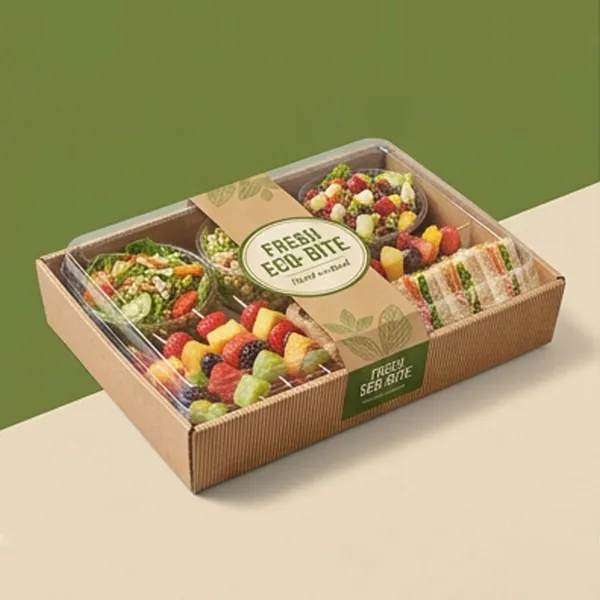
| Band only | Barely | Yes | No | No |
The five failures, and their causes
Lids popping off in the van
Insufficient overlap for the tray depth, or a base that flexes under load and changes shape. Both are specification issues.
Arrangements sliding
A base specified for cost rather than load, which bows when lifted from the middle. Heavier board or a corrugated construction fixes it.
Collapsed stacks
No corner posts. Stack strength does not come from the base or the lid; it comes from the corners.
Crushed presentation
Depth sized to average food rather than the tallest garnish.
Anonymous delivery
Plain packaging on every drop, quietly costing referrals nobody counts.
Why the branding case is stronger in catering than anywhere else
A catering tray is opened in front of a room of people who eat the food and often ask who supplied it. Nothing else in food service puts your product in front of that many potential customers at once, in a setting where they are predisposed to like it.
The practical implication is that breadth beats quality. One colour on kraft, printed on every tray you use, will do more for a catering business than a beautiful four-colour design used only on premium orders. Print everything, cheaply, rather than one thing expensively.
Hot food and board trays: board catering trays are designed for ambient and chilled service. Hot food produces steam inside a closed lid, which softens board and drips onto the presentation. For hot buffet work, use foil pans inside a corrugated carrier tray rather than filling a board tray directly.
Adjacent formats worth knowing
Grazing has borrowed most of its structural thinking from catering, and the charcuterie and grazing range applies the same lid, rigidity and stacking questions to a different product.
Outdoor and seasonal work changes the ordering pattern more than the specification, as covered in the festival and event guide.
Questions this guide gets asked
How many tray sizes should a caterer stock?
Two or three that stack together, rather than six that do not. A coherent footprint family saves more van space and loading time than any other decision, and it simplifies stock control considerably.
How do I stop lids coming off in transit?
Correct overlap for the tray depth, and a base rigid enough not to flex under load. Those two together account for almost every case. If you have had the problem, send the tray you use now and it is usually obvious which caused it.
How many loaded trays can be stacked?
That is a specification rather than a fixed number. Tell your supplier the stack height and the loaded weight. Stack strength comes from corner posts, and it should be built with margin rather than to a theoretical maximum.
Should I get window lids?
Where the client sees the tray before it is opened — buffet lines, retail chillers, drop-offs left on a table. Where your own staff open every tray, a window adds cost and a film component for no benefit.
Can catering trays carry hot food?
Board trays are made for ambient and chilled service. For hot buffet work, put foil pans inside a corrugated carrier tray — the pan handles the heat and the tray handles the carrying.
Is printed packaging worth it for a caterer?
It is one of the few places in food service where packaging demonstrably wins new business. Print everything at one colour rather than one item at four; breadth of exposure matters more than finish quality here.
What lead time should I allow for a first order?
Enough for a dieline round, artwork approval and production — and note that artwork approval on your side is usually the longest stage. Repeat orders are much faster because the die already exists.
Can I run different designs for different clients?
Yes, and it is cheaper than most caterers expect. The cutting die is shared, so an additional client-branded version carries plate cost only rather than a new tooling project.