Resource guide
Food Tray Materials Explained
A plain-language comparison of the materials food trays are made from — kraft board, corrugated, moulded fibre and rigid board — and what each is genuinely good at.
Updated August 28, 2026 · About 11 minutes to read
Four materials cover almost every food tray made: kraft folding board, corrugated board, moulded fibre and rigid board. They are not interchangeable, they suit genuinely different jobs, and choosing badly is the most expensive packaging mistake available, because it is only discoverable after tooling.
This guide describes what each one is, what it does well, and — more usefully — where it fails.
The four materials
Kraft folding board
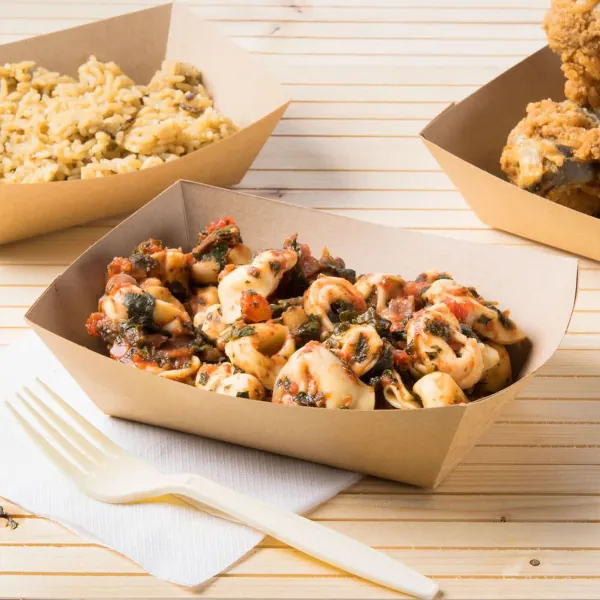
A single solid sheet of paperboard, folded and creased into shape. Natural (brown) or bleached (white). It is the cheapest, the lightest, the fastest to tool and the best at taking print of the four.
It is weakest under load and under moisture. A folding board tray holding several kilos will flex; one holding wet food for hours will soften. It is the right answer for lightweight, short-duration, high-volume applications — which is most counter service.
Corrugated board
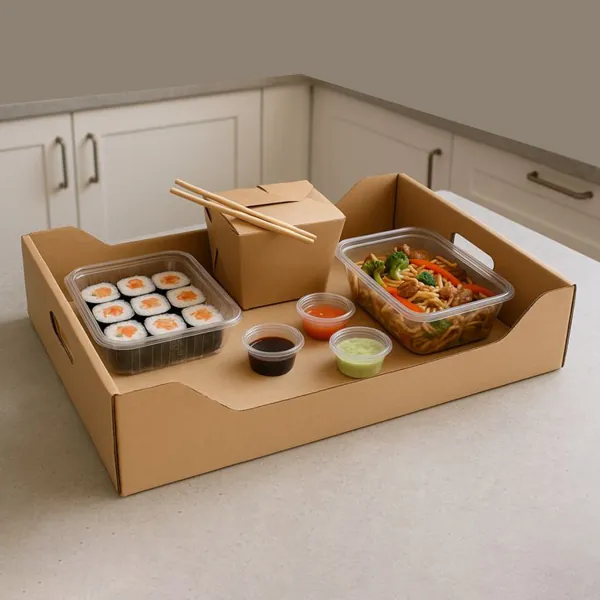
Two liners with a fluted layer between them. The flutes act as small arches, which makes corrugated dramatically stiffer than solid board of the same weight. Flute grades run from F (finest) through E and B to double-wall BC.
Its weakness is moisture, because liquid wicks along the flutes faster than it soaks through the liner. It also cannot fold as crisply as solid board, so very small or intricate shapes suit it less well.
Moulded fibre
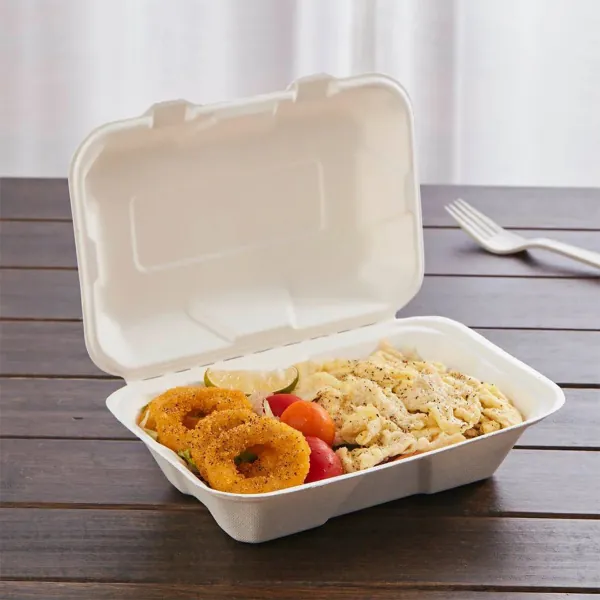
Wet pulp pressed against a heated tool. Produces deep, seamless, curved forms that folding cannot, tolerates hot food, and absorbs a small amount of liquid rather than pooling it.
It cannot carry fine print, cannot produce crisp square corners, needs longer tooling lead times and suits higher volumes. Feedstocks include bagasse and recovered pulp.
Rigid board
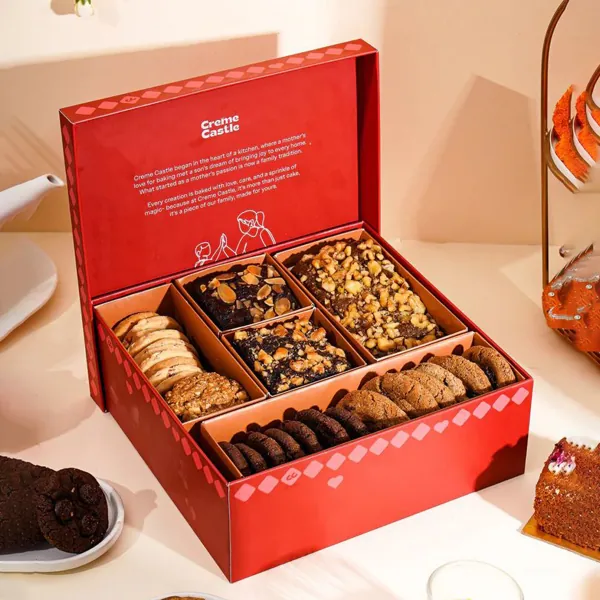
Thick greyboard wrapped in printed or plain paper, assembled rather than folded. The wrapped edge and the weight in the hand are what people are paying for.
It is the most expensive by a wide margin, ships assembled rather than flat, and has the longest lead times. It earns its cost only where the packaging itself carries commercial value — gifting, premium retail, hotel service.
Direct comparison
| Kraft board | Corrugated | Moulded fibre | Rigid | |
|---|---|---|---|---|
| Relative unit cost | Lowest | Low | Moderate | Highest |
| Load capacity | Low | High | Moderate | High |
| Hot food tolerance | Low | Moderate | High | Low |
| Wet food tolerance | Low | Low without a barrier | Moderate | Low |
| Print quality | Excellent | Good on E and F flute | Poor | Excellent |
| Formed depth | Limited | Limited | Excellent | Limited |
| Tooling lead time | Shortest | Short | Longest | Long |
| Ships flat | Yes | Yes | Nests | No |
Choosing by what the tray has to survive
Hot food for more than twenty minutes
Moulded fibre. Board of any kind softens under prolonged steam, and a barrier treatment delays rather than prevents it.
Several kilos, lifted from the middle
Corrugated, in B-flute or heavier. Folding board of any caliper will flex under that load.
A full-colour brand design
Kraft folding board, or E-flute corrugated. Fibre cannot carry it and rigid is overkill unless the pack is a gift.
Deep formed wells
Moulded fibre. A single folded blank cannot produce a curved, seamless well of any real depth.
Being kept by the recipient
Rigid. It is the only one of the four that reads as an object rather than as packaging.
Barriers and treatments
Any of these materials can be given a grease-resistant or moisture-resistant food-contact face, and for a great many applications that treatment matters more than the base material. A treated kraft tray outperforms an untreated corrugated one under fried food, despite being the weaker material overall.
Treatments do have a consequence: they change what a recycling facility will accept, and the rules differ by locality and by country. That is why we state the exact construction of what you order in writing, rather than making a general recyclability claim.
On environmental claims: "paper", "fibre" and "board" are descriptions of a material. "Recyclable", "compostable" and "biodegradable" are claims about what happens at end of life, and they depend on the treatment applied, the local infrastructure and, in some markets, a specific certification. We will tell you what the material is; what you may claim about it is a question for the rules where you sell.
Seeing the trade-off in practice
The clearest illustration of the material trade-off is the compartment tray range, where the same layout in folded board, moulded fibre and rigid behaves quite differently under a hot meal.
Retail packaging is where material choice becomes visible to the customer rather than only to the kitchen; the deli and supermarket guide sets out the constraints a listing imposes.
Questions this guide gets asked
Which material is strongest?
Corrugated, for load-bearing per unit weight, because the fluted layer resists bending far better than a solid sheet. Rigid board is thicker and heavier but is not usually specified for load — it is specified for how it feels.
Which material handles hot food best?
Moulded fibre, by a clear margin. Board of any kind softens under prolonged steam, and a barrier treatment slows that rather than preventing it.
Can I print full colour on all of these?
On kraft board and E-flute corrugated, yes. On moulded fibre, no — the surface is textured and absorbent, so use a band, sleeve or applied label. On rigid, yes, and with finishes such as foiling that the others cannot take.
Is corrugated waterproof?
No. Liquid wicks along the flutes faster than it soaks through the liner, which is why corrugated needs a barrier for wet food. It is a genuine limitation and any supplier who says otherwise is overselling.
What is bagasse?
The fibrous residue left after sugarcane is pressed for juice, used as a feedstock for moulded fibre packaging. Other fibre trays are made from recovered paper pulp. Both are moulded fibre; the feedstock differs.
Are all of these recyclable?
Uncoated paper-based materials are widely accepted in paper streams where they are not saturated with food. Coatings, laminates and barriers change that, and local rules differ substantially. We state the exact construction so you can check it where the tray is used.
Which material has the shortest lead time?
Kraft folding board, because a cutting die is quick to make. Corrugated is close behind. Moulded fibre is the longest because it needs a formed metal mould, and rigid is long because of the assembly steps.