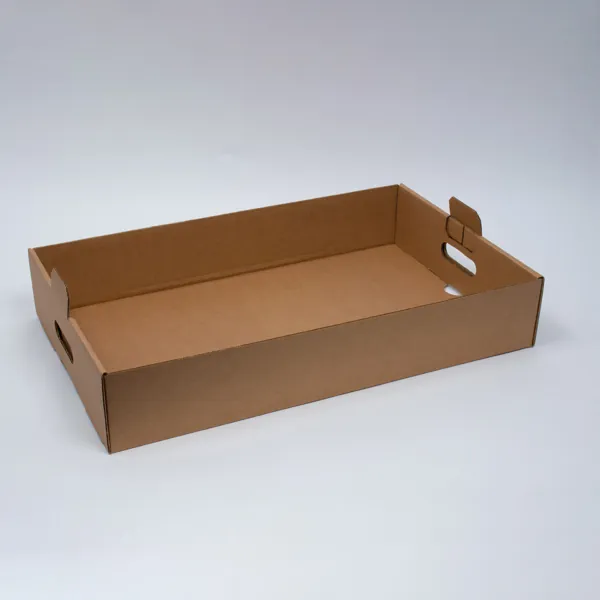
Corrugated Food Trays
Corrugated Food Trays
- E, B or F flute
- Carries weight without flexing
- Hand holes available
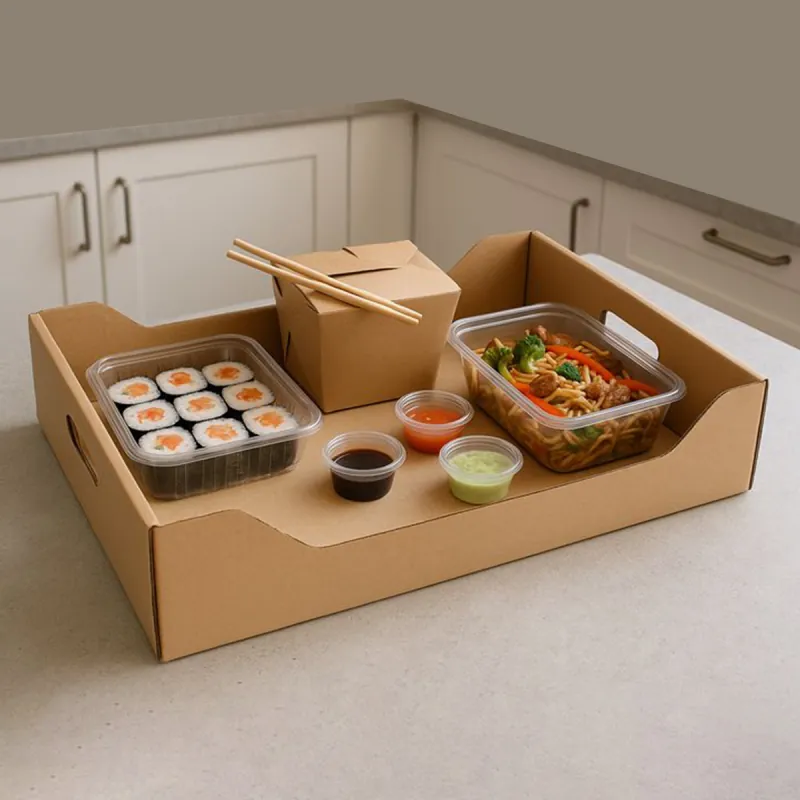
Corrugated trays exist for one reason: a loaded tray that has to be picked up from the middle without folding in half. The fluted layer sandwiched between two liners acts as a row of small arches, and it is why a corrugated tray only fractionally thicker than a folding carton will hold several kilos without complaint.
This is the general-purpose version of that — an open tray in the size, depth and flute you specify, with or without hand holes, printed or plain. It is the format most delis, caterers and food halls end up standardising on once they outgrow a lightweight kraft tray.
- Flute grade specified against your actual load, not a nominal size
- Optional die-cut hand holes, reinforced so they do not tear
- Prints well on E-flute — close to folding carton quality
- Ships flat, which keeps freight and stockroom space sensible
Pricing starts from $0.30 per tray
The unit price depends on the size, board, printing, finishing, quantity and delivery country, so every quote is worked out for your specification rather than taken from a list.
Get pricing for corrugated food trays
Send the size and the run length. We reply with pricing, material options and a production date — usually within one working day.
01 — Specification
Specification at a glance
Every element below is set when we quote. Nothing here is a fixed catalogue entry — if a line does not match what you need, say so and we will change it.
- Flute options
- F, E, B or BC double wall depending on load and print requirements
- Footprint
- Any — cut to your drawing or an existing sample
- Wall height
- From about 25 mm shallow up to deep bulk trays
- Corners
- Locking tabs for flat shipping, or glued for maximum strength
- Hand holes
- Optional, reinforced, positioned to suit your print
- Food contact
- Plain liner, or grease and moisture resistant treatment
- 1–4 colours; best results on E and F flute
02 — Build the spec
Design this tray in five steps
The same five questions we would ask on a phone call, with the corrugated food tray already selected. You get a properly detailed brief at the end, which is what makes a first quote accurate rather than approximate.
Prefer the full builder with a live sketch? Open the tray designer.
03 — In detail
How the flute grade changes the tray
Flute grade is the specification that most affects how a corrugated tray behaves, and it is the one people most often leave to chance.
F-flute — thin and crisp
The finest of the common grades, at well under a millimetre. Folds cleanly, prints almost as well as a folding carton, and suits small trays where the load is light but the appearance matters. It is the wrong choice the moment weight enters the picture.
E-flute — the default
Around a millimetre and a half. Strong enough for most food-service loads, good enough for four-colour print, and thin enough that flat-packed trays do not eat your stockroom. If you do not have a reason to specify otherwise, this is the grade you want.
B-flute — for weight
About three millimetres, and noticeably stiffer. This is what a loaded catering tray or a bread tray needs. Large flat areas of solid ink can show a faint ridging over the flutes, which is invisible in service and occasionally visible in a studio photograph.
BC double wall — bulk only
Two flutes laminated together, around six millimetres. Reserved for heavy bulk trays and shipper-style bases. Nobody chooses it for appearance; it is a structural decision.
Matching the tray to the job
| If the tray has to… | Specify | Why |
|---|---|---|
| Sit on a counter holding a light portion | F or E flute, shallow wall | Print quality matters more than stiffness |
| Be carried loaded across a room | E flute with hand holes | The holes need reinforced walls to survive |
| Hold several kilos of deli food | B flute, deeper wall | Resists sagging when lifted from the middle |
| Be stacked three or four high when full | B flute with corner posts | Stack strength comes from the corners, not the base |
| Hold wet or oily food for hours | Any flute plus a barrier liner | Fluted board wicks moisture along the flutes |
Structural options worth asking about
- Reinforced double-thickness walls where hand holes are cut, so the tray does not tear under load.
- Corner posts, which take almost all the compression strength in a stacked tray.
- A scalloped or curved front wall, which makes food visible on a counter and looks less industrial.
- A tuck-in front flap so the tray can be closed for short transport without a separate lid.
- Glued rather than tab-locked corners, if your staff have no time to assemble trays.
The moisture question, answered honestly
Corrugated board wicks liquid along its flutes faster than it absorbs it through the surface. That is a genuine limitation, and any supplier who tells you a plain corrugated tray will hold wet food indefinitely is overselling.
The practical answers are a barrier treatment on the food-contact liner, a separate greaseproof insert, or — for genuinely wet food — a different material entirely. Tell us the food, the temperature and how long it sits, and we will specify against that or tell you to look at a moulded fibre tray instead.
04 — Nearby
Trays that work alongside this one
Chosen because operators who buy the corrugated food tray usually need one of these in the same order, not because they happen to sit in the same category.

Corrugated Deli Tray
A deli tray takes more punishment than most food packaging.
View tray & get pricing →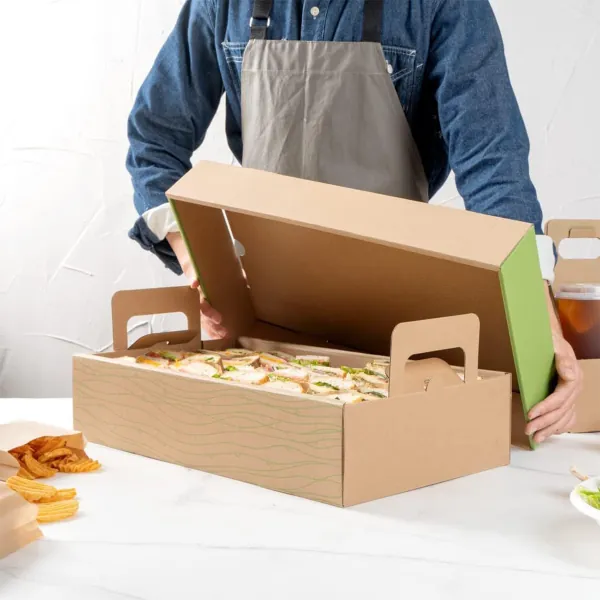
Corrugated Catering Tray
This is the working catering tray: fluted, deep, strong enough to hold several full foil pans, and usually built with a raised header board that turns t…
View tray & get pricing →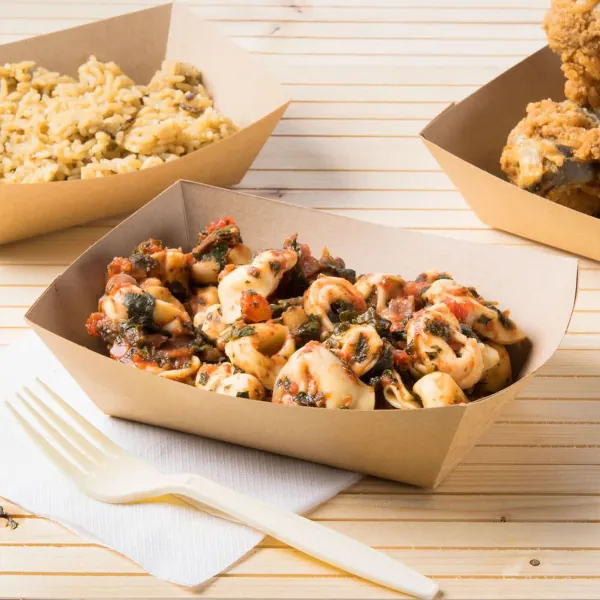
Kraft Paper Food Tray
The kraft paper food tray is the one shape that every counter ends up buying.
View tray & get pricing →05 — Questions
Corrugated Food Tray questions
What flute grade should I order?
E-flute unless you have a reason to change. Move to B-flute if the tray holds several kilos or is stacked when full, and to F-flute if it is small and print quality is the priority. Tell us the heaviest load and whether trays are stacked, and we will specify it rather than leaving it to you.
Can corrugated trays hold hot food?
They tolerate warm food better than lightweight folding board, but steam is still the enemy — it softens the liner from the inside. For genuinely hot service, ask for a moisture-resistant liner and expect to design in some venting.
Do the trays come flat or assembled?
Flat as standard. An erected corrugated tray is mostly air, so shipping flat keeps freight and storage sensible. Glued styles arrive formed on one axis and are opened by hand in a second.
Will printing look good on corrugated?
On E and F flute, yes — close to folding carton. On B-flute, large solid areas can show faint ridging where ink sits over the flutes. Designing with line art, bold type and generous white space gives a better result on fluted board than a full-bleed photograph does.
Can you cut hand holes into the tray?
Yes, and they change a tray from something you carry with two hands into something one person can move across a car park. The walls around the hole need reinforcing, which takes space out of your print area, so decide on hand holes before finalising artwork.
How strong does the tray need to be for stacking?
Stack strength comes from the corners rather than the base. Tell us how many loaded trays sit on top of each other and the weight of each, and we will build in enough margin that the bottom tray is not carrying its limit.
Can I get a window cut into the tray?
Yes. A window removes structural material, so we compensate with board grade or a wider frame around the aperture. Send the artwork and we will show you where a window can safely sit on your dieline.
Are corrugated food trays recyclable?
Uncoated corrugated is among the most widely recycled packaging materials, provided it is not saturated with food or grease. A moisture barrier can change what a given facility accepts. We put the exact construction in writing so you can check it locally rather than relying on a general claim.
Will the brown colour be identical every order?
Close, but not identical. Kraft liner is a natural material and its shade drifts slightly between mill batches. Printed areas stay consistent because they are matched to your proof; exposed board can vary a shade. If exact background colour matters, specify a printed flood or a white liner.
What is a realistic first order quantity?
Corrugated tooling is inexpensive compared with rigid or moulded formats, so first runs can be modest. Ask for pricing at two or three quantities and the unit cost curve will make the sensible commitment obvious.
Before you order, read
- Kraft vs Corrugated Food Trays — Solid board or fluted board — a direct comparison for buyers.
- Food Tray Materials Explained — Kraft, corrugated, moulded fibre and rigid board compared honestly.
Who buys this tray
Ready to price the corrugated food tray?
Send the dimensions, the quantity and the country you want it delivered to. We come back with a full quote — material, print, finishing, freight and a production date.