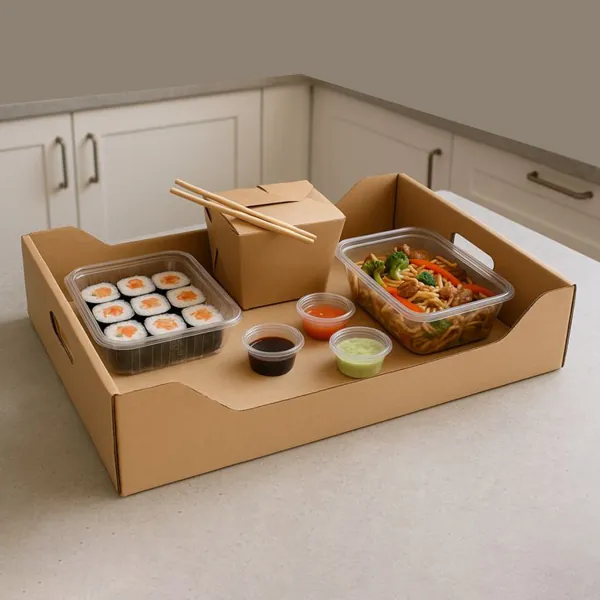
Corrugated Food Tray
Corrugated trays exist for one reason: a loaded tray that has to be picked up from the middle without folding in half.
View tray & get pricing →Custom food packaging · US · UK · Canada · Australia
Corrugated Food Trays
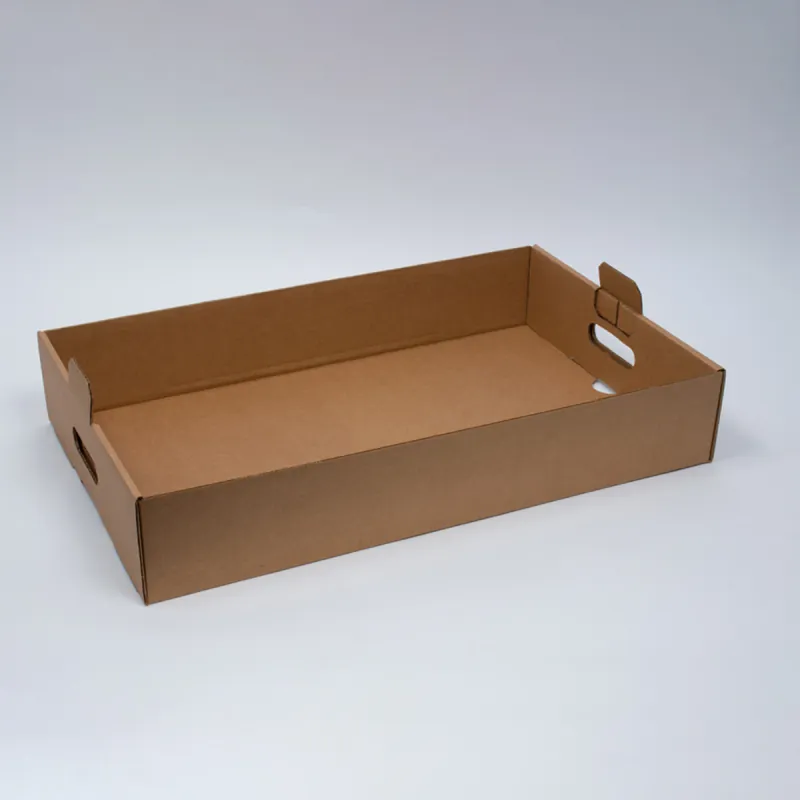
An appetiser tray is deliberately shallow. The food is meant to be seen and picked at rather than contained, so the walls come down low enough that a shared plate of wings, wedges or croquettes reads as generous rather than buried.
That shallowness is also what makes the format harder to get right than it looks — low walls in fluted board need the crease and the corner lock to be spot on, or the tray splays outward the moment it is loaded.
Pricing starts from $0.30 per tray
The unit price depends on the size, board, printing, finishing, quantity and delivery country, so every quote is worked out for your specification rather than taken from a list.
Send the size and the run length. We reply with pricing, material options and a production date — usually within one working day.
01 — Specification
Every element below is set when we quote. Nothing here is a fixed catalogue entry — if a line does not match what you need, say so and we will change it.
02 — Build the spec
The same five questions we would ask on a phone call, with the corrugated appetizer tray already selected. You get a properly detailed brief at the end, which is what makes a first quote accurate rather than approximate.
Prefer the full builder with a live sketch? Open the tray designer.
03 — In detail
A deep tray hides its contents. That is fine for a takeaway portion the customer has already paid for, and actively bad for a sharing plate landing on a table where other people can see it. The appetiser tray gives up containment in exchange for visibility, and it is the right trade whenever the food is being shared or displayed.
The practical limit is around two inches of wall. Below that, loose items roll out when the tray is moved; above it, the food disappears into a box. Most operators settle somewhere between one and a half and two inches once they have seen a sample loaded with their own food.
Wings, wedges, croquettes, sliders. The tray goes straight onto the table and the low walls make a modest portion look generous.
A scalloped front wall turns the tray into a display unit, which is why bakery and deli counters use this shape for hot snacks.
Carried by staff and offered to guests, which means the tray needs to look composed from above and be rigid enough to hold flat in one hand.
A wide, shallow base that a smaller container, a drink or a dip pot sits inside — effectively a printed platform for a combined offer.
Five things, and the quote comes back right first time:
04 — Nearby
Chosen because operators who buy the corrugated appetizer tray usually need one of these in the same order, not because they happen to sit in the same category.
Corrugated trays exist for one reason: a loaded tray that has to be picked up from the middle without folding in half.
View tray & get pricing →
The chip and dip tray is the simplest divided format there is: a main bay and one or two smaller wells.
View tray & get pricing →
A deli tray takes more punishment than most food packaging.
View tray & get pricing →
A party tray is a divided platter under a clear lid.
View tray & get pricing →05 — Questions
Around an inch is workable for flat items such as sliders or bruschetta. Below that the tray stops containing anything and becomes a board. For loose fried items, an inch and a half to two inches is the practical range.
If the flute grade and the crease are right, yes. Splaying walls on a shallow tray almost always mean the board was too light for the load or the corner lock was badly designed. Send us the loaded weight and we will specify against it.
It lowers the front wall in the middle so the food is visible from a customer’s eye level while the sides stay tall enough to hold the tray together. It is a display feature, and it works well on a hot counter.
Yes — either loose, or in a die-cut well sized to your pot. If you want a well, send us the pot so we can cut to its actual rim and base diameters.
For anything fried, yes. Appetiser food is disproportionately fried, and the shallow format means the food is spread over more board rather than sitting in a deep pile, which increases the contact area.
Not reliably — low walls mean a stacked tray sits on the food below. If trays need to stack, use a deeper format or add a lid. The corrugated party tray with lid is the usual answer.
On a shallow tray the front wall is typically an inch to two inches tall and the full width of the tray. That is a good strip for a wordmark, and it faces the customer, which is the best position on the tray.
Very well. Cold sharing plates, charcuterie selections and canapés all suit the shallow open format. For chilled retail display where condensation is a factor, ask for a moisture-resistant liner.
Send the dimensions, the quantity and the country you want it delivered to. We come back with a full quote — material, print, finishing, freight and a production date.