Resource guide
Food Tray Size Guide
How food tray sizes are described, what 1lb to 5lb actually means, how to choose a depth, and how to work out the footprint you need from the food you serve.
Updated August 28, 2026 · About 9 minutes to read
Food tray sizing is confusing because the industry uses at least three incompatible conventions at once. Some sizes are described by portion weight, some by nominal dimensions, some by an internal volume, and almost none of them are standardised between suppliers. A "2lb tray" from one manufacturer will not be the same as a "2lb tray" from another.
This guide explains what each convention means, and then gives you a method for working out the size you actually need from your own food rather than from a chart.
The three sizing conventions
Portion weight — the "1lb, 2lb, 5lb" system
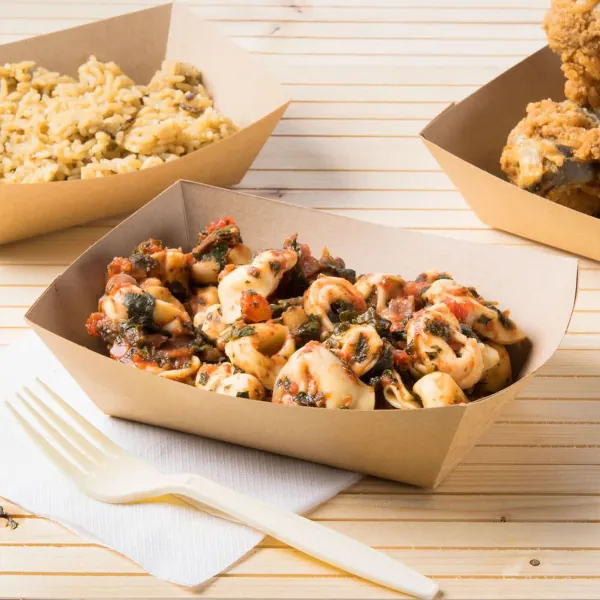
The most common in North American food service. The number refers approximately to the weight of food the tray is intended to hold, not to any dimension. A 1lb tray is a single side portion; a 5lb tray is a table basket.
It is useful shorthand between people who already know the range, and useless for specifying a tray precisely, because two suppliers can produce very different shapes that both hold a pound of fries.
Nominal dimensions
Length by width by depth, usually in inches in the US and millimetres elsewhere. More precise, but you have to know whether the figures are internal or external. On a fluted tray the difference is a few millimetres per wall; on a rigid tray with a wrapped edge it can be more.
Always ask, and always specify internal dimensions when you brief a supplier — internal is what the food sits in.
Volume
Used for compartment trays, scoops and anything holding loose food. Expressed in millilitres or fluid ounces. It is the most useful convention for anything where the food is poured or scooped rather than laid out, because it captures depth and area together.
What the common portion sizes mean in practice
Approximate guidance for the North American portion-weight convention. Treat as a starting point, not a specification.
| Nominal size | Serves | Typical menu items |
|---|---|---|
| 1lb | One side portion | Regular fries, onion rings, coleslaw, samples |
| 2lb | One generous serving | Loaded fries, six to eight wings, a taco portion |
| 3lb | Two people sharing | Shared nachos, mixed fried platter, small basket meal |
| 5lb | A table or group | Table baskets, seafood boils, event sharing portions |
A method for finding your own size
This takes about fifteen minutes and produces a better answer than any chart, because it uses your actual food.
-
Plate the portion as you serve it
On a flat surface, arranged the way the customer will see it — not piled up. Piling makes food take less area and more depth, which produces the wrong tray.
-
Measure the rectangle it occupies
Length and width of the space the food covers, in whatever unit you work in. Add about an inch to each dimension for clearance and a margin for staff to handle the tray.
-
Measure the height of the tallest item
Including garnish, sauce and anything that stands up. This sets the wall height, and it is the measurement people most often take from an average item rather than the tallest.
-
Tilt test it
Load a candidate tray, tilt it to about thirty degrees, and see what escapes. Anything that comes out will come out in a delivery bag.
-
Check the constraints
Does it fit the delivery bag, the counter fixture, the carrier, the chiller shelf? Any of those can override the size the food suggests.
Depth: a short guide
Wall height is decided by what the food does, not by how much of it there is.
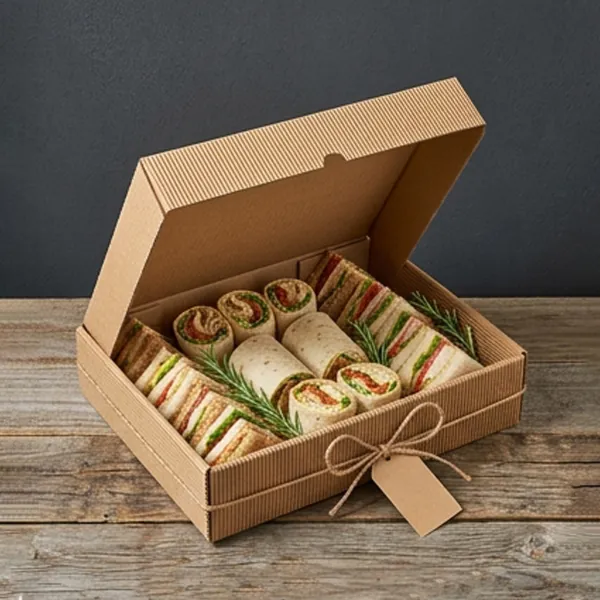
- Under 25 mm — flat display items: sandwiches laid flat, pastries, canapés, sushi.
- 25–40 mm — items that must not roll: hot dogs, wraps, single portions of loose food.
- 40–60 mm — mixed portions and anything with a topping that must stay on: loaded fries, nachos, deli plates.
- 60–90 mm — full meals, bulk portions, anything transported: fish suppers, catering trays, boils.
- Above 90 mm — bulk and transport only. Food disappears into a tray this deep and looks less generous.
The most common sizing error is choosing depth from the average item rather than the tallest one. A lid that presses on your tallest garnish ruins the presentation on every single tray, and it cannot be fixed after the cutting die is made.
Sizing to a fixture rather than to the food
Sometimes the food does not get to decide. A retail shelf, a servery rail, a delivery bag or a display cabinet is fixed, and the tray has to fit it. In those cases, work from the fixture inward: measure the usable space, decide how many trays you want across it, divide, and check whether the resulting footprint holds your portion.
If it does not, that is a genuine conflict and it is worth resolving deliberately — either by changing the portion, changing the number of facings, or accepting a wasted strip on the shelf. Discovering it after tooling is much more expensive than discovering it now.
Where the sizing decisions land
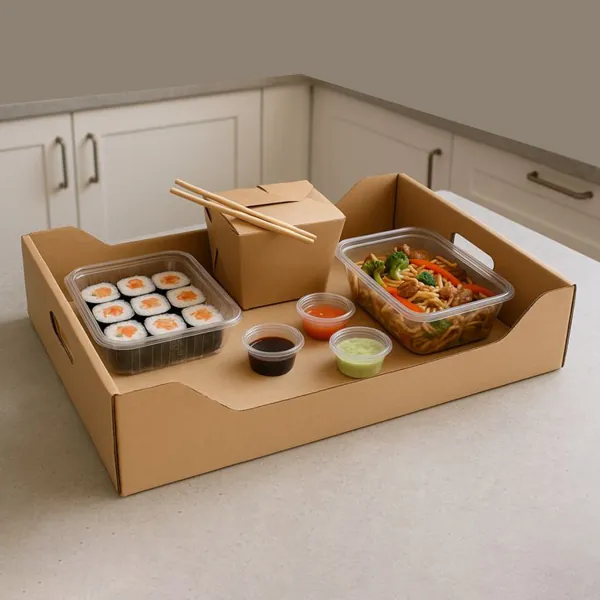
Sizing matters most where the tray is a presentation surface, which is why the serving trays and platters range is specified from a laid-out arrangement rather than a portion weight.
It matters commercially most in drop-off work, where a tray sized to the wrong cover count wastes food or looks mean. The guide for catering companies covers how that plays out across a working week.
Questions this guide gets asked
Is a 2lb tray the same from every supplier?
No. The portion-weight convention is approximate and unstandardised, so two suppliers can produce quite different shapes that both notionally hold two pounds. Always specify internal dimensions rather than a nominal size.
Should I give internal or external dimensions?
Internal, always, because that is where the food goes. On a fluted tray the difference is a few millimetres per wall, which sounds trivial until a portion no longer fits.
How much clearance should I add around the food?
About an inch on each dimension for a service tray — enough for the food to sit without touching the walls and for staff to handle the tray without touching the food. Presentation platters usually want more.
How do I choose a depth?
From the tallest item you serve in that tray, not the average. Then tilt-test a loaded sample: anything that escapes at thirty degrees will escape in a delivery bag.
Can you match a tray I already use?
Yes — sending a physical sample is the fastest and most accurate route. We reverse-engineer the flat blank from the folded tray, so your racks, carriers and portioning all stay unchanged.
What if the food and the fixture disagree?
Resolve it deliberately rather than compromising by accident. Either adjust the portion, accept fewer facings, or accept a wasted strip. It is a business decision, and it is much cheaper to make now than after tooling.