
Kraft Charcuterie Board
Grazing is a business where the packaging is most of what gets photographed and much of what justifies the price.
View tray & get pricing →Custom food packaging · US · UK · Canada · Australia
Food tray category — 4 trays

Grazing boxes are a business where the packaging is not incidental — it is most of what the customer photographs. A board that flexes when it is picked up, or shows a printed logo through a gap in the cheese, undoes an hour of arranging.
The formats here are built for that. Rigid boards that stay flat under two kilos of charcuterie, domed trays that let the arrangement be seen without being touched, and small individual boards for grazing-for-one and corporate boxes.
Tell us which of the charcuterie & grazing boards you need, the size and roughly how many. We reply with a full quote, usually within one working day.
01 — The range
Boards and domed trays built for grazing businesses, where presentation is the product. Every one is made to order, so treat the descriptions as starting points rather than fixed specifications.
Grazing is a business where the packaging is most of what gets photographed and much of what justifies the price.
View tray & get pricing →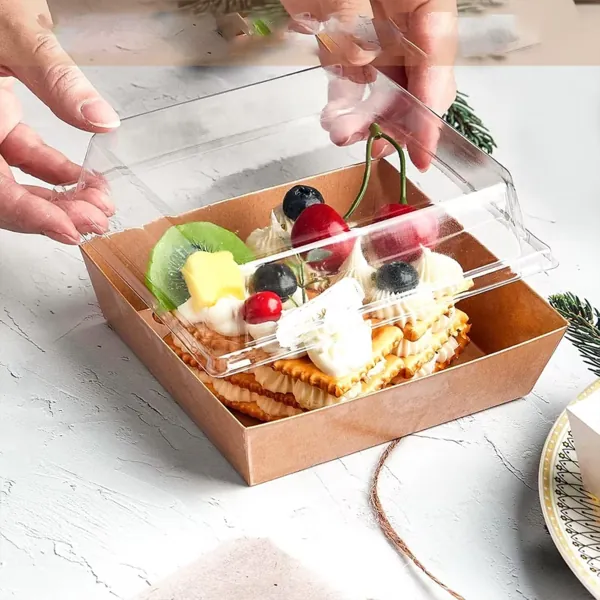
Individual grazing boxes have grown from a novelty into a substantial category, driven by corporate catering that needs single-serve portions and by ret…
View tray & get pricing →
A dome turns a grazing board into a product you can put on a shelf.
View tray & get pricing →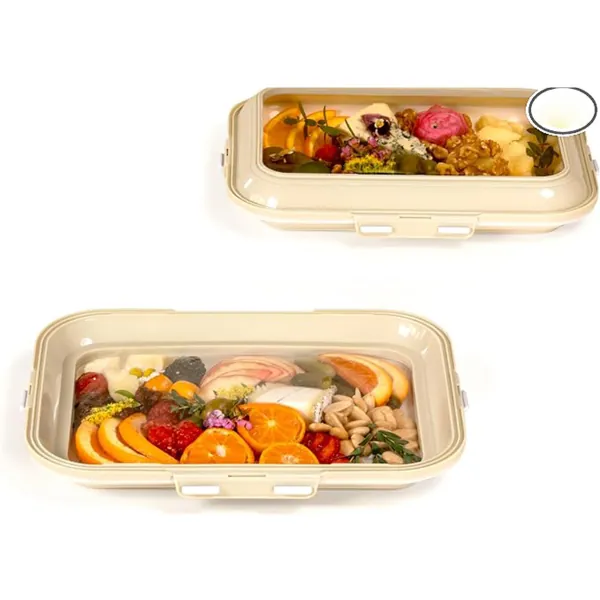
A crudité platter has a problem that other platters do not: the food is meant to stand up.
View tray & get pricing →02 — In detail
Most food packaging is designed around a portion of a known shape. Grazing is the opposite: the arrangement changes every time, the load is heavy relative to the footprint, and the customer sees the packaging for far longer than they would a takeaway tray, because a grazing board sits on a table for the length of an event.
That pushes the specification in three directions. The base needs to be genuinely rigid, not merely thick. The surface needs to be a colour that flatters food rather than competing with it — which in practice means matt black, matt white or natural kraft. And the branding needs to be somewhere that will not be covered by the food, which usually means the rim, the underside or a separate belly band.
For events and large orders. Rigid enough to be carried loaded by one person at the edges. See the kraft charcuterie board.
A clear dome over an arranged board — the format that made grazing boxes a retail product. The domed grazing board is the standard.
For corporate boxes, hotel turndown and grazing-for-two. Small footprints where a heavier caliper is cheap and makes an outsized difference.
Domed trays with a recessed centre for dip. A crudité tray with dome keeps sticks upright rather than sliding flat.
Rigidity and finish decide almost everything here, because the board is in every photograph a customer takes.
03 — Questions
Rigid enough that it does not visibly bow when lifted from the edges with a full load. That is a function of caliper, board grade and the span between the points where it is held. Tell us the loaded weight and the board size and we will specify to it rather than guessing at a caliper.
Dark boards flatter charcuterie, cheese and pale foods; kraft suits rustic, bread-led arrangements; white works when the food itself is colourful. If your business posts to social media, look at your own photographs and pick the background that appears most often behind your best-performing images.
Yes, and many grazing businesses buy them on different cycles because dome breakage rates and board usage differ. The important thing is that the dome and the board rim are dimensionally matched, so order the first set together.
The boards are made for direct food contact where specified as such. Because grazing arrangements often include fatty and moist items sitting for hours, we will confirm the exact food-contact specification of the board you order in writing so you can hold that on file.
Three places work: the rim, the underside and a paper belly band around the whole assembled box. Bands are the cheapest to change and let you run seasonal designs without a new board order.
As a starting point, most grazing businesses serving four use something in the region of a 12 by 8 inch footprint, but it varies enormously with how generous the arrangement is. Photograph one of your standard builds on a ruler-marked surface and send it — we will size from your actual product.
Not densely, and that is the format’s main cost. A domed board takes its full height in a van. Some businesses use a flat lid for delivery and a dome for collection or display. It is worth costing both before you commit to a single format.
Yes. Grazing is a business where the packaging affects the price you can charge, so testing two or three board styles before committing makes sense. Ask us for a short trial quantity alongside your production pricing.
Describe the food, the portion and the setting. We will tell you which tray in this range fits, and say so plainly if the answer is a format from somewhere else on the site.