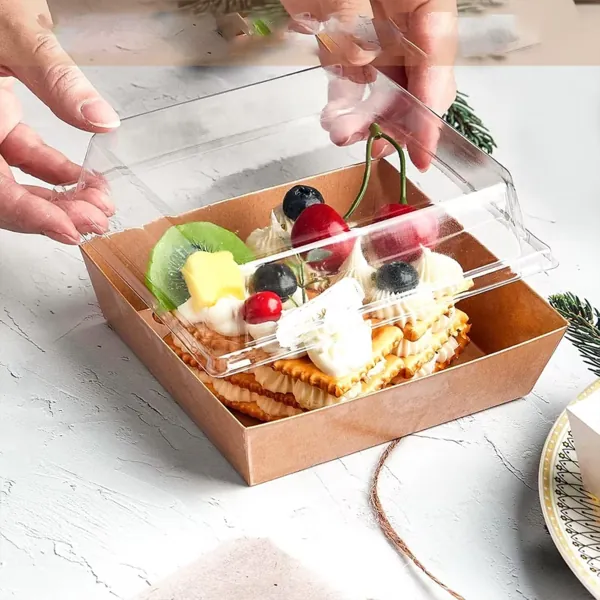
Mini Charcuterie Tray
Individual grazing boxes have grown from a novelty into a substantial category, driven by corporate catering that needs single-serve portions and by ret…
View tray & get pricing →Custom food packaging · US · UK · Canada · Australia
Charcuterie & Grazing Boards

Grazing is a business where the packaging is most of what gets photographed and much of what justifies the price. A board that flexes when it is lifted, or shows through gaps in the arrangement, undoes an hour of careful work.
These boards are built for that specific job: rigid at full load, matt so they do not reflect a ring light, and with the branding placed where food will not cover it.
Pricing starts from $0.30 per tray
The unit price depends on the size, board, printing, finishing, quantity and delivery country, so every quote is worked out for your specification rather than taken from a list.
Send the size and the run length. We reply with pricing, material options and a production date — usually within one working day.
01 — Specification
Every element below is set when we quote. Nothing here is a fixed catalogue entry — if a line does not match what you need, say so and we will change it.
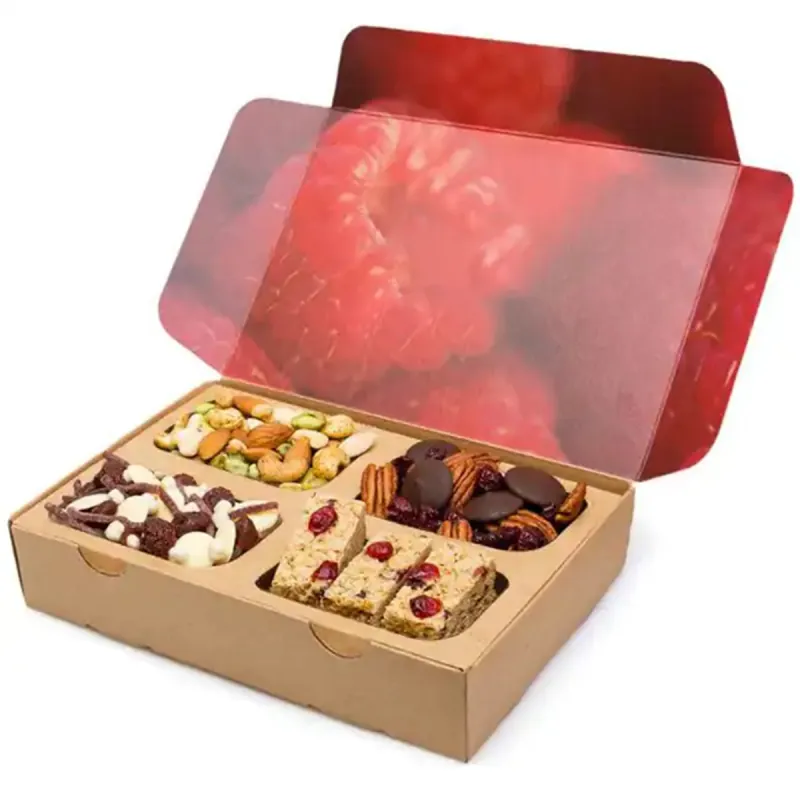
02 — Build the spec
The same five questions we would ask on a phone call, with the kraft charcuterie board already selected. You get a properly detailed brief at the end, which is what makes a first quote accurate rather than approximate.
Prefer the full builder with a live sketch? Open the tray designer.
03 — In detail
The most photogenic and the cheapest. Suits collection and on-site service where the board goes straight onto a table. It offers no protection in transit, so it is the wrong choice for delivery.
A board with a fitted lid, so the arrangement survives a car journey. This is the workhorse format for grazing businesses that deliver, and the lid becomes the main branding surface.
Divided sections that hold each element in place. It makes the arrangement faster to build and far more consistent between staff, at the cost of some of the free-form look that grazing customers respond to.
A loaded grazing board is heavy relative to its area, and it is picked up from the edges. Four things determine whether it holds flat.
Tell us the board size and the heaviest arrangement you build, and we will specify to it rather than guess at a caliper.
The centre of a grazing board is completely covered within a minute of being built, which means any branding printed there is wasted. The three places that stay visible are the rim, the underside and a band around the outside of the assembled box.
Bands are the most flexible. They cost little, they can be reprinted for a season or a collaboration without touching your board stock, and they photograph well because they frame the arrangement rather than competing with it.
Photograph your own product before you order. Grazing businesses sell through images, and the right board colour is the one that already sits behind your best-performing photographs. Build a typical board on kraft, on white and on black card, photograph all three in your normal light, and let that decide rather than a colour swatch.
04 — Nearby
Chosen because operators who buy the kraft charcuterie board usually need one of these in the same order, not because they happen to sit in the same category.
Individual grazing boxes have grown from a novelty into a substantial category, driven by corporate catering that needs single-serve portions and by ret…
View tray & get pricing →
A dome turns a grazing board into a product you can put on a shelf.
View tray & get pricing →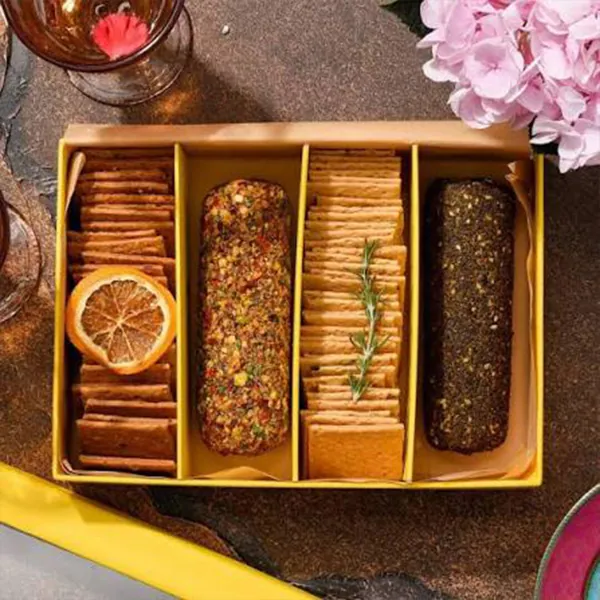
The cheese and cracker tray has one specific enemy: moisture.
View tray & get pricing →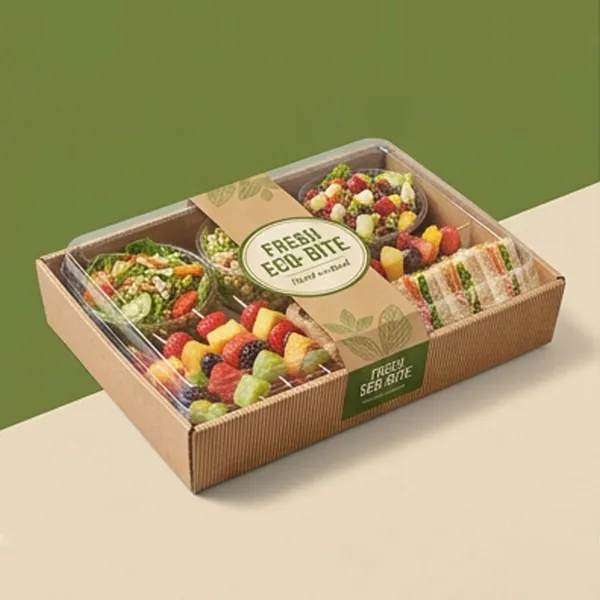
A party tray is a divided platter under a clear lid.
View tray & get pricing →05 — Questions
Rigid enough that it does not visibly bow when lifted from the edges with your heaviest arrangement. That depends on caliper, span and load together. Tell us the board size and the loaded weight and we will specify it rather than leaving you to pick a thickness.
Kraft suits rustic, bread-led arrangements; black flatters pale cheese and charcuterie; white works when the food is colourful. Build a typical board on each and photograph it in your usual light — your own images will decide faster than any advice.
If you deliver, yes. An unlidded board will not survive a car journey with the arrangement intact. If customers collect and carry the board themselves, a band and careful handover is often enough.
The rim, the underside, or a belly band — never the centre, which is covered within a minute. Bands are the most practical because they can be reprinted seasonally without touching your board stock.
They make building faster and far more consistent between staff, which matters if several people assemble boards. They also make the result look more packaged and less hand-arranged, which some grazing customers respond to less well. It is a real trade-off.
Where specified for direct food contact, yes, and we confirm that in writing. Grazing arrangements include fatty and moist items sitting for hours, so it is worth asking for a moisture and grease resistant face on the food-contact surface.
It depends entirely on how generous your arrangement is. Photograph one of your standard four-person boards on a ruler-marked surface and send it to us — we will size from your actual product rather than a notional serving figure.
Yes, and for grazing we would encourage it. The board affects the price you can charge, so testing two or three formats with real customers before committing to volume is a sensible spend.
Yes, and they are usually quoted alongside the boards. Bands are the item you will reorder most often, so it is worth getting separate pricing for them at several quantities.
Send the dimensions, the quantity and the country you want it delivered to. We come back with a full quote — material, print, finishing, freight and a production date.