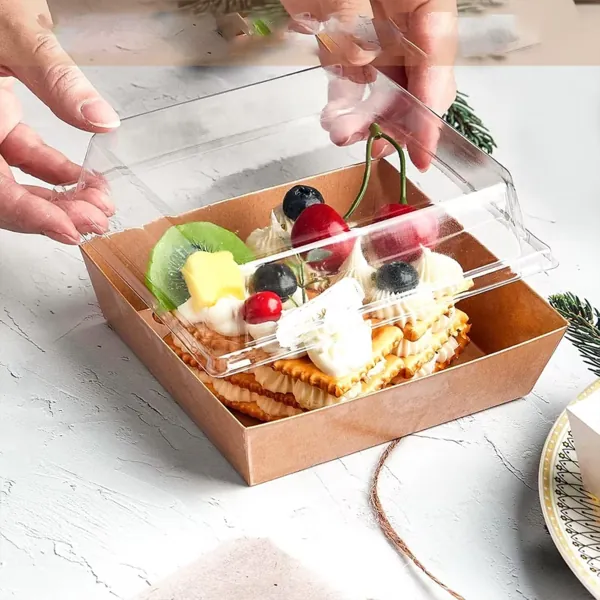
Mini Charcuterie Tray
Individual grazing boxes have grown from a novelty into a substantial category, driven by corporate catering that needs single-serve portions and by ret…
View tray & get pricing →Custom food packaging · US · UK · Canada · Australia
Serving Trays & Platters
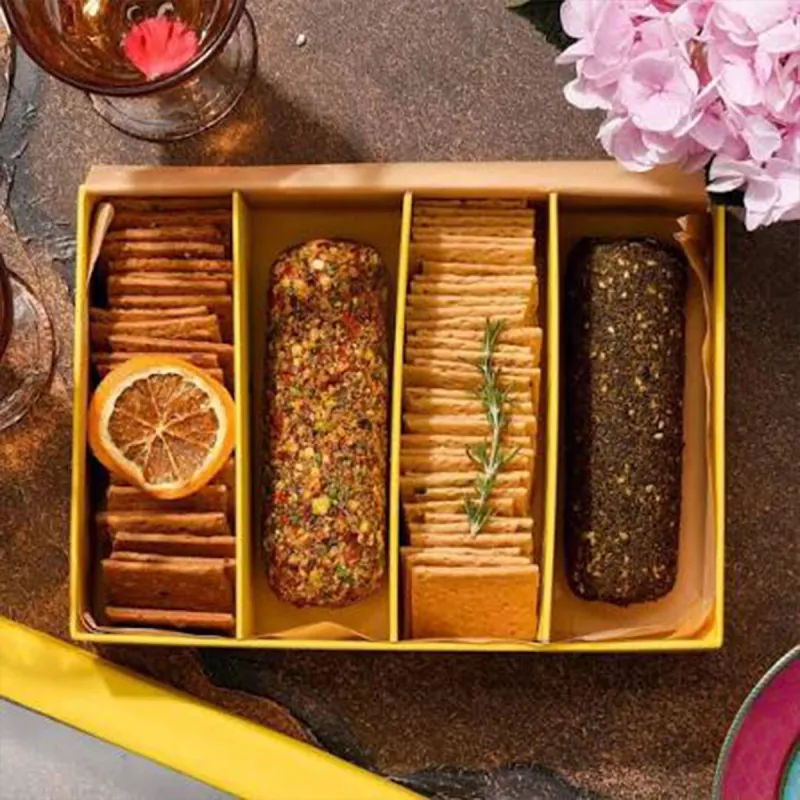
The cheese and cracker tray has one specific enemy: moisture. Cheese gives it off, crackers absorb it, and within a few hours a beautifully packed selection has soft crackers and a damp board. Every design decision on this format is really a decision about managing that.
The answer is compartments with genuine separation, a surface that does not absorb whey, and — for anything with a shelf life measured in days rather than hours — a closure that holds.
Pricing starts from $0.30 per tray
The unit price depends on the size, board, printing, finishing, quantity and delivery country, so every quote is worked out for your specification rather than taken from a list.
Send the size and the run length. We reply with pricing, material options and a production date — usually within one working day.
01 — Specification
Every element below is set when we quote. Nothing here is a fixed catalogue entry — if a line does not match what you need, say so and we will change it.
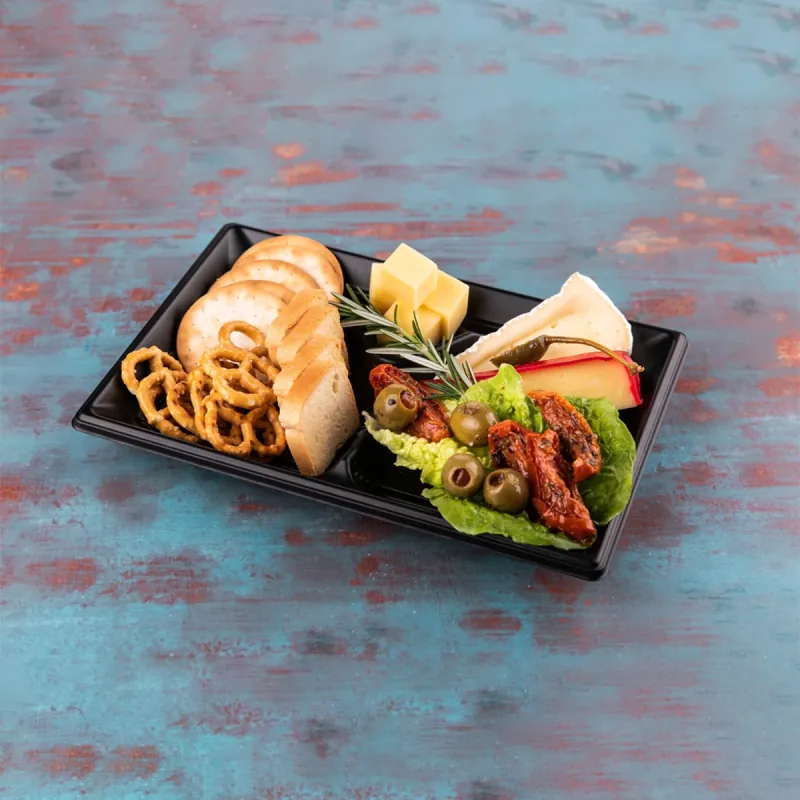
02 — Build the spec
The same five questions we would ask on a phone call, with the cheese and cracker tray already selected. You get a properly detailed brief at the end, which is what makes a first quote accurate rather than approximate.
Prefer the full builder with a live sketch? Open the tray designer.
03 — In detail
These three measures, in combination, are what keep a cheese and cracker selection presentable for its stated shelf life.
Compartment walls that reach the full internal height, not partial dividers. A wall two-thirds of the way up lets humid air move freely over the top, which defeats the purpose entirely.
Soft cheese in particular releases whey. Untreated board absorbs it, darkens, and eventually softens. A moisture-resistant face on the cheese compartments prevents the visible damage and buys you shelf life.
A deep compartment with a small portion holds a lot of humid air. Sizing compartments close to the portion reduces the volume of air the crackers are exposed to. It also makes the pack look fuller, which is a commercial bonus.
Cheese packs are sized from the actual product more than most trays. Five things settle it:
Selling this as a pre-packed retail line? Cheese is a regulated product category and the labelling requirements — allergens, storage, use-by, weight declaration — differ between the US, UK, Canada and Australia. Design a dedicated legal panel into the pack from the start rather than trying to add one to a finished layout.
A cheese and cracker selection is a commodity assembled into something people pay a premium for. The premium comes almost entirely from arrangement and presentation, which means the tray is not a cost line — it is the thing creating the margin.
That argues for spending more on this format than you would on a service tray. A matt black or a well-printed kraft pack with properly sized compartments will support a materially higher price than the same cheese in a plain container.
04 — Nearby
Chosen because operators who buy the cheese and cracker tray usually need one of these in the same order, not because they happen to sit in the same category.
Individual grazing boxes have grown from a novelty into a substantial category, driven by corporate catering that needs single-serve portions and by ret…
View tray & get pricing →
Grazing is a business where the packaging is most of what gets photographed and much of what justifies the price.
View tray & get pricing →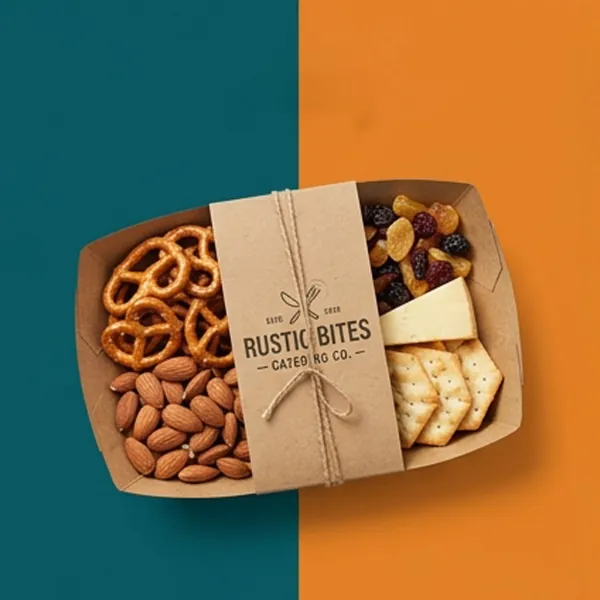
A snack tray is a small divided tray that turns loose items into a product.
View tray & get pricing →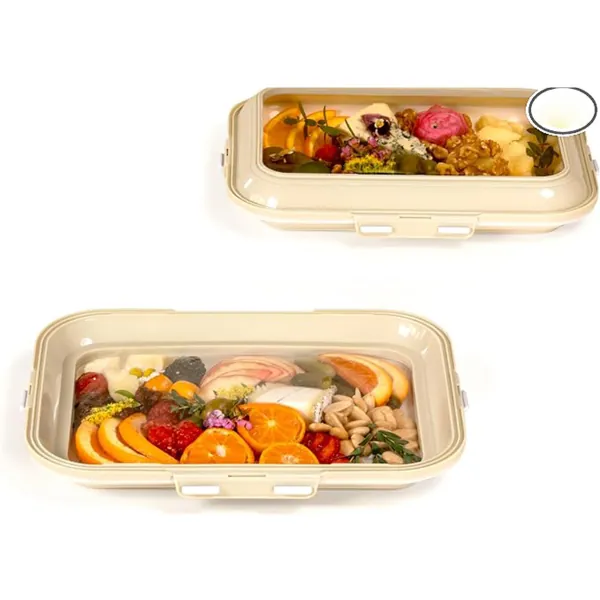
A crudité platter has a problem that other platters do not: the food is meant to stand up.
View tray & get pricing →05 — Questions
Full-height compartment walls, a moisture-resistant face under the cheese, and compartments sized close to the portions so there is less humid air in the pack. All three together work; any one alone helps but does not solve it.
Three at minimum — cheese, crackers, and one accompaniment. Four to six lets you show variety, which is what justifies the price. Build the selection physically before deciding, because the food determines the layout more reliably than a plan does.
Yes, in a compartment cut to the pot. Send us the pot — we size the well to its rim and base so it does not tip when the tray is carried at an angle.
A band for same-day catering, a clear lid for chilled display where the customer chooses on appearance, and a film seal for anything with a stated multi-day shelf life. The closure follows from the shelf life rather than from preference.
Untreated board absorbs whey from soft cheese, darkens, and can soften. A moisture-resistant face on the cheese compartments prevents it. For a retail pack with a multi-day life, treat it as essential rather than optional.
Black flatters pale cheese and cured meat, which is why so many premium cheeseboards use it. Kraft suits rustic and farm-shop positioning. White works if the accompaniments are colourful. All three are available on the same structure.
Yes, and there is a lot of overlap. If the arrangement is the product rather than a fixed selection, look also at the charcuterie and grazing range, which is built for larger, less structured layouts.
That depends on your cheese, your process and your storage, not on the tray. What packaging can do is prevent the visible failures — soft crackers, a damp board, a leaking compartment. The microbiological shelf life is yours to determine and declare.
Yes, and it is usually cheaper to run a range together than separately. The artwork is adapted to each dieline. Ask for all the sizes in one quote.
Send the dimensions, the quantity and the country you want it delivered to. We come back with a full quote — material, print, finishing, freight and a production date.