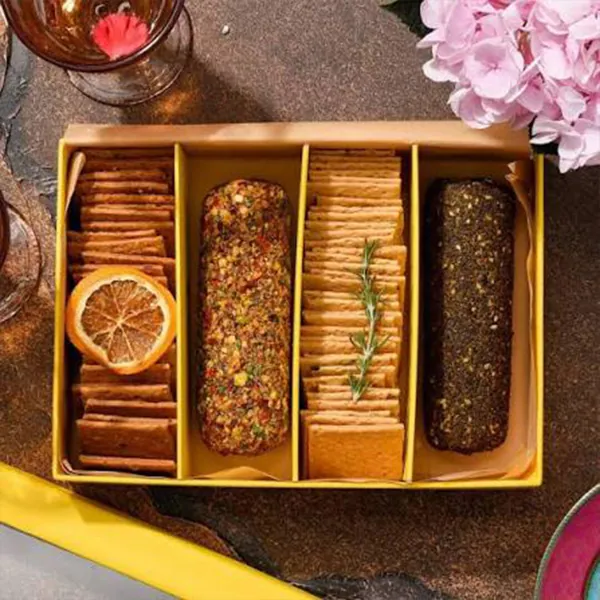
Cheese and Cracker Tray
The cheese and cracker tray has one specific enemy: moisture.
View tray & get pricing →Custom food packaging · US · UK · Canada · Australia
Kraft Food Trays
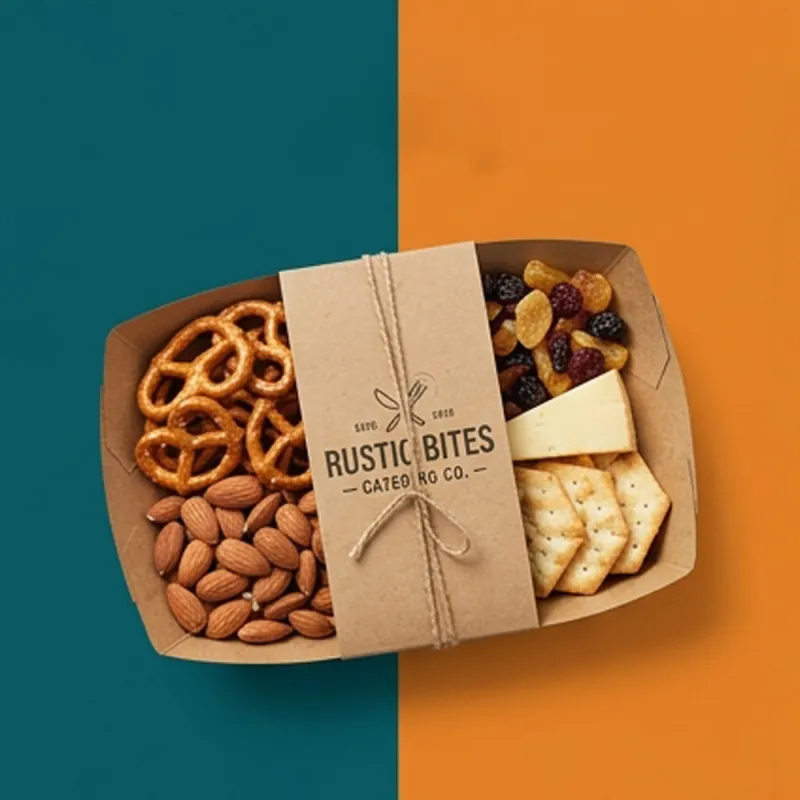
A snack tray is a small divided tray that turns loose items into a product. Pretzels, cheese, nuts, dried fruit, crackers, sliced apple — separately they are ingredients; arranged in four sections behind a printed sleeve they are something a customer will pay four dollars for at a till.
That is the whole design brief. The divisions have to be deep enough to keep items apart, the footprint has to fit a grab-and-go shelf, and the sleeve has to do the selling.
Pricing starts from $0.30 per tray
The unit price depends on the size, board, printing, finishing, quantity and delivery country, so every quote is worked out for your specification rather than taken from a list.
Send the size and the run length. We reply with pricing, material options and a production date — usually within one working day.
01 — Specification
Every element below is set when we quote. Nothing here is a fixed catalogue entry — if a line does not match what you need, say so and we will change it.
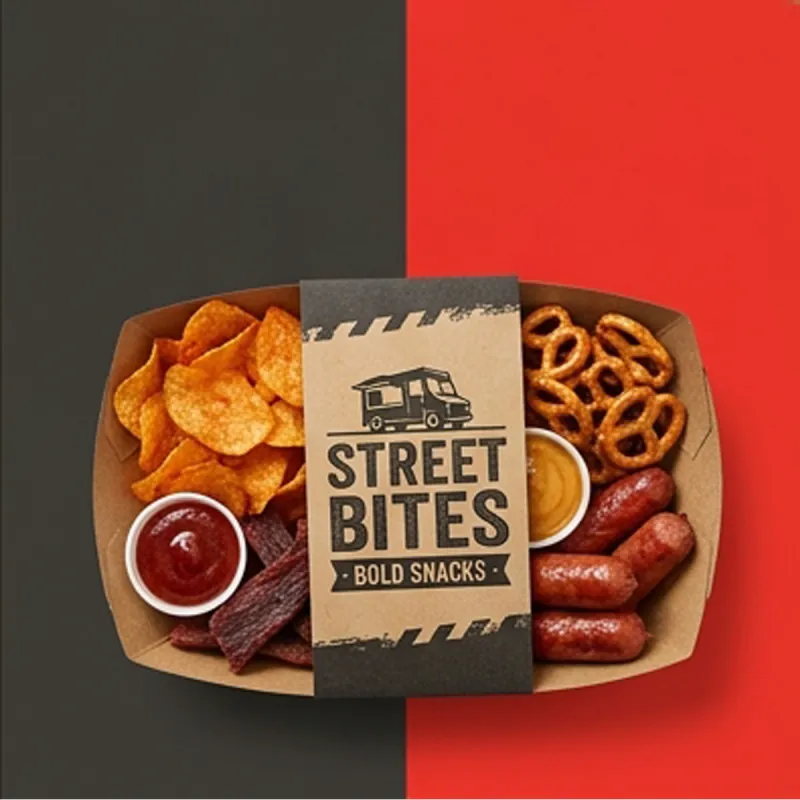
02 — Build the spec
The same five questions we would ask on a phone call, with the kraft snack tray already selected. You get a properly detailed brief at the end, which is what makes a first quote accurate rather than approximate.
Prefer the full builder with a live sketch? Open the tray designer.
03 — In detail
Dividing a snack tray is not decoration. Each partition solves a specific problem that shows up in a chiller within a few hours.
The branding decision on a snack tray is unusually consequential, because it is also the merchandising decision.
Wraps the middle of the tray and covers roughly a third of the contents. It gives you a large, flat, full-colour surface for the product name, the ingredients panel and the price, and it is cheap enough to reprint for a seasonal range without touching your tray stock.
A narrower version of the same idea. It shows more of the food and less of your branding — the right trade-off when the contents are the selling point and your brand is already known.
Cheapest per unit at volume and the most durable, but changing the design means a new tray run. Best when your range is stable and your volumes are high.
A practical note on labelling: most markets require an ingredients and allergen declaration on a pre-packed snack tray, and the rules differ between the US, UK, Canada and Australia. Design the sleeve with a dedicated panel for it from the start — retro-fitting a legal panel into a finished design is always worse than planning for it.
Lay out the actual items on a table and photograph them. It takes ten minutes and settles the section count and the volumes better than any spreadsheet.
Grab-and-go shelves have a fixed depth and a fixed facing width. The tray needs to fit both without wasting a strip.
Open with a sleeve is cheapest. A film seal or a clear lid extends shelf appearance and is usually necessary for anything with a stated shelf life.
We supply the flat sleeve template with the legal panel area marked. This is where most of the design time goes, and it is worth it.
04 — Nearby
Chosen because operators who buy the kraft snack tray usually need one of these in the same order, not because they happen to sit in the same category.
The cheese and cracker tray has one specific enemy: moisture.
View tray & get pricing →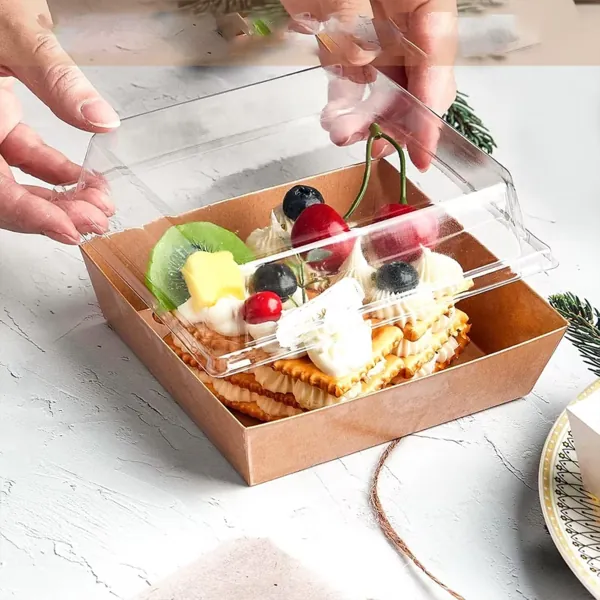
Individual grazing boxes have grown from a novelty into a substantial category, driven by corporate catering that needs single-serve portions and by ret…
View tray & get pricing →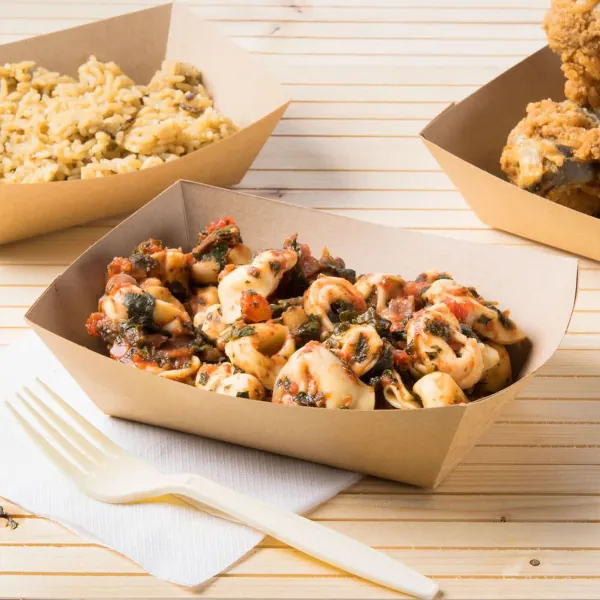
The kraft paper food tray is the one shape that every counter ends up buying.
View tray & get pricing →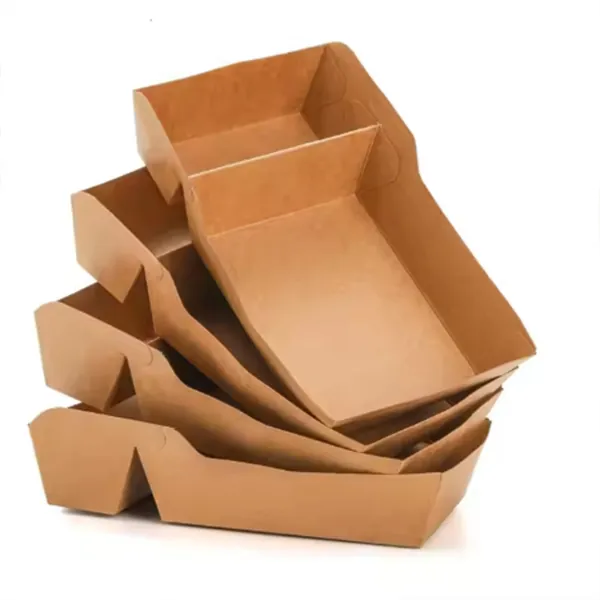
The chip and dip tray is the simplest divided format there is: a main bay and one or two smaller wells.
View tray & get pricing →05 — Questions
Three or four in most cases. Two reads as thin for a retail price point; five or more makes each section too small to hold a satisfying portion of anything. Build the mix physically before deciding — the food usually tells you.
Better than in an undivided one, because the partition keeps them away from cheese and fruit. Beyond that it is down to the closure: an open tray with a sleeve is fine for same-day sale, while anything with a multi-day shelf life needs a seal.
Yes. A clear lid shows the whole arrangement, which sells well, but it adds a plastic component and needs a matched rim. Many operators use both — a lid for retail chillers and a sleeve for catering and corporate orders.
Yes, and they are usually quoted together. Sleeves are the part you will reorder most often, so it is worth asking for sleeve pricing at several quantities separately from the tray pricing.
That depends entirely on your fixture. Measure the usable shelf depth and the facing width you have been allocated, and tell us how many facings you want. We size the tray to fit a whole number across the shelf.
They work well for it — the divided layout suits a fruit, cracker and protein mix, and a printed sleeve gives you room for the nutrition information schools and parents look for. Section sizes usually come down slightly for a child portion.
Yes, if we size one section to your pot. Send us the pot — the diameter at the rim and the base are both relevant because the well needs to hold it without it tipping when the tray is carried at an angle.
A custom layout needs its own cutting die, so there is a practical floor. It is usually lower than people expect. Ask for pricing at your realistic annual volume and at a trial quantity, and we will show you both.
Send the dimensions, the quantity and the country you want it delivered to. We come back with a full quote — material, print, finishing, freight and a production date.