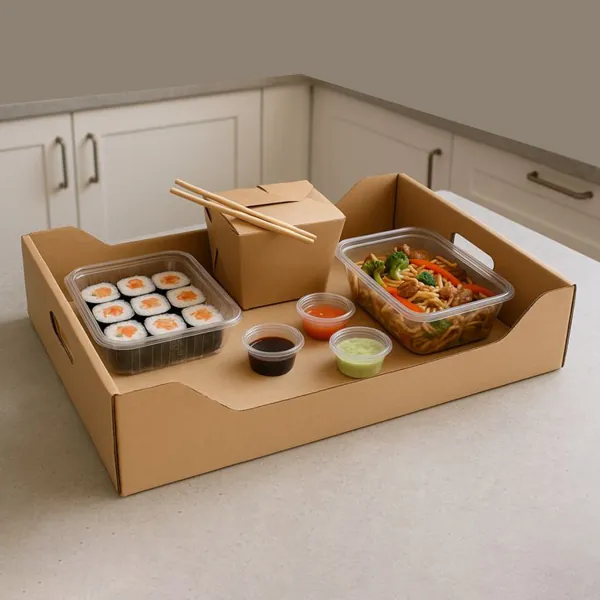
Corrugated Food Tray
Corrugated trays exist for one reason: a loaded tray that has to be picked up from the middle without folding in half.
View tray & get pricing →Custom food packaging · US · UK · Canada · Australia
Corrugated Food Trays
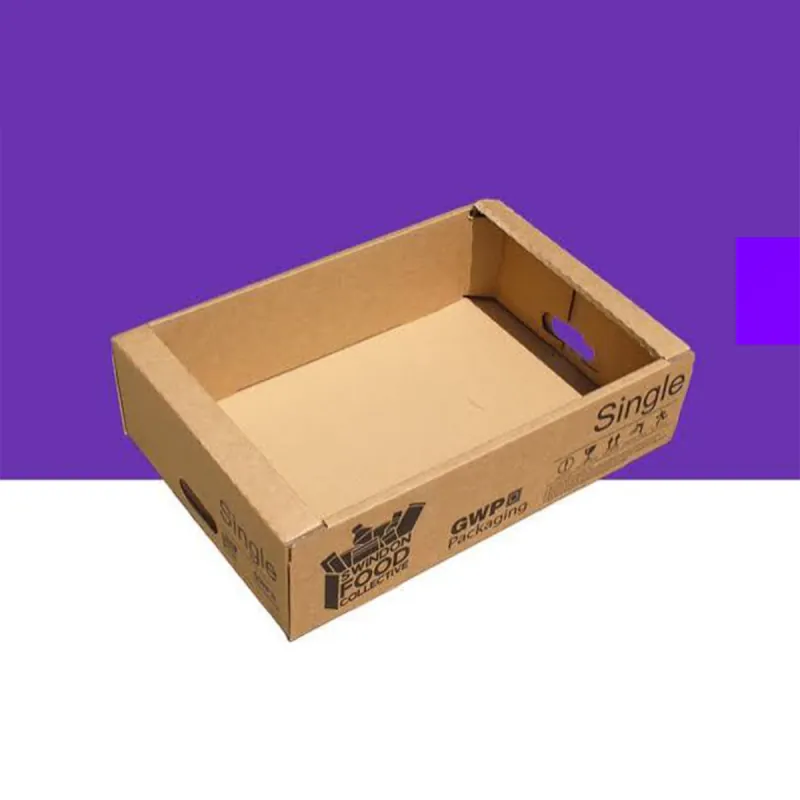
A deli tray takes more punishment than most food packaging. It gets loaded hot, it sits under a lamp, it is handled by staff wearing gloves and by customers who are not paying attention, and it usually contains something oily. Everything about the specification should be pointed at that.
The trays here are fluted rather than folded because the loads are heavier — a full tray of wings, ribs or hot sides is a meaningful weight to lift from the middle.
Pricing starts from $0.30 per tray
The unit price depends on the size, board, printing, finishing, quantity and delivery country, so every quote is worked out for your specification rather than taken from a list.
Send the size and the run length. We reply with pricing, material options and a production date — usually within one working day.
01 — Specification
Every element below is set when we quote. Nothing here is a fixed catalogue entry — if a line does not match what you need, say so and we will change it.
02 — Build the spec
The same five questions we would ask on a phone call, with the corrugated deli tray already selected. You get a properly detailed brief at the end, which is what makes a first quote accurate rather than approximate.
Prefer the full builder with a live sketch? Open the tray designer.
03 — In detail
These are the four failures we get asked to fix most often when somebody switches supplier. All four are specification problems rather than manufacturing ones.
None of these cost much to prevent. All four cost a great deal in wasted trays and irritated customers.
A rough guide. Weigh and load your own portion into a sample before committing to a die.
| Portion | Suggested depth | Note |
|---|---|---|
| Wings or tenders, single serving | About 50 mm | Deep enough that pieces do not roll out |
| Mixed hot deli plate | About 65 mm | Room for a main plus two sides without mixing |
| Ribs or bone-in portions | About 75 mm | Bones sit higher than you expect |
| Family sharing portion | About 90 mm | Needs B-flute at this depth and load |
Hot deli food produces steam. In an open tray it escapes and the food stays crisp. Put a lid on it and the steam condenses on the underside, drips back onto the food and turns a crisp coating soft within ten minutes. Every operator who has sold soggy wings has met this.
If your trays leave the shop closed, the answer is either a vented lid or a construction that lets some air out. It costs a little more and it is the difference between food that arrives as intended and food that arrives disappointing. Say at quote stage whether the tray travels closed, because it changes what we recommend.
A deli tray goes home with the customer and sits on a table in front of whoever else is eating. On a takeaway-heavy operation, that is a larger audience than your shop window reaches in a week.
One colour on kraft-lined board is enough. Name, one line of positioning, and how to order again. It costs a fraction of a single social media campaign and it works on every tray you sell for the life of the run.
04 — Nearby
Chosen because operators who buy the corrugated deli tray usually need one of these in the same order, not because they happen to sit in the same category.
Corrugated trays exist for one reason: a loaded tray that has to be picked up from the middle without folding in half.
View tray & get pricing →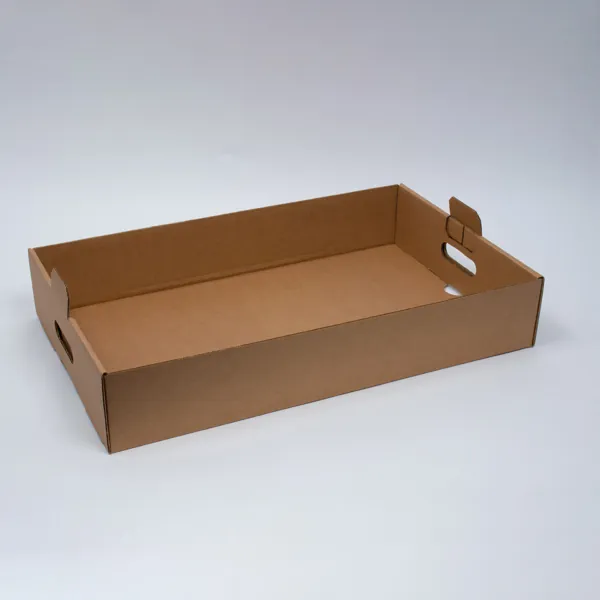
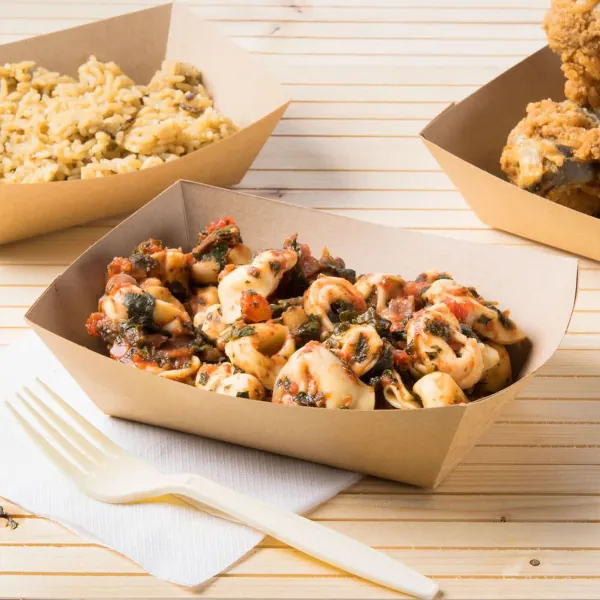
The kraft paper food tray is the one shape that every counter ends up buying.
View tray & get pricing →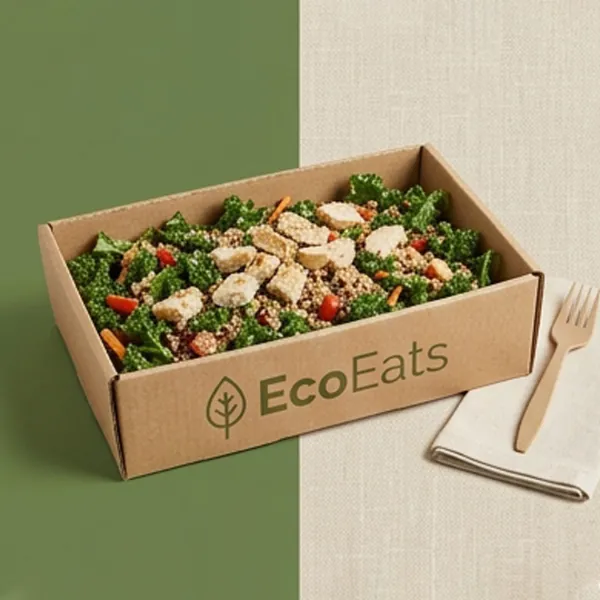
The lunch tray sits between a takeaway container and a proper meal tray.
View tray & get pricing →05 — Questions
For a hot deli counter, treat it as standard rather than optional. Untreated board under fried food darkens within minutes and goes translucent under the portion, which is the most visible packaging failure there is.
Between about 50 mm for a single wings portion and 90 mm for a family sharing tray. Load your actual portion into a sample and tilt it — if anything escapes, go deeper before committing to the die.
Fluted board handles radiant heat reasonably, but prolonged time under a lamp dries and embrittles it, and steam from the food softens the liner from the other side. Tell us how long trays sit under lamps and we will specify with that in mind.
Yes, but think about venting first. A sealed hot tray steams and softens crisp food. A vented lid or a partly open construction usually gives a better result than a tight seal for anything fried.
On anything above about a two-portion tray, yes. They turn a two-handed carry into a one-handed one. Just remember they take space out of the print area and need reinforced walls, so decide before artwork.
Only with a lid or a rigid frame, otherwise the tray above sits on the food. If your hot cabinet is stacked, tell us the shelf spacing and we will size the tray to it.
It depends on your fixture. Measure the insert opening and tell us how many trays you want across it. Sizing a tray to your counter rather than adapting your counter to a stock tray is one of the main advantages of ordering custom.
We can, though on a deli tray the interior is covered by food immediately. The exterior long wall does far more work for the same money.
Repeat orders run faster than first orders because the die exists and the artwork is approved. We give you a real date on the quote rather than a standard lead time, since it depends on the run length and where it is going.
Send the dimensions, the quantity and the country you want it delivered to. We come back with a full quote — material, print, finishing, freight and a production date.