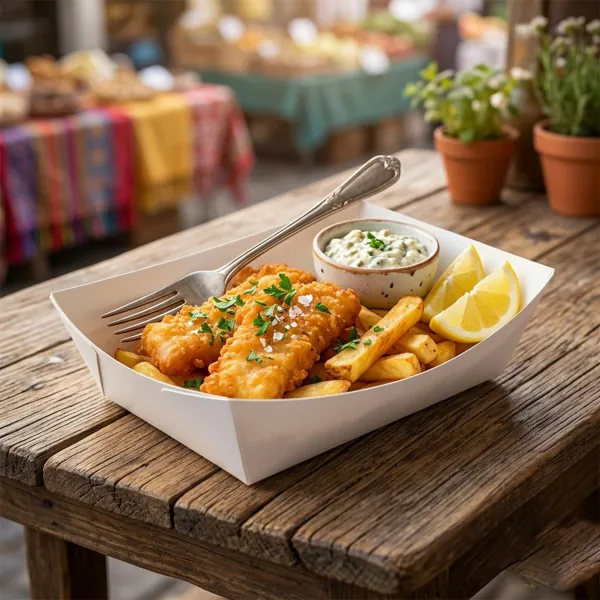
White Paper Food Tray
The white paper food tray is the same shape as the kraft version with a different surface underneath.
View tray & get pricing →Custom food packaging · US · UK · Canada · Australia
Fast Food & Concession Trays
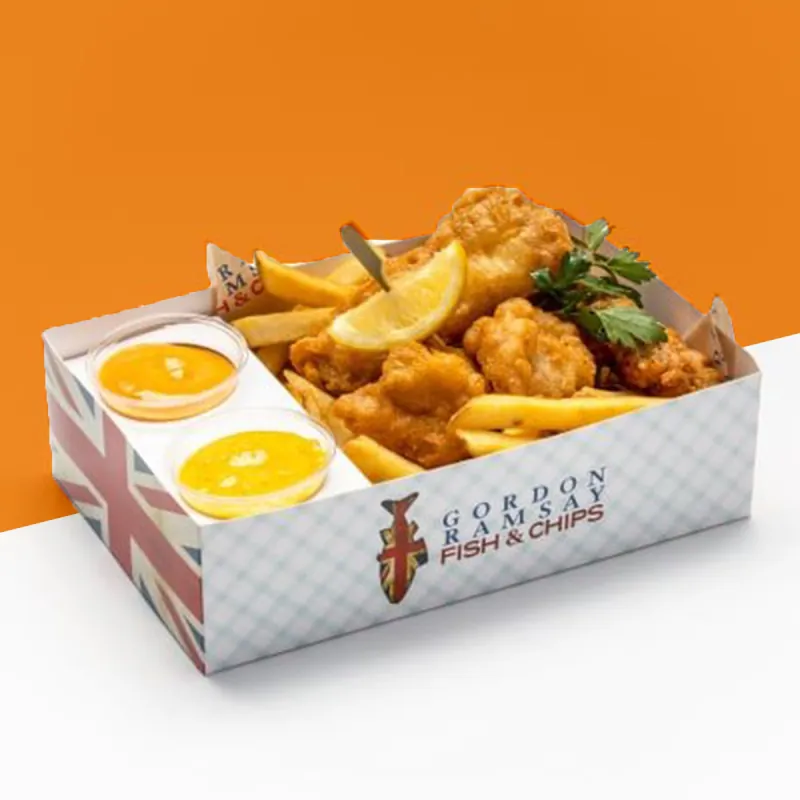
Fish and chips is the hardest test a board tray faces. The portion is heavy, it comes straight out of a fryer, it is dripping with oil, it steams enormously, and the customer expects the batter to still be crisp when they open it ten minutes later.
Every part of the specification here exists to manage one of those four things.
Pricing starts from $0.30 per tray
The unit price depends on the size, board, printing, finishing, quantity and delivery country, so every quote is worked out for your specification rather than taken from a list.
Send the size and the run length. We reply with pricing, material options and a production date — usually within one working day.
01 — Specification
Every element below is set when we quote. Nothing here is a fixed catalogue entry — if a line does not match what you need, say so and we will change it.
02 — Build the spec
The same five questions we would ask on a phone call, with the fish and chips tray already selected. You get a properly detailed brief at the end, which is what makes a first quote accurate rather than approximate.
Prefer the full builder with a live sketch? Open the tray designer.
03 — In detail
Freshly fried food releases a lot of oil, and it goes into plain board within a minute. A grease-resistant food-contact face is not an upgrade on this product — it is the baseline specification.
A closed box full of hot fried food fills with steam, which condenses and softens the batter. Vents let it escape. A vented box will deliver noticeably crisper fish than a sealed one over a ten-minute journey.
A large fish supper is a substantial weight in a board container that is being carried by its sides. Board grade has to be specified for that, especially if the box is carried in one hand.
Prolonged contact with very hot food will soften board over time, which is a separate issue from grease. This is why the treated face and the board grade are specified together rather than independently.
| Service | Format | Key feature |
|---|---|---|
| Eat-in at a table | Open deep tray | Steam escapes freely; nothing to soften the batter |
| Takeaway, short walk | Open tray with a paper wrap | Traditional and effective; wrap holds heat briefly |
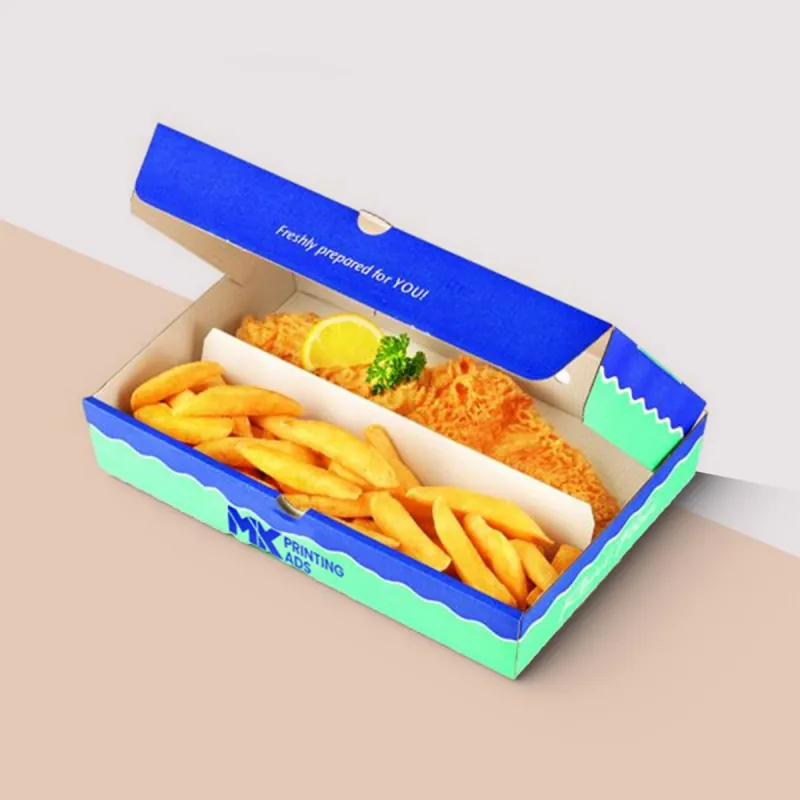
| Takeaway, driven home | Hinged box with vents | Vents are what keep the batter crisp |
| Delivery platform | Hinged box with vents plus an outer bag | Box handles steam, bag handles heat |
| Seaside kiosk, eaten standing | Open tray, deeper walls | Wind and gulls both argue for depth |
The single biggest improvement most chip shops can make is adding vents to a closed box. It costs almost nothing in the die and it changes the product the customer actually eats. If you have ever had a customer say the fish was soggy, this is usually why.
Fish portions vary enormously between shops, and a box sized to somebody else’s regular is either wasteful or too tight. Lay out your standard portion — fish, chips, and whatever else goes in — and measure the space it needs with the pieces separated rather than piled.
The chips are the variable that catches people out. A generous chip portion loosely filled takes far more space than the same weight pressed down, and pressing chips down is exactly what makes them soft.
04 — Nearby
Chosen because operators who buy the fish and chips tray usually need one of these in the same order, not because they happen to sit in the same category.
The white paper food tray is the same shape as the kraft version with a different surface underneath.
View tray & get pricing →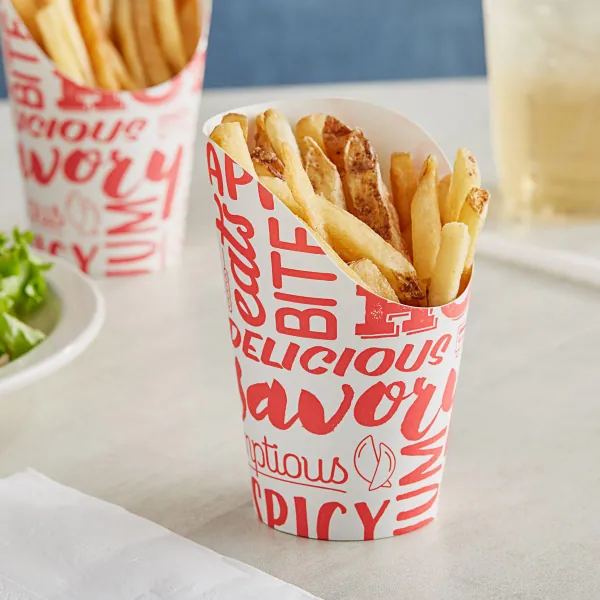
The fry scoop exists because of a specific piece of ergonomics: a member of staff should be able to fill it from a fryer basket with one hand, in one mo…
View tray & get pricing →
A deli tray takes more punishment than most food packaging.
View tray & get pricing →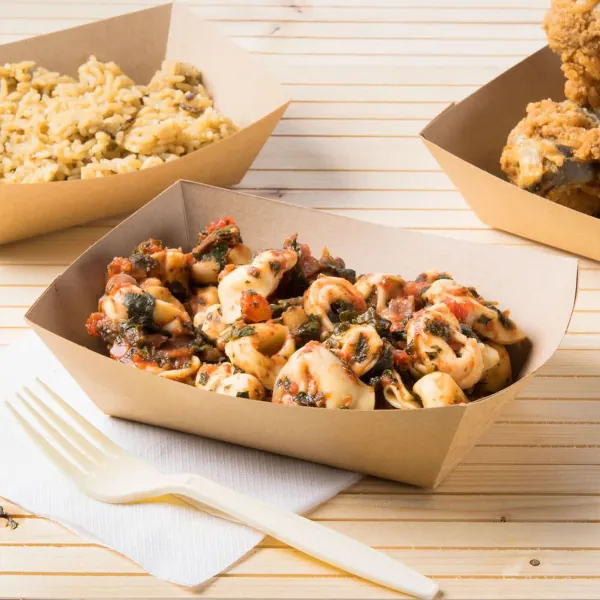
The kraft paper food tray is the one shape that every counter ends up buying.
View tray & get pricing →05 — Questions
For fish and chips, yes, without qualification. Freshly fried food goes into plain board within a minute and the customer sees it. Treat it as the baseline rather than an option on this product.
Vent the box. Steam is what softens batter, and a sealed container traps all of it. Die-cut vents cost almost nothing and are the single biggest improvement available on this format.
Between about 60 and 90 mm for a full portion, depending on your fish size and how generously you serve chips. Lay out your actual portion loosely — not pressed down — and measure the space it takes.
Open for eat-in, where steam escaping is a benefit. Hinged and vented for takeaway and delivery, where the box has to hold the portion together as well as let steam out.
If we specify the board for it. A large portion is a real weight and it is carried by the sides. Tell us the heaviest portion you serve and we will grade the board for that rather than an average.
White is the conventional expectation for a chip shop and suits the golden colour of the food. Kraft hides grease marks better, which matters if you have not specified a treated face — though you should.
Yes, and it is worth it. A fish and chip box goes home and sits on a table for the length of a meal. One colour on both long sides is inexpensive and highly visible.
Yes. A range that shares a design across the main box, a chip tray and a side pot looks considerably more professional than a mixed set, and running them together is cheaper than separate orders.
Widely — Australia and Canada both have substantial fish and chip trade, and the format is used for fried seafood baskets in the US. The portion conventions differ by market, so we size from your actual product.
Send the dimensions, the quantity and the country you want it delivered to. We come back with a full quote — material, print, finishing, freight and a production date.