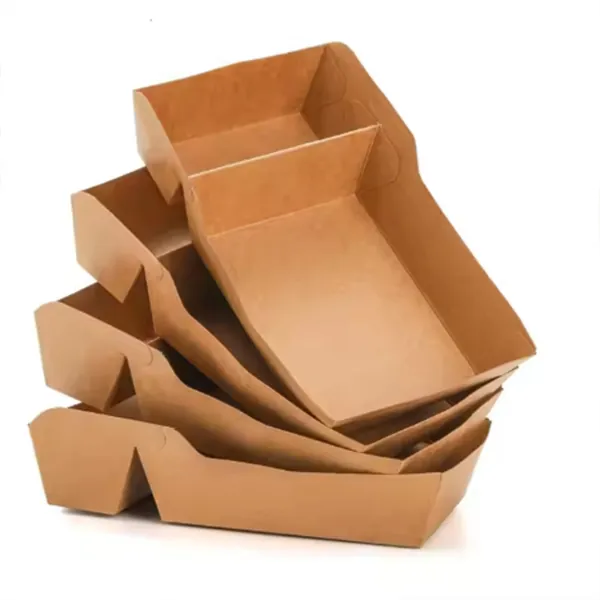
Chip and Dip Tray
The chip and dip tray is the simplest divided format there is: a main bay and one or two smaller wells.
View tray & get pricing →Custom food packaging · US · UK · Canada · Australia
Kraft Food Trays
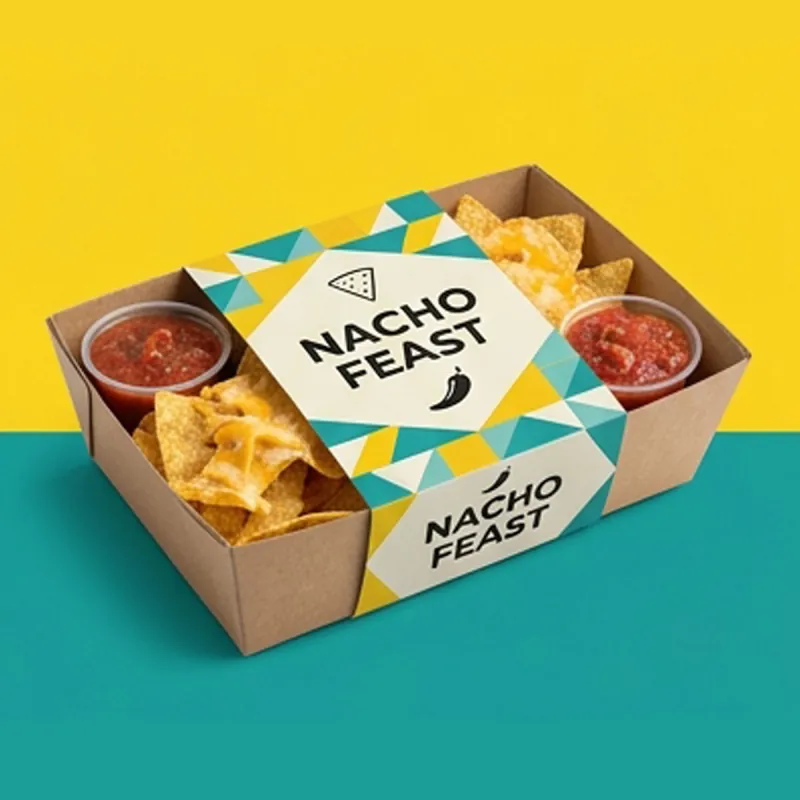
Nachos are a packaging problem disguised as a menu item. Chips need volume and air; the dip needs to be contained and not soak the chips; and the customer usually has one hand free because the other is holding a drink.
The nacho tray solves it with a divided footprint: a large open bay for the chips and one or two moulded or folded wells at the side for salsa, cheese sauce or guacamole. It works standing up at a stadium concourse, which is the real test.
Pricing starts from $0.30 per tray
The unit price depends on the size, board, printing, finishing, quantity and delivery country, so every quote is worked out for your specification rather than taken from a list.
Send the size and the run length. We reply with pricing, material options and a production date — usually within one working day.
01 — Specification
Every element below is set when we quote. Nothing here is a fixed catalogue entry — if a line does not match what you need, say so and we will change it.
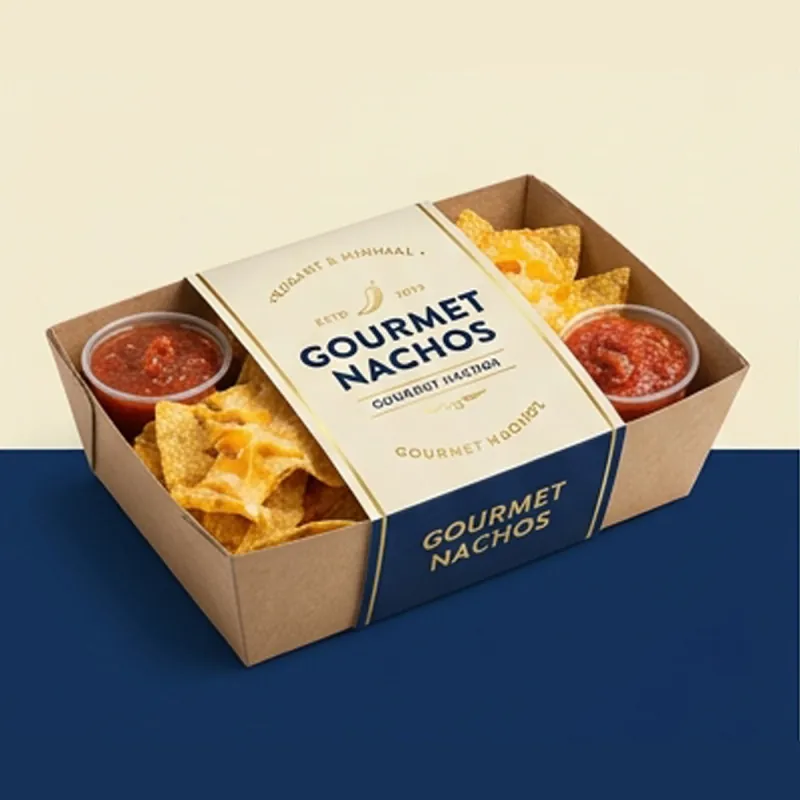
02 — Build the spec
The same five questions we would ask on a phone call, with the kraft nacho tray already selected. You get a properly detailed brief at the end, which is what makes a first quote accurate rather than approximate.
Prefer the full builder with a live sketch? Open the tray designer.
03 — In detail
This is the first decision, and it changes the tray, the labour and the cost.
The well is cut to hold a standard dip pot. Portions are exact, the dip does not touch the board, and you can pre-fill pots during quiet periods. The downsides are the cost of the pot and an extra component to stock.
Cheaper and faster at the counter, with nothing extra to buy. It needs a properly grease-resistant surface because hot cheese sauce sits directly against the board, and portioning is by eye rather than by pot.
Serving hot cheese sauce? Say so at quote stage. Hot sauce sitting in a board well for ten minutes is a far more demanding condition than cold salsa, and it changes the treatment we specify on the food-contact face.
A nacho tray is looked at from above and from the front, usually while the customer is standing. That rules out fine detail and small type — the design has to read at about two feet, in whatever lighting a concourse or a street pitch has.
Bold single-colour marks work best. Two spot colours on kraft gives you a logo plus a highlight without moving to process printing. Save the detail for the tray you use in a sit-down setting.
04 — Nearby
Chosen because operators who buy the kraft nacho tray usually need one of these in the same order, not because they happen to sit in the same category.
The chip and dip tray is the simplest divided format there is: a main bay and one or two smaller wells.
View tray & get pricing →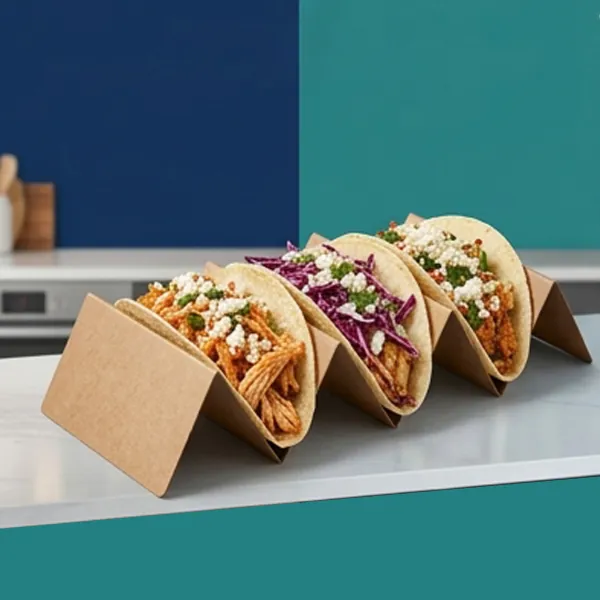
A taco holder does one thing: it stops tacos falling over.
View tray & get pricing →
The kraft paper food tray is the one shape that every counter ends up buying.
View tray & get pricing →
Popcorn is sold by volume and eaten by the handful, which makes the pack unusually important: the customer’s sense of value comes almost entirely…
View tray & get pricing →05 — Questions
One covers a standard nacho serving. Two lets you offer salsa and cheese, or cheese and sour cream, without a second container — which is worth doing if your menu prices on toppings. Beyond two, the chip bay gets too small to be generous.
Yes, if we cut it to your pot. Send us the pot and we will size the well around its rim and base diameters so it sits in firmly rather than rattling or having to be forced.
Untreated board will darken and eventually soften under hot sauce. A grease-resistant food-contact face handles a normal service period comfortably. Tell us if the sauce is served hot — it changes what we specify.
Up to a point. Once the footprint gets much beyond about eight inches on the long side, a loaded tray needs two hands regardless of board. If one-handed service matters, keep the tray compact and tell us — we will specify the board for the resulting load.
For delivery, yes. A lid changes the format significantly though: closed nachos steam and soften, so vented constructions and a separate dip pot are usually necessary. Tell us it is for delivery and we will design for that rather than adapting a counter tray.
Concourse operators generally want the largest tray a customer can hold with a drink in the other hand, which in practice caps out around a two to three pound footprint. See food trays for stadium concessions for how this fits a wider concourse range.
They can, though on a nacho tray the interior is covered in chips almost immediately, so it is rarely the best place for your budget. The front wall does far more work.
Flat-packed, yes — they store efficiently. Assembled trays nest only partially because of the well divider, so assemble as you go rather than building a shift’s worth in advance.
Send the dimensions, the quantity and the country you want it delivered to. We come back with a full quote — material, print, finishing, freight and a production date.