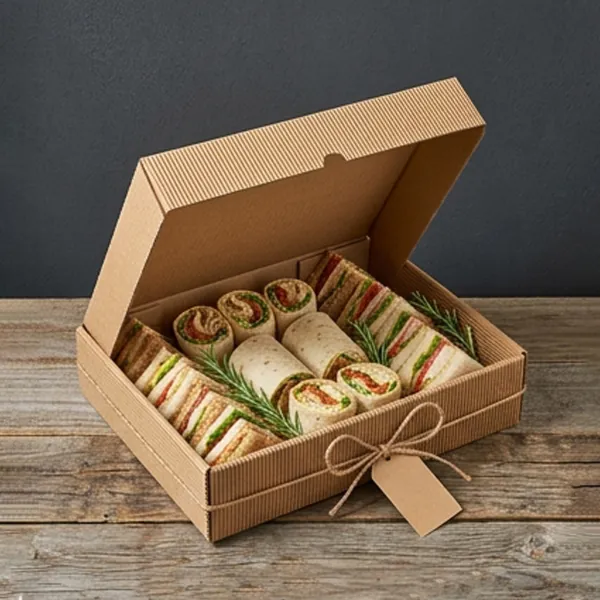
Corrugated Sandwich Platter
The corporate sandwich platter is one of the highest-volume formats in catering, and the specification is almost entirely determined by how you cut your…
View tray & get pricing →Custom food packaging · US · UK · Canada · Australia
Serving Trays & Platters
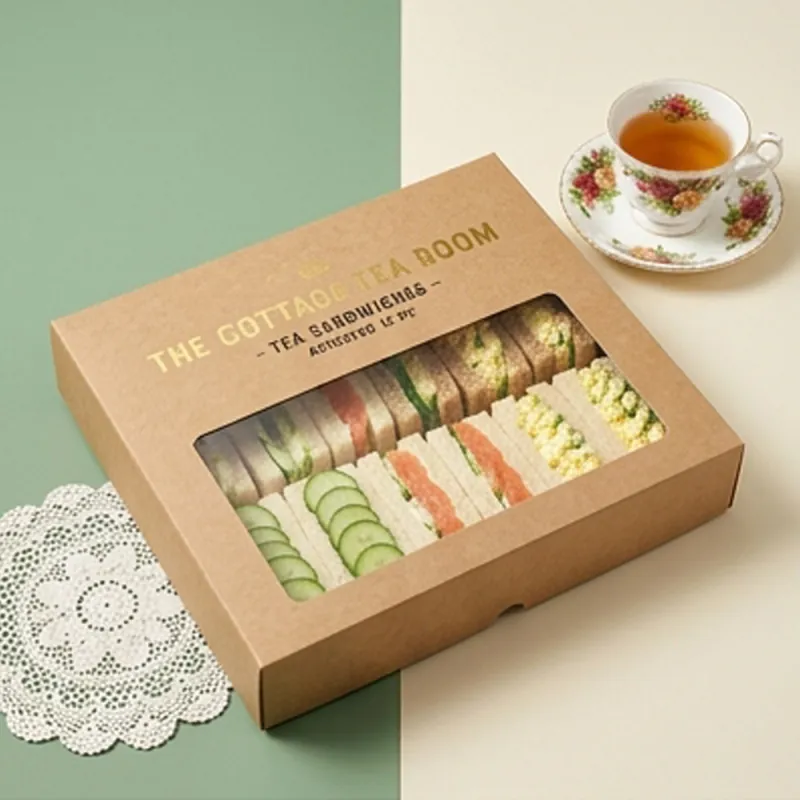
Finger sandwiches are packed in rows, standing on their cut edge, and the whole point is that a customer can see the row through a window before they buy. That gives this format a very particular shape: long, narrow, shallow, and almost always with a window in the lid.
It is the standard for afternoon tea boxes, hotel room service, cocktail catering and the premium end of retail sandwich selections.
Pricing starts from $0.30 per tray
The unit price depends on the size, board, printing, finishing, quantity and delivery country, so every quote is worked out for your specification rather than taken from a list.
Send the size and the run length. We reply with pricing, material options and a production date — usually within one working day.
01 — Specification
Every element below is set when we quote. Nothing here is a fixed catalogue entry — if a line does not match what you need, say so and we will change it.
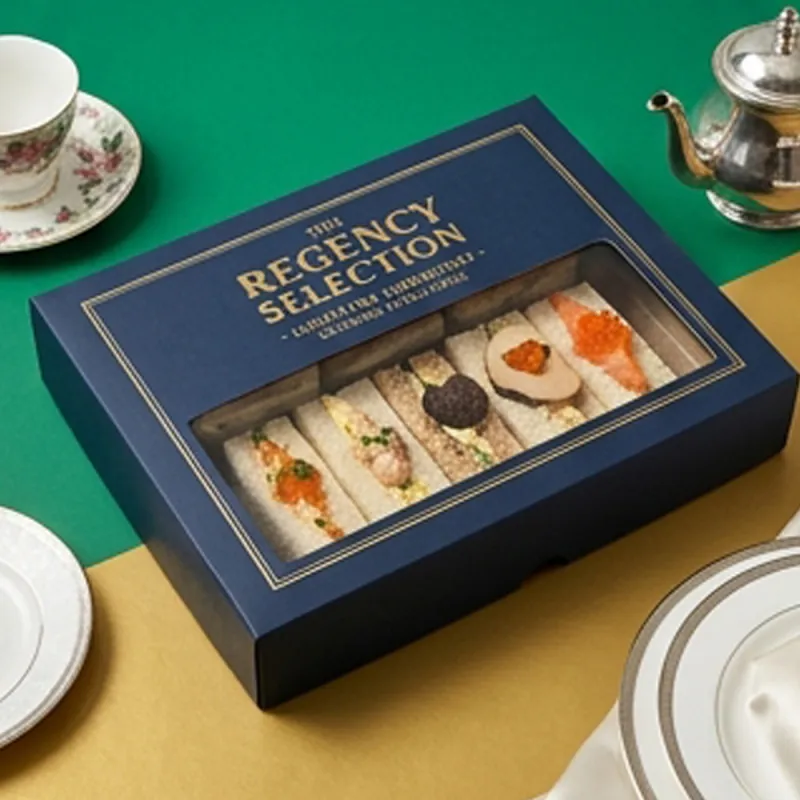
02 — Build the spec
The same five questions we would ask on a phone call, with the tea sandwich tray already selected. You get a properly detailed brief at the end, which is what makes a first quote accurate rather than approximate.
Prefer the full builder with a live sketch? Open the tray designer.
03 — In detail
Finger sandwiches stand on their long cut edge, and they hold each other up. If the box is wider than the row, the whole row leans and the presentation collapses on the first corner. The internal width has to match the assembled row almost exactly.
This determines how many sandwiches per box. Decide the count first based on your price point, then measure a row of that many and add a few millimetres of clearance.
Deep enough to clear the top of the sandwich and the window film, and no deeper. A tall box makes the row look sparse and lets the sandwiches tip forward.
You can make this format without a window, and it will be cheaper. It will also sell noticeably worse anywhere the customer chooses at the point of sale, because a closed box of finger sandwiches gives a buyer nothing to react to.
Where the box is part of a pre-ordered afternoon tea and the customer has already committed, a solid lid with good print is entirely reasonable and gives you more room for design. The window pays for itself specifically in self-selection settings.
Sandwiches packed slightly warm, or moved from a chiller into a warm room, will mist the inside of the window. On a product where the window is the selling point, that is a real problem and it is almost always a process issue rather than a packaging one.
Pack fully chilled, avoid sealing the box completely if it is going into a warm room, and, where misting is persistent, ask us about anti-fog window film. It costs more and it works.
04 — Nearby
Chosen because operators who buy the tea sandwich tray usually need one of these in the same order, not because they happen to sit in the same category.
The corporate sandwich platter is one of the highest-volume formats in catering, and the specification is almost entirely determined by how you cut your…
View tray & get pricing →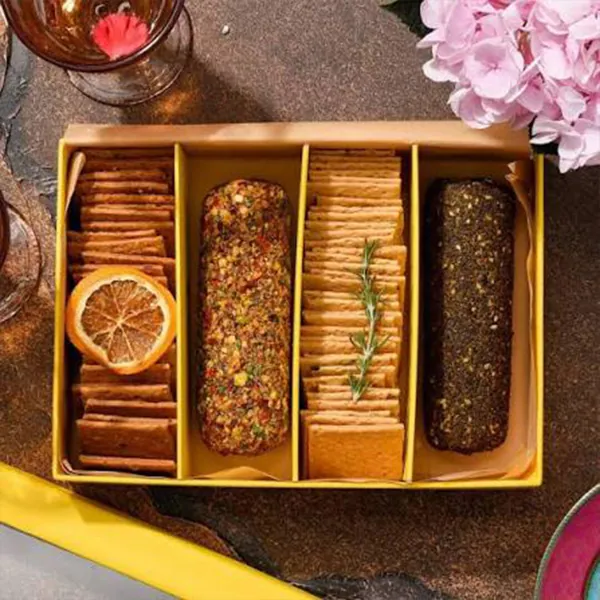
The cheese and cracker tray has one specific enemy: moisture.
View tray & get pricing →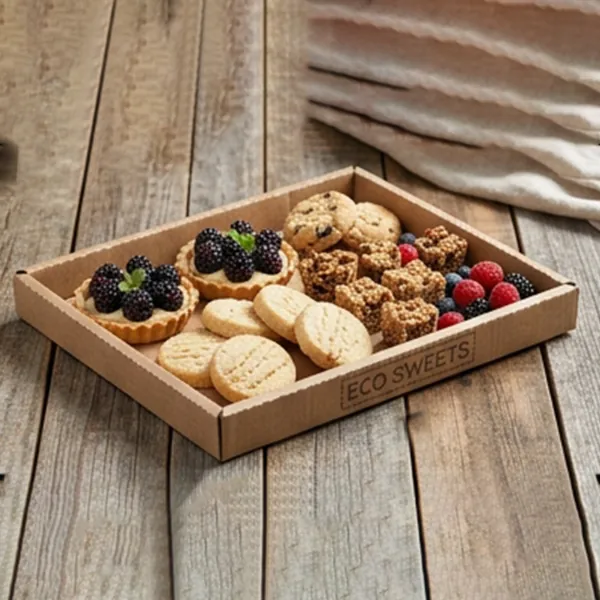
Dessert is the one course where the packaging is photographed.
View tray & get pricing →
05 — Questions
Almost exactly as wide as your assembled row. The sandwiches hold each other upright, so any slack lets the row lean and collapse. Build a row of your standard count, measure it, and add only a few millimetres.
That is your decision rather than the box’s — decide the count from your price point, then we size the length to it. Tell us the count and the sandwich dimensions and we will do the arithmetic.
If the customer chooses at the point of sale, yes — a closed box of finger sandwiches gives a buyer nothing to respond to. If the box is part of a pre-ordered afternoon tea, a solid printed lid is perfectly reasonable and gives you more design space.
Usually because the product went in warm, or the box moved from a chiller into a warm room. Pack fully chilled first. If misting persists, anti-fog window film is available and effective, at some extra cost.
Gently. A window lid is a weak point under load, and the sandwiches inside will not tolerate much compression. If you need to stack for delivery, tell us and we will strengthen the frame around the window.
Bleached folding board for a premium afternoon tea product, natural kraft where the brand is more rustic. Fine-flute corrugated is an option where the box needs more rigidity, though it is less refined at close range.
Yes — the frame around the window is the main print surface and it works well for a wordmark and a short description. Keep the frame wide enough to carry legible type when you set the window size.
Yes, and it is one of the main uses. Ask for a moisture-resistant construction, and be aware that a retail listing will usually need a flat panel for a barcode and a legal information panel.
Send the dimensions, the quantity and the country you want it delivered to. We come back with a full quote — material, print, finishing, freight and a production date.