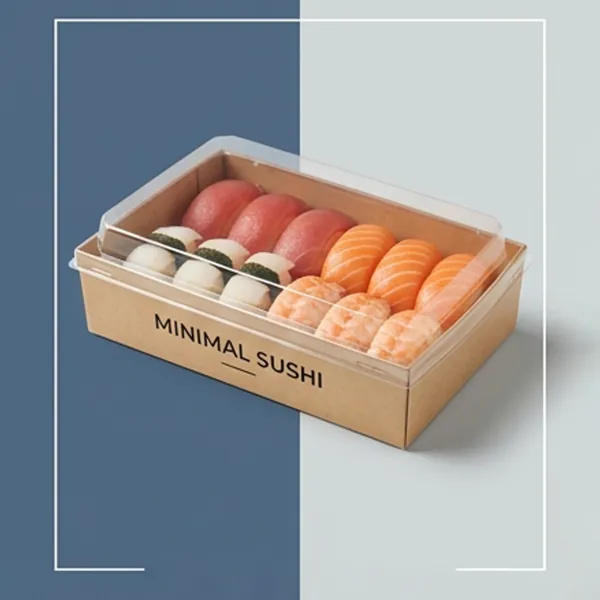
Kraft Sushi Tray with Lid
This is the retail sushi pack: a kraft base sized to a specific piece count, with a clear lid so the customer can see exactly what they are buying.
View tray & get pricing →Custom food packaging · US · UK · Canada · Australia
Sushi & Seafood Trays
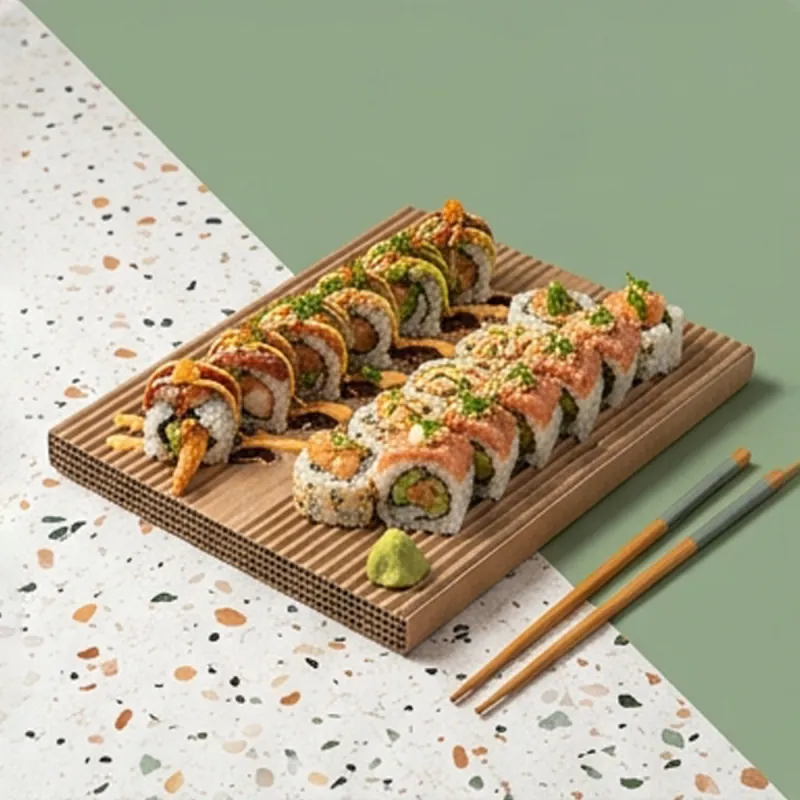
A sushi platter is a flat presentation surface that has to stay flat. Sushi is arranged in precise rows, and any bow in the base makes the arrangement look wrong immediately — far more so than with less geometric food.
It also has to cope with rice, which sits directly on the surface, is wet, and is in contact for the whole life of the pack.
Pricing starts from $0.30 per tray
The unit price depends on the size, board, printing, finishing, quantity and delivery country, so every quote is worked out for your specification rather than taken from a list.
Send the size and the run length. We reply with pricing, material options and a production date — usually within one working day.
01 — Specification
Every element below is set when we quote. Nothing here is a fixed catalogue entry — if a line does not match what you need, say so and we will change it.
02 — Build the spec
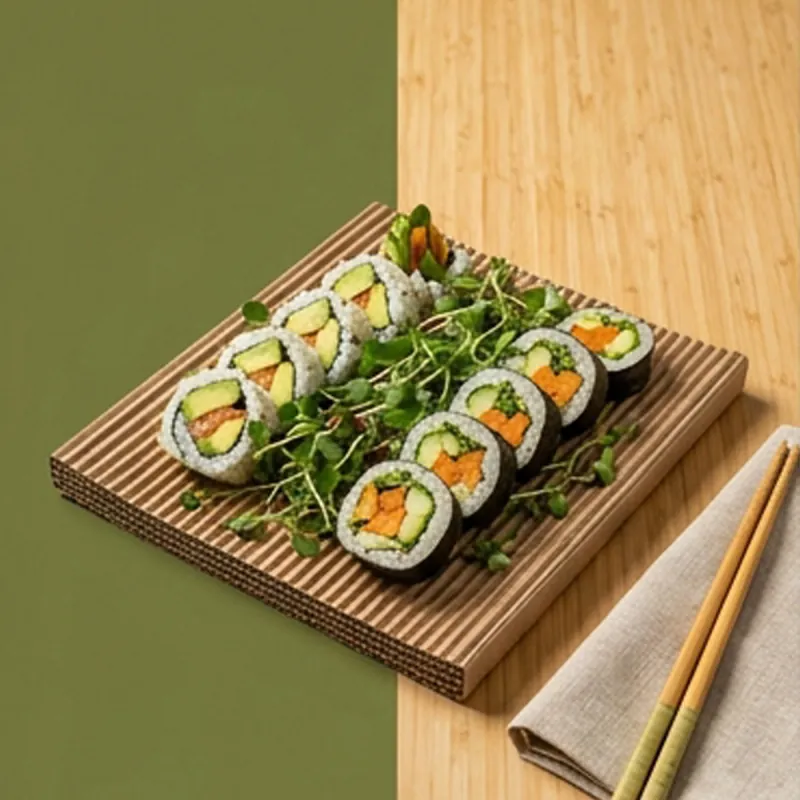
The same five questions we would ask on a phone call, with the corrugated sushi platter already selected. You get a properly detailed brief at the end, which is what makes a first quote accurate rather than approximate.
Prefer the full builder with a live sketch? Open the tray designer.
03 — In detail
Most food hides a slightly bowed tray. Sushi does not, because the pieces are arranged in straight rows and any curvature in the base makes every row read as crooked. A platter that would be perfectly acceptable under a mixed buffet selection looks defective under sushi.
Flatness comes from board caliper relative to the span and from how the platters are stored before use. Specify the caliper against the loaded weight and the platter size, and store the stock flat and dry.
Rice sits directly on the surface, wet, for the whole life of the pack. An untreated face will darken under the rice and soften at the contact points.
A low rim keeps pieces from sliding off and gives the platter rigidity. A completely flat board looks more like a serving board and photographs better. Which suits depends on whether the platter travels.
Soy, ginger and wasabi need somewhere to go. Either a formed recess, a space sized to a pot, or a separate container — decide before the die is cut.
Open with a band for immediate service; a clear lid for retail and transport. A lid needs a compatible rim, so it is designed in rather than added.
The visible flute edge reads as texture rather than as packaging, which is why so many premium sushi platters use corrugated rather than a smooth board. Against the geometric precision of sushi, a natural texture provides contrast in a way a flat printed surface does not.
It is also, practically, the stiffest board per unit weight, which matters on a platter that must not bow. The aesthetic and the engineering point in the same direction here, which is unusual.
04 — Nearby
Chosen because operators who buy the corrugated sushi platter usually need one of these in the same order, not because they happen to sit in the same category.
This is the retail sushi pack: a kraft base sized to a specific piece count, with a clear lid so the customer can see exactly what they are buying.
View tray & get pricing →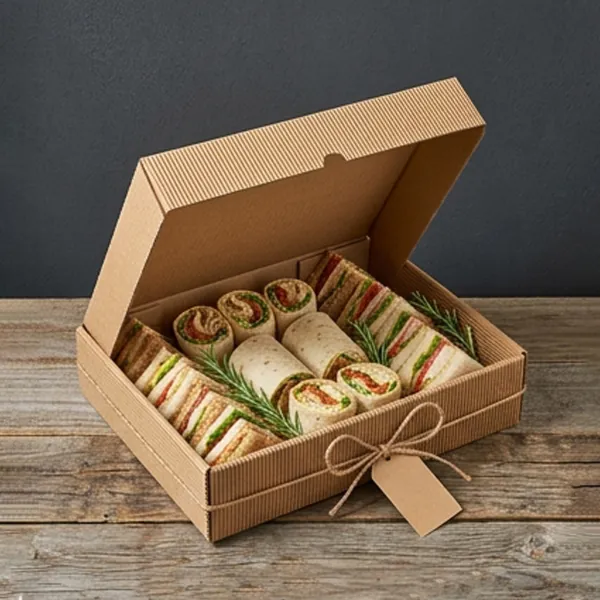
The corporate sandwich platter is one of the highest-volume formats in catering, and the specification is almost entirely determined by how you cut your…
View tray & get pricing →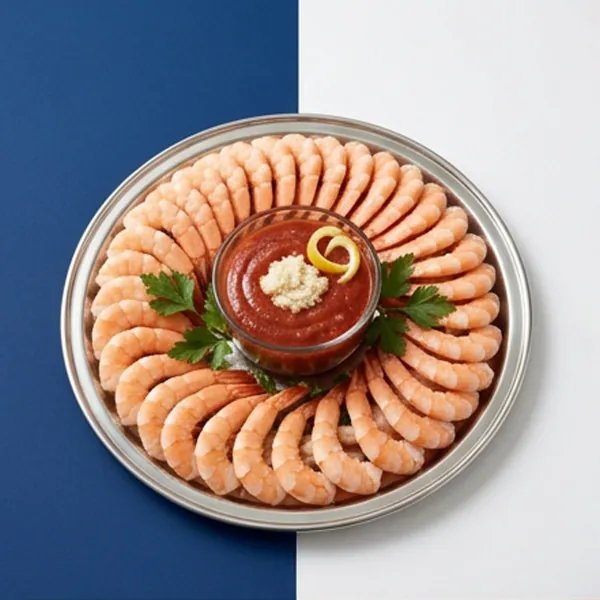
The shrimp platter is one of the most instantly recognisable formats in food retail: a ring of prawns arranged tail-inward around a central pot of cockt…
View tray & get pricing →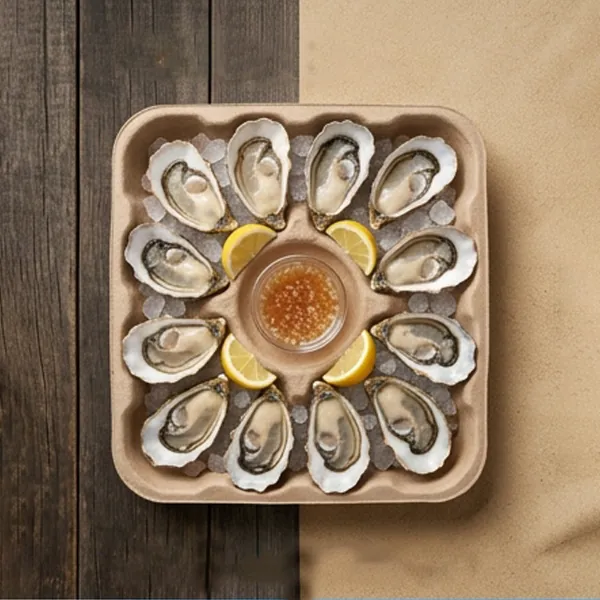
Oysters on the half shell have one packaging requirement above all others: they must stay level.
View tray & get pricing →05 — Questions
Because sushi is arranged in straight rows, and any bow in the base makes every row look crooked. A platter that would be fine under a mixed buffet selection looks defective under sushi. Specify the caliper against the span and the load.
Rice is wet and sits directly on the surface for the whole life of the pack, so an untreated board will darken and soften at the contact points. A moisture-resistant food-contact face prevents it.
Lay out your standard selection in the arrangement your chefs use, measure the rectangle it occupies, add a border at least a finger width wide, and allow specific space for soy, ginger and wasabi.
A rim keeps pieces from sliding and adds rigidity, which matters if the platter travels. A flat board looks more like a serving board and photographs better for immediate service. Choose based on whether it moves.
Yes, and for retail it is essential. The lid and the platter rim have to be dimensionally matched, so order them together the first time rather than sourcing separately.
Pack fully chilled. Most heavy condensation comes from packing product that has not cooled, which puts warm moist air inside a closed pack. Where it persists on a retail line, anti-fog lid film is available.
It is what many premium sushi brands choose. The visible flute reads as texture rather than as packaging, and against the geometric precision of sushi that contrast works well. It is also the stiffest board per unit weight.
Yes, on E-flute the print quality is good. Most sushi platters keep print to a minimum — a mark on the rim or an applied band — because the food is the arrangement and heavy print competes with it.
Yes — see the kraft sushi tray with lid for the single-serving lidded format used in retail chillers and takeaway.
Send the dimensions, the quantity and the country you want it delivered to. We come back with a full quote — material, print, finishing, freight and a production date.