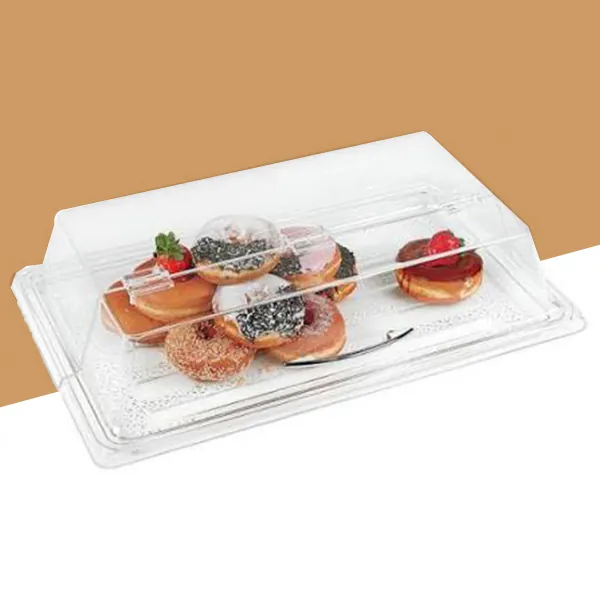
Bakery Display Tray
A bakery display tray has to do two jobs that pull in opposite directions.
View tray & get pricing →Custom food packaging · US · UK · Canada · Australia
Bakery & Dessert Trays
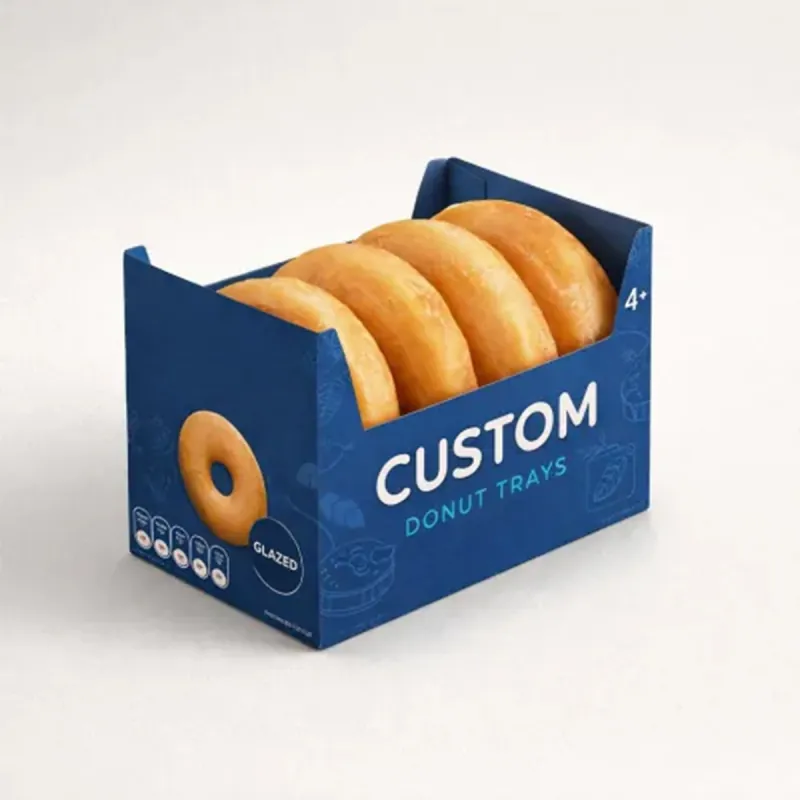
Donuts are wide, glazed and easily damaged, which makes them one of the more demanding bakery products to package. The glaze sets soft, so anything touching it leaves a mark; the toppings stand proud, so lid clearance matters; and they are almost always sold in multiples, so the count layout drives the whole box.
A well-designed donut box is one where the donuts do not touch each other, do not touch the lid, and are visible before the customer commits.
$0.30 per tray, plain or printed
Minimum order 100 trays, with free shipping to the United States, United Kingdom, Canada and Australia. You approve a free digital proof before anything is printed, then pay by PayPal invoice or bank transfer, or cash on delivery in the US and Canada.
Starting from $0.30 per tray
Plain or printed with your artwork. Minimum order 100 trays. Free shipping to the United States, United Kingdom, Canada and Australia.
01 — Specification
The details below describe how we usually make this tray. If a line does not match what you need, say so in your order notes and we will confirm it on the proof.
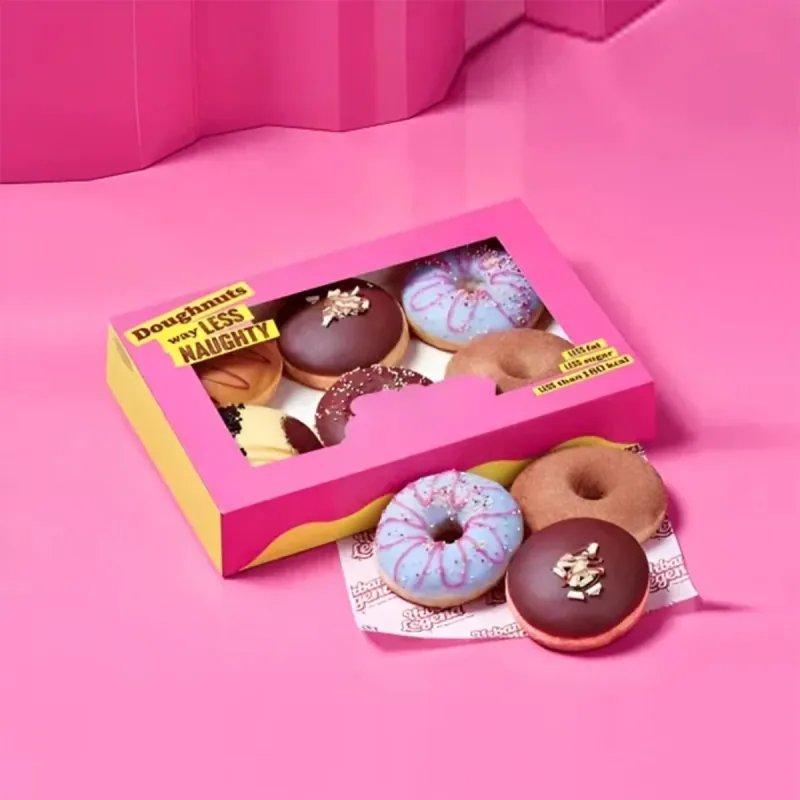
02 — Build the spec
The same five questions we would ask on a phone call, with the donut display tray already selected. You get a detailed brief at the end, which makes your first proof accurate.
Prefer the full builder with a live sketch? Open the tray designer.
03 — In detail
The single most common failure in donut packaging is a lid that touches the glaze. It happens because the box was sized against a plain ring donut and then used for the topped range, where a sprinkle-and-drizzle donut can stand fifteen millimetres taller.
Measure your tallest product — the one with a cream topping and a decoration on top of that — and specify clearance from it. The box will look slightly generous with a plain donut in it, which is a far better outcome than a smeared glaze on the underside of a lid.
The impulse purchase. Small enough to carry in one hand with a coffee, and the format most likely to be an add-on at the till.
A treat for a couple or a small family. Sits neatly on a passenger seat, which matters more than it sounds.
The standard sharing box and usually the best margin. Big enough to feel like an occasion, small enough to be an unplanned purchase.
Office and event buying. Needs a genuinely rigid base — a dozen donuts in a flexing box arrive in a heap.
Donuts are among the most photographed food products there are, and the box is in almost every one of those photographs. That makes the lid design and the interior finish commercially significant in a way they are not for most bakery packaging.
Two practical consequences: keep the interior clean and light so the donuts read well against it, and put the branding on the lid where it appears in the shot of the opened box, rather than only on the side where it does not.
04 — Nearby
Chosen because operators who buy the donut display tray usually need one of these in the same order, not because they happen to sit in the same category.
A bakery display tray has to do two jobs that pull in opposite directions.
View tray & get pricing →
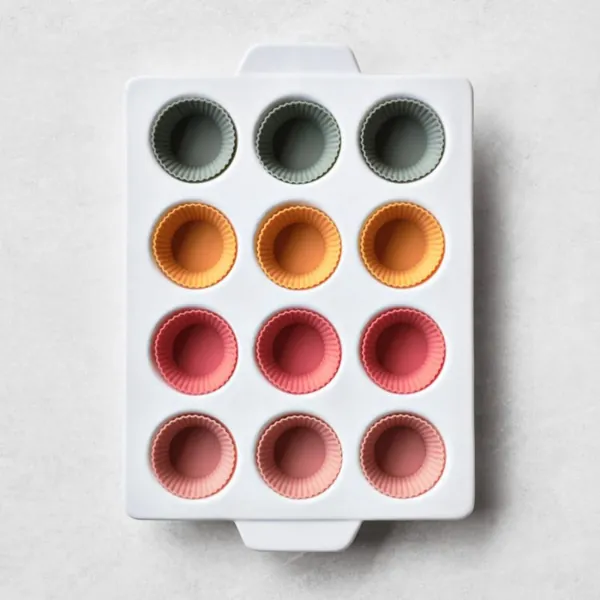
An insert is the difference between a box of cupcakes and a box of icing.
View tray & get pricing →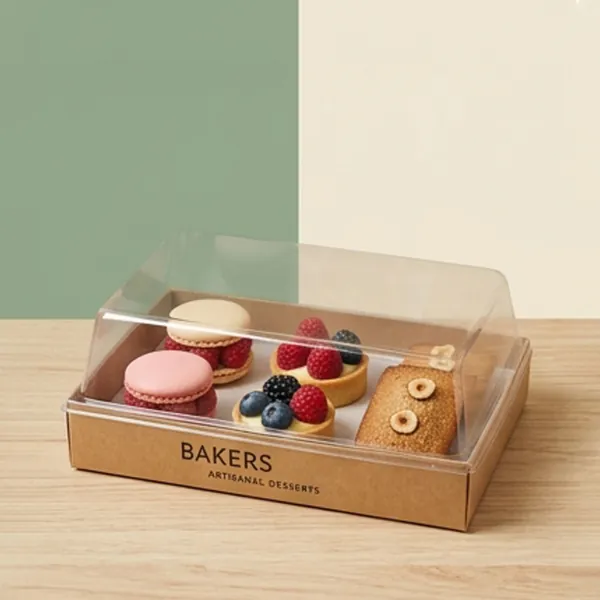
A dome over a kraft tray is the standard presentation for a mixed patisserie selection sold from a counter.
View tray & get pricing →05 — Questions
Measured from your tallest topped donut plus headroom, never from a plain ring. A lid touching the glaze is the most common failure on this format, and it is entirely a sizing decision.
For topped and filled ranges, yes — without separation they slide together and the decoration is damaged. For plain rings sold to be eaten immediately, a snug box without compartments is workable.
Wherever the customer chooses at a counter, yes. Donuts sell on appearance more than most bakery products, and a closed box makes a customer rely on a description rather than the product.
Glaze and filling both migrate into untreated board. A grease-resistant base prevents the translucent marks that appear under each donut within a couple of hours.
Two, six and twelve covers most operations — impulse, sharing and office. Four is worth adding if you sell a lot to couples. Each count needs its own die, so start with the two you sell most of.
With compartments and a properly rigid base, yes. A dozen donuts loose in a flexing box will not survive a delivery bag. Tell us it is for delivery and we will specify the base accordingly.
Yes, and on this format it is worth it. The opened box is what gets photographed, and the inside of the lid is in that shot. It adds a second ink pass, so mention it when you order and it will show on your proof.
Yes with a solid lid; window lids are weaker under load. If you stack filled boxes on a counter, tell us the stack height and we will strengthen the frame around the window.
Send one and we will match it, so your counter fixture, your delivery bags and your portioning stay unchanged.
On the lid, where it appears in the shot of the opened box, rather than only on the side wall that never makes it into the photo. Keep the interior clean and light so the donuts read well against it. The donut display tray lid is also the panel the customer sees first on the counter.
Every donut display tray is starting from $0.30 per tray, with a minimum order of 100 and free shipping to the US, UK, Canada and Australia. Order on this page, or message us with any question first.